 Cedar Biblical
Hebrew Scripture Studies · 9 min read
The Mystery of the Sacred Name, Part 2: Judah, Shua, and the Prophetic Seed in Genesis 38
Why Judah left his brethren for Adullam and married the daughter of Shua, and how the Lion of Judah and salvation meet in one name.
Introduction
The thirty-eighth chapter of Genesis often strikes the casual reader of Scripture as an abrupt and perplexing detour. The sacred narrative has just introduced the dramatic betrayal of Joseph, cast into a pit and sold by his brothers into Egyptian bondage. Yet, precisely as the reader anticipates following Joseph into Egypt, the Holy Spirit pauses the story to recount the private life of Judah. In Genesis 38, we find a complex narrative marked by departures, intermarriage with Canaanites, and moral complexity. To dismiss this chapter as a mere historical digression, however, is to overlook one of the most astonishing prophetic tapestries hidden within the Old Testament. Beneath the surface of Judah's journey lies an intricate prophetic revelation of the Messiah, the calling of the Gentile bride, and the revelation of the divine name of salvation.
When the Scriptures are examined with spiritual discernment and attention to their original Hebrew foundations, even the specific letters of the patriarchs' names bear the imprint of divine design. Genesis 38 is not an accidental interruption in the patriarchal record. Rather, it is a deliberate, prophetic shadow of the gospel. Through the journey of Judah, his departure from his natural brethren, his covenant with the daughter of Shua, and the mystery of the doorway of salvation, God encoded the very architecture of redemption thousands of years before the incarnation of Christ.
Judah Among the Nations: A Typology of the Bridegroom
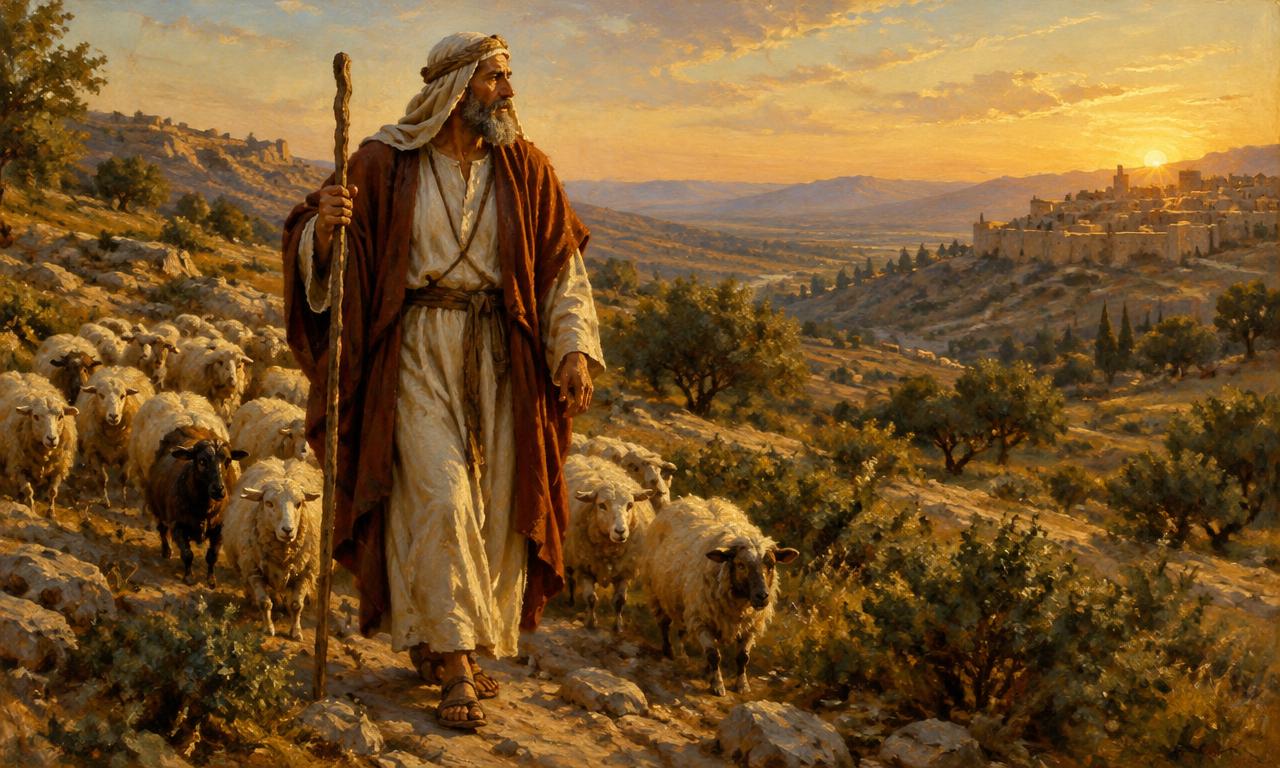
The narrative opens with an unexpected movement away from the covenant community. The inspired text records in Genesis 38:1: "And it came to pass at that time, that Judah went down from his brethren, and turned in to a certain Adullamite, whose name was Hirah." Judah separates himself from his family and enters the territory of a foreigner, taking up dwelling in Adullam.
Within biblical typology, Judah frequently serves as a prophetic picture of Jesus Christ, the Lion of the tribe of Judah. As Judah departed from his own brethren to dwell among those outside the immediate covenant family of Jacob, so Jesus Christ, when He came unto His own and His own received Him not, extended the offer of redemption outward to the nations. The purpose of Judah going among the Gentiles was not merely social; it was the setting in which he would seek a wife. In like manner, the departure of the Messiah toward the uttermost parts of the earth represents the great mystery of grace: the Lord seeking a bride from among all nations, gathering a chosen people out of a Gentile world.
This historical event foreshadows the overarching dispensational movement of the New Testament. The Lord Jesus Christ, having been rejected by His natural brethren according to the flesh, turns toward the outside world to call out a people for His name. What appears on the historical surface to be a descent by Judah into Canaanite territory is, in the hidden counsel of God, the staging ground for a bridal union that prefigures the marriage of the Lamb.
The Anatomy of the Name: The Mystery of Yehudah
To understand the deeper dimensions of this narrative, one must explore the Hebrew composition of Judah's name, Yehudah. In the original text, Yehudah is constructed of five Hebrew letters: Yod, He, Vav, Dalet, and He. When one looks at this name closely, an astonishing reality emerges. If the letter Dalet is removed from Yehudah, the remaining four letters are Yod, He, Vav, and He—the sacred Tetragrammaton, the unutterable covenant name of God, Yahweh.
In ancient Hebrew thought, each letter carried distinct symbolic and pictographic meaning. The Yod signifies the hand or active divine power. The He conveys the meaning of "behold" or the breath of divine grace. The Vav represents a nail, peg, or securing bond. When observing the sacred name, one reads the profound pictographic message: behold the hand, behold the nail. Yet in the name of Yehudah, an additional letter is strategically inserted between the Vav and the final He. That letter is the Dalet.
In the Hebrew alphabet, the Dalet signifies a door—not a massive city gate, but an entrance, a humble door through which a person enters an enclosure. The name of Yehudah, therefore, contains within its very linguistic fabric the divine name of God enclosing an open door. The Messiah, springing from the tribe of Judah, is Himself the embodiment of the divine covenant who carries within His identity a door of entrance for mankind.
The Daughter of Shua and the Covenant Union
Having departed from his brethren, Judah encounters the household of a Canaanite man. Genesis 38:2 declares: "And Judah saw there a daughter of a certain Canaanite, whose name was Shuah; and he took her, and went in unto her." The name Shua is composed of three Hebrew letters: Shin, Vav, and Ayin.
In biblical lexicography, the root of Shua carries multifaceted meanings. Primarily, it conveys the idea of riches, opulence, and wealth. Simultaneously, it holds the connotation of an urgent cry for help—a cry for salvation and deliverance. In this thematic intersection, the daughter of Shua represents the condition of the soul called into fellowship with the Messiah. On one hand, she represents humanity in desperate need, lifting a cry for deliverance from outer darkness. On the other hand, through her union with the heir of the covenant, she enters into the unsearchable riches of God.
The union between Judah and the daughter of Shua points prophetically to the church. Believers, once alien to the commonwealth of Israel and strangers from the covenants of promise, are sought out by the King of glory. Through this covenant union, the bride who was once outside the camp is brought into direct relationship with Judah. She does not remain outside; she must enter into the household and life of the patriarch.
The Open Door and the Gathering of the Sheep
How does the daughter of Shua enter the life and covenant of Yehudah? Typologically, she must enter through the door embedded within his very identity. As established, the letter Dalet inside Yehudah represents the doorway. In the New Testament, our Lord Jesus Christ explicitly identified Himself with this exact imagery. In John 10:9, Christ proclaimed: "I am the door: by me if any man enter in, he shall be saved, and shall go in and out, and find pasture."
Salvation is found exclusively within the door. When the daughter of Shua is united to Judah, she passes through that Dalet. She represents the sheep of God entering the safety of the fold. This door remains wide open throughout the present age of grace, welcoming every soul that responds to the call of the Gospel. From the day of Pentecost, when three thousand souls entered into the fold, through successive generations of missionary proclamation, the sheep of Christ have been passing through this open portal.
Yet Scripture makes it clear that this door is designated only for the redeemed. The wicked and the unrepentant cannot trespass through the sanctuary of the Lord. The prophet Nahum describes this divine protection in Nahum 1:15: "Behold upon the mountains the feet of him that bringeth good tidings, that publisheth peace! O Judah, keep thy solemn feasts, perform thy vows: for the wicked shall no more pass through thee; he is utterly cut off." The pathway through Judah is preserved for the covenant bride. The wicked are barred from crossing that threshold, reserved instead for divine judgment.
Furthermore, this entrance has a determined consummation. The door does not stand open indefinitely. Just as the door of Noah's ark was open until the final creature entered, so the door of grace remains open until the very last sheep of Christ's flock is gathered. When the fullness of the Gentiles has entered in, that door (Dalet) will be closed, sealing the bride within the safety of her Lord.
The Prophetic Fusion: The Emergence of Yehoshua
Herein lies the ultimate mystery concealed within Genesis 38. When the daughter of Shua enters through the door (Dalet) into the life of Yehudah, a remarkable linguistic and prophetic transformation occurs. If the door (Dalet) is occupied and traversed by Shua, the letters of the bride's name (Shin, Vav, Ayin) are brought into the very heart of Yehudah (Yod, He, Vav, Dalet, He).
When the letter of the door gives way to the presence of the bride who has entered within, the letters merge: the Yod, He, and Vav of the divine name unite with the Shin, Vav, and Ayin of Shua, concluding with the final He. These seven letters form the full, majestic Hebrew name of the Redeemer: Yehoshua, the name from which the shortened form Yeshua and our English name Jesus originate.
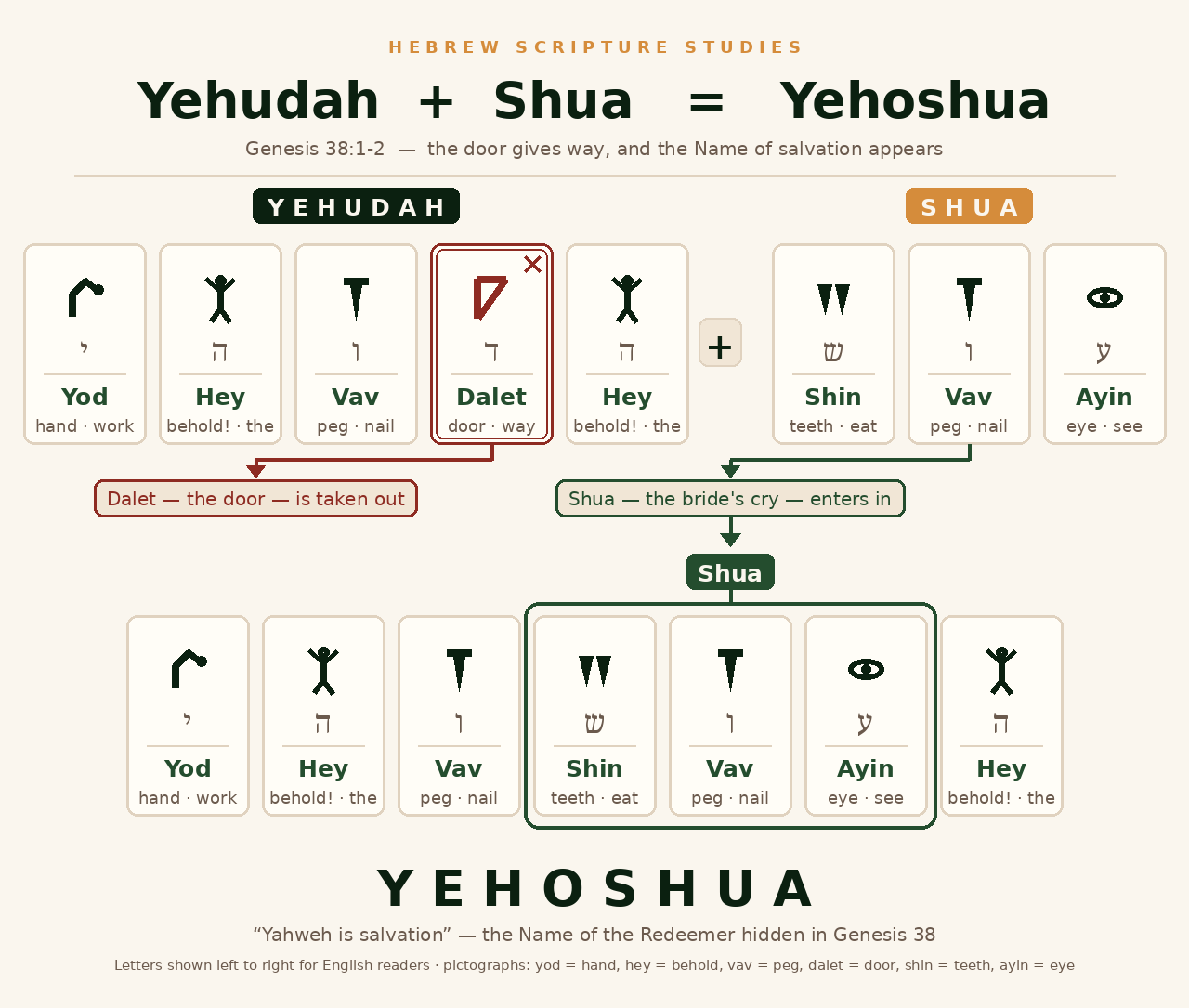
Consider the theological wonder of this revelation. The name Yehoshua literally means "Yahweh is salvation." In the historical reality of Genesis 38, Judah's marriage to the daughter of Shua appeared to be a human journey. Yet in the sovereign providence of the Holy Spirit, the union of the Prince of Judah with the bride who cried for salvation produced the exact prophetic name of the Savior of the world. Hidden in the very first book of Moses, within a chapter often dismissed as an account of family tragedy, God inscribed the name of His Son. The union of the Bridegroom and the bride reveals the full manifestation of salvation.
The Sovereign Name Above Every Name
This divine name, prefigured through the letters of Genesis 38, was not invented by human convention. It was ordained directly from the courts of heaven. When the fullness of time had come, the angel Gabriel was dispatched from the presence of God to announce the conception of the Messiah to the Virgin Mary, commanding that His name be called Jesus—Yehoshua—for He would save His people from their sins.
The apostle Peter, standing before the rulers of Israel in the power of the Holy Ghost, bore witness to the absolute supremacy of this identity in Acts 4:12: "Neither is there salvation in any other: for there is none other name under heaven given among men, whereby we must be saved." There is only one name authorized by heaven for the redemption of fallen man.
In His boundless mercy, God honors the sincere cries of His children across every tongue and dialect. Whether a believer cries out to Jesus in English, French, Spanish, or Tamil, the Lord inclines His ear, wipes away tears, and releases transforming power. The Spirit of God responds to the heart of faith. Yet, as students of the sacred text, we must hold in profound reverence the holy, original root revealed in the Hebrew Scriptures. God has watched over His Word with absolute precision, ensuring that the eternal name of salvation was written into the very lineage, marriages, and letters of the patriarchs.
Conclusion
Genesis 38 is far more than an ancient record of domestic trial; it is a profound prophetic portrait of the gospel of Jesus Christ. Through the departure of Judah, we perceive the Bridegroom seeking His bride among the nations. Through the Hebrew name Yehudah, we behold the divine hand and the nail enclosing the open door of salvation. Through the daughter of Shua, we see ourselves—the needy soul crying out for deliverance, brought through the door into the unfathomable riches of divine covenant.
When the last sheep passes through that open door and the door is shut, the complete mystery of God is accomplished: Yehoshua, Yahweh our Salvation, glorified in His saints and admired in all them that believe. May our hearts be filled with renewed awe at the breathtaking perfection of the Holy Scriptures, resting securely in the one door, through the one Lord, whose name alone brings eternal redemption.