 Cedar Biblical
Hebrew Scripture Studies · 9 min read
The Mystery of the Sacred Name, Part 1: From the Tetragrammaton (YHWH) to Yahoshua
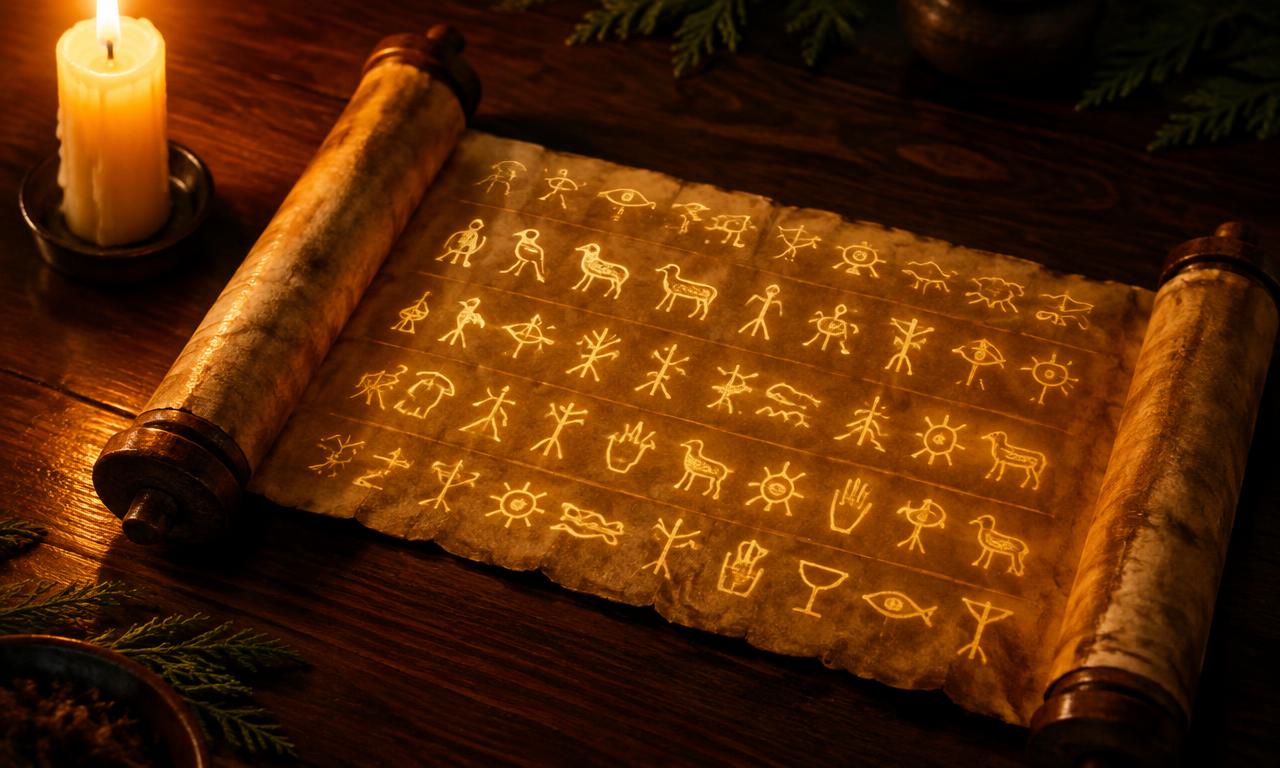
Exodus 6:3 and the ancient pictographs of Yod-Hey-Vav-Hey: behold the hand, behold the nail, and the salvation hidden inside the Name.
Introduction
Throughout the sacred Scriptures, the self-revelation of God is inextricably bound to the unveiling of His name. In biblical thought, a name is never a mere label or an arbitrary designation; it is a profound declaration of essence, character, purpose, and covenant destiny. When the Almighty steps into human history to redeem a fallen world, He does not remain an anonymous sovereign. Instead, He reveals Himself progressively, meeting humanity at deepening levels of covenant relationship.
From the patriarchal wanderings of Abraham to the burning bush of Moses, and ultimately to the climactic redemptive work at Mount Calvary, the unfolding of the Divine Name tracks the unfolding of God's master plan of redemption. When the four sacred consonants of the Tetragrammaton are examined through the ancient lens of Paleo-Hebrew pictographs, and traced forward into the fullness of the Messianic name Yahoshua, an astonishing tapestry emerges. What many have treated merely as an ancient linguistic enigma becomes an awe-inspiring prophetic portrait of the Gospel: the covenant Lord weaving the instruments of our salvation into the very fabric of His holy name.
The Progressive Revelation of the Covenant Name
The historical narrative of the Bible shows that God did not reveal all of His character to every generation all at once. Rather, His revelation expanded as the redemptive drama unfolded. When the Almighty called Abraham out of Ur of the Chaldees to establish an everlasting covenant, He introduced Himself primarily through titles of sovereign authority and sufficiency.
This progressive unveiling is expressly affirmed in the book of Exodus. When the children of Israel groaned under the weight of Egyptian bondage, God spoke to Moses at the dawn of the Exodus, saying: "And God spake unto Moses, and said unto him, I am the LORD: And I appeared unto Abraham, unto Isaac, and unto Jacob, by the name of God Almighty, but by my name JEHOVAH was I not known to them" (Exodus 6:2-3). To the patriarchs, He had proven Himself as El Shaddai—the Almighty God, all-sufficient to preserve, bless, and multiply a single family line. Yet to Moses and the nascent nation of Israel, a deeper revelation was granted: the sacred name composed of four Hebrew letters, known historically as the Tetragrammaton.
For centuries, scholars, translators, and seekers have wrestled with the exact historical vocalization of these four consonants. Because ancient Hebrew was recorded without vowel points, and out of profound reverence the Jewish people avoided pronouncing the sacred Name aloud, the original vocalization has been the subject of extensive academic and theological debate. Some vocalize it as Jehovah, others as Yahweh, and others still as Yahvah. Some students of Scripture even prefer to vocalize each consonant individually during prayerful meditation: Yod, Hey, Vav, Hey. Yet beneath the centuries of linguistic debate lies a far deeper, visual, and prophetic dimension preserved in the earliest forms of the Hebrew language.
The Paleo-Hebrew Pictographs of YHWH
To appreciate the prophetic texture of the Tetragrammaton, one must look prior to the modern square Aramaic script (the Ktav Ashuri) to the ancient pictographic alphabet known as Paleo-Hebrew. In this ancient writing system, every letter was originally a pictograph—a stylized picture representing a real-world object, conveying intrinsic semantic and conceptual meaning.
When the four letters of the Tetragrammaton (Yod-Hey-Vav-Hey) are observed in their ancient pictographic representations, their combined meanings form an undeniable prophetic silhouette:
The first letter, Yod, was drawn as a hand and forearm (yad), signifying a hand, an arm, work, deed, or mighty power in action.
The second letter, Hey, was drawn as a human figure with raised arms or an open lattice window, carrying the meaning of behold, lo, look, or divine revelation.
The third letter, Vav, was depicted as a wooden peg, nail, or securing tent stake—the very implement driven deep into the desert soil to secure the ropes of a tabernacle so it would stand unmovable.
The fourth letter is a repetition of Hey, once again meaning behold, lo, or revelation.
When these pictographic concepts are assembled in order, they convey an extraordinary message: "Hand, behold; nail, behold"—or as often expressed in biblical meditation, "Behold the hand, behold the nail." Long before the Roman Empire instituted crucifixion as an instrument of capital punishment, and centuries before David prophesied in the Psalms that the Messiah’s hands and feet would be pierced, the eternal God had embedded the prophetic emblem of His suffering into the four consonants of His covenant identity. The very name revealed at the burning bush silently pointed forward to a future day when the work of the Divine Hand would be accomplished through the piercing of a nail.
The Sacred Monosyllable: Yah and the Arm of the Lord
A crucial structural component of the Divine Name is its abbreviated, poetic form: Yah. Formed by the first two letters of the Tetragrammaton—the Yod and the Hey—this name occurs independently throughout the poetic literature of the Old Testament. It is the joyful foundation of the universal shout of praise, Hallelujah, which literally translates as "Praise ye Yah."
Furthermore, this sacred abbreviation is woven into the personal names of numerous Hebrew prophets and kings. Elijah (Eliyahu) proclaims "My God is Yah"; Zechariah (Zekaryahu) declares "Yah remembers"; Zephaniah (Tsefanyahu) testifies that "Yah has hidden"; and Obadiah (Ovadyahu) identifies as the "Servant of Yah." In each case, the presence of these two letters anchors the individual's identity in the covenant God.
Pictographically, Yah combines the Yod (hand or arm) and the Hey (behold). It presents a spiritual summons: "Behold the hand" or "Look upon the arm of God." This linguistic reality adds extraordinary depth to the Messianic prophecies of Isaiah. In Isaiah 53, the prophet opens his great discourse on the Suffering Servant with a mournful question: "Who hath believed our report? and to whom is the arm of the LORD revealed?" (Isaiah 53:1).
Isaiah understood that the "arm of the LORD" is not merely a metaphor for raw divine power, but a personified redemptive mystery. For the majority of observers, this arm would remain hidden or unrecognized; yet to those granted spiritual sight, the arm would be revealed in a manner entirely contrary to worldly expectations. The hand of God would not be revealed in an imperial palace of earthly splendor, but in an arena of voluntary suffering and substitutionary sacrifice.
The Pierced Hand and Prophetic Redemption
The mystery of the revealed arm is made explicit as Isaiah continues his prophetic vision. How was this holy arm to accomplish its saving purpose? The prophet answers with piercing clarity: "But he was wounded for our transgressions, he was bruised for our iniquities: the chastisement of our peace was upon him; and with his stripes we are healed" (Isaiah 53:5).
The healing and restoration of humanity do not spring from an abstract decree of divine sovereignty, but from physical wounds borne in the flesh. The ancient pictograph of the Vav—the nail—finds its ultimate prophetic fulfillment here. It was the driving of the nail into the holy hands of the Messiah that produced the stripes by which fallen sinners are made whole. The secret concealed within the hand was the wound inflicted by the nail.
This profound truth echoes the promise recorded earlier in Isaiah: "The LORD hath made bare his holy arm in the eyes of all the nations; and all the ends of the earth shall see the salvation of our God" (Isaiah 52:10). When did God make bare His holy arm before the eyes of all nations? It occurred at the crossroads of the ancient world outside the walls of Jerusalem, where Jews, Romans, and travelers from distant lands looked upon an elevated cross. There, the arms of the Savior were stretched wide and nailed to the wood. In that public display of suffering love, the nations beheld the holy arm of the Lord, and through those pierced hands, divine salvation was poured out to the ends of the earth.
From the Tetragrammaton to Yahoshua: The Anatomy of Salvation
This redemptive trajectory reaches its linguistic and theological summit when the covenant Name is united with the concept of deliverance. In the Hebrew language, the root for salvation, deliverance, or a desperate cry for help is shua, spelled with the letters Shin, Vav, and Ayin.
When the name Yah is joined to the root of salvation (shua), a crucial linguistic bridge is required: the letter Vav. In Hebrew grammar and phonology, the Vav can function not only as a consonant but also as a vowel carrier, frequently producing an "o" or "u" sound. Thus, the full historical name of the Messiah emerges as Yahoshua (or Yehoshua).
The theological study of this construction reveals a breathtaking harmony. The Vav—the pictographic nail—stands precisely at the center, joining Yah (the covenant God whose hand we behold) to shua (deliverance and salvation). In this structural synthesis, salvation is not detached from the instrument of the cross. Rather, the name Yahoshua proclaims: Yah is salvation, accomplished through the nail.
Without the nail—without the crucifixion—there is no redemptive bridge between the holy God and a perishing world. The nail is the indispensable connector that unites the Divine Hand to the cry of human helplessness. Therefore, the fullness of the Messianic name Yahoshua carries within its very anatomy the complete history of salvation: the Father's covenant identity, the Son's pierced hands, and the resulting deliverance for all who believe.
The Name Above Every Name
In the early chapters of the book of Acts, the Apostle Peter stood before the religious rulers in Jerusalem to testify of the crucified and risen Christ. Filled with the Holy Ghost, he proclaimed the singular exclusivity of the Redeemer: "Neither is there salvation in any other: for there is none other name under heaven given among men, whereby we must be saved" (Acts 4:12).
Over the centuries, as the Gospel crossed continents and cultures, this divine Name has been pronounced across diverse tongues—from the Hebrew Yahoshua and Yeshua, to the Greek Iesous, the Latin Iesus, the English Jesus, and various translations across the languages of the earth. While dialect and pronunciation vary according to human speech, the spiritual authority of the Name remains unchanging and undivided. It is the one name authorized by Heaven, because it is the only name whose structural reality embodies the totality of God's redemptive sacrifice.
To call upon this Name in faith is not to utter a magical formula, but to place one's full confidence in the One whose identity was foreshadowed at Sinai, detailed by the prophets, and consummated at the cross. It is to look upon the pierced hands of the Savior and recognize that the Almighty has visited His people, bearing their sins in His own body on the tree.
Conclusion
The revelation of the Divine Name from the Tetragrammaton (YHWH) to Yahoshua is one of the most sublime testimonies of the unity of Holy Scripture. What began in the ancient pictographs of the desert as "Behold the hand, behold the nail" became living history when the Son of God extended His hands upon the wood of the cross.
In Yahoshua, the eternal Yah has indeed made bare His holy arm before all nations. The wounds inflicted by the nails did not signal defeat; they were the very means by which eternal salvation (shua) was sealed forever. As believers search the Scriptures, they may look with renewed wonder upon the covenant Name, rejoicing in the eternal wisdom of a God who wrote the story of our redemption into His very name before the foundation of the world.