 Cedar Biblical
Hebrew Scripture Studies · 9 min read
The Mystery of the Sacred Name, Part 3: David, Bath-shua, and the Testimony of the Scriptures
Search the scriptures, for they testify of Me (John 5:39): David's royal line and the Name every Old Testament shadow points to.
Introduction
In the Gospel of John, the Lord Jesus Christ delivered a profound hermeneutical principle that governs how the entirety of the sacred writings must be approached: "Search the scriptures; for in them ye think ye have eternal life: and they are they which testify of me" (John 5:39). This declaration was not merely a casual exhortation to historical inquiry; it was a divine revelation concerning the singular focus of Scripture. From the opening chapters of Genesis to the closing doxology of the prophetic books, every narrative, every genealogical record, every festival, and indeed every single letter within the sacred text operates under an overarching divine architecture designed to bear witness to Christ.
The Scriptures are flawless and without defect. When examined through the illumination of the Holy Spirit, they unveil an astonishing depth of Christ-centered typology. In the Book of Revelation, the glorified Lord declares, "Saying, I am Alpha and Omega, the first and the last" (Revelation 1:11). While Alpha and Omega are the first and final letters of the Greek alphabet, the Hebrew equivalent points to Aleph and Tav. In English, one might say that the Lord is the A to Z, the complete sum and substance of all revelation. When the Old Testament Scriptures were penned, every consonant was weighed in divine wisdom. By searching beneath the surface of the sacred text, students of the Word discover that even the spelling of historic biblical names carries prophetic blueprints pointing to the redemption accomplished by the Messiah.
The Testimony of the Hebrew Script: From Aleph to Tav
The structural perfection of the Old Testament Scriptures is vividly demonstrated in the acrostic poetry of the Psalter, most notably in Psalm 119. This majestic psalm is arranged into twenty-two distinct sections, corresponding exactly to the twenty-two letters of the Hebrew alphabet. Each section contains eight verses, with each verse beginning with the corresponding Hebrew letter, beginning with Aleph and concluding with Tav.
The Holy Spirit chose to preserve this alphabetical framework within the canon of Scripture to remind the church of an enduring truth: from the very first letter to the very last, the testimony is about the Redeemer. If Aleph, the first letter, points typologically to the supremacy, strength, and sacrifice of Christ, then Tav, the final letter, historically depicted in ancient script as a cross or mark of covenant, testifies equally of Him. In light of Christ’s words in John 5:39, these letters do not merely convey ancient history or moral philosophy; they testify of the Son of God.
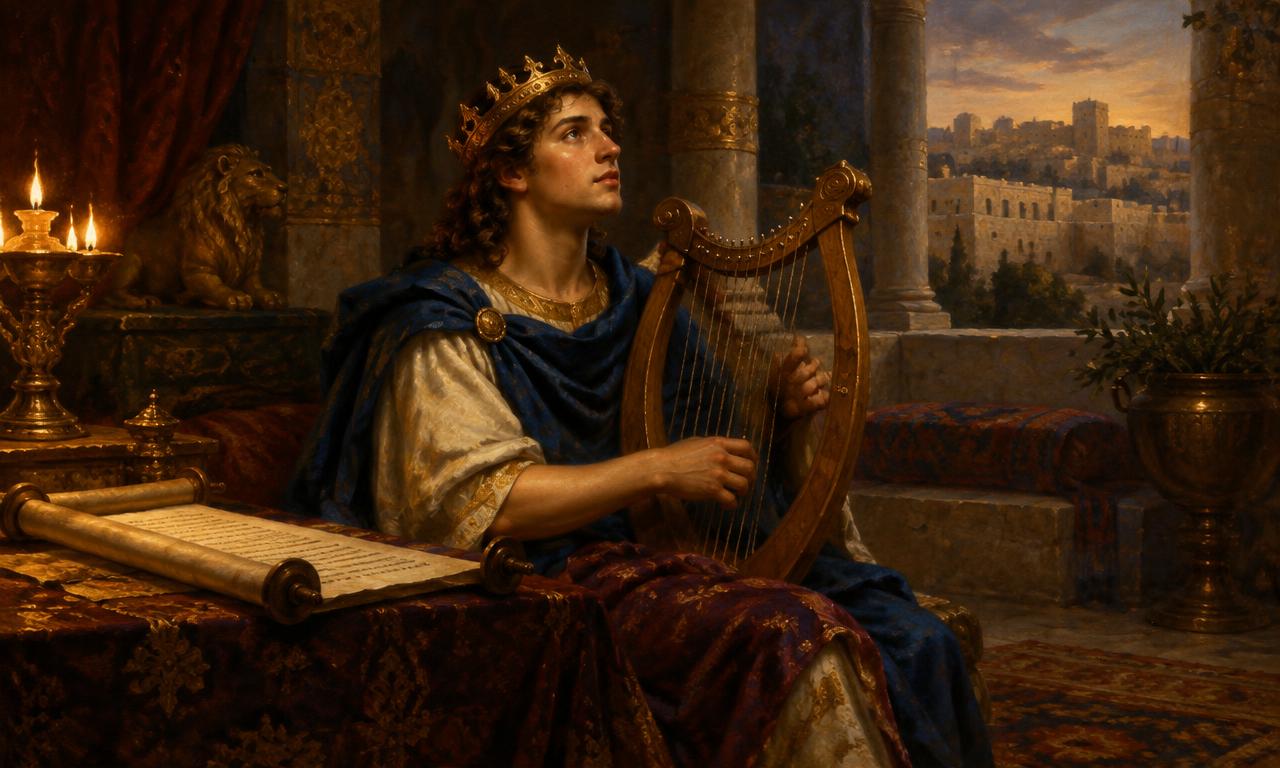
Because the linguistic elements of the Hebrew text are imbued with such significance, a careful linguistic examination of biblical names often yields rich theological insights. The historical narratives of Israel’s monarchs are not merely accounts of human triumph and failure; they are living parables and prophetic shadow-pictures. Among these, none holds a more central typological role than King David, whose very name, lineage, and royal marriage contain hidden treasures concerning the revelation of the Messiah.
The Anatomy of a Name: Deciphering the Letters of David
In English, we read the name as David; in modern transliterations, it is often written as Dawid. In the original Hebrew text, this venerable royal name is composed of three foundational consonants: Dalet, Vav, and Dalet.
In the ancient pictographic and linguistic heritage of the Hebrew language, each letter possesses an inherent visual and symbolic meaning. The fourth letter of the alphabet, Dalet, carries the pictographic representation of a tent door or an entrance gate (delet). It signifies a doorway, a threshold, or a passageway through which one enters into an enclosure, a covenant, or an estate. The letter Vav, the sixth letter, is depicted as a tent peg, a nail, or a secure hook. It denotes connection, bonding, and joining two separate entities together. Furthermore, within Hebrew phonology, the Vav frequently serves as a vowel letter, producing the deep "o" or "u" sound that joins consonant sounds into a harmonious whole.
Thus, when looking closely at the structural anatomy of the name David (Dalet-Vav-Dalet), an extraordinary picture emerges: a door, followed by a nail, followed by another door. It presents an architectural concept of two distinct doorways joined together at the center by a unifying pin or nail. This structural reality in the Hebrew text invites careful theological reflection. Why would the royal name from which the Messiah sprang be structured around two doors united by a nail? The answer unfolds as one examines the marital and covenantal history of the Davidic dynasty.
The Mystery of Bath-shua and the Royal Union
The historical account of David’s union with the mother of his royal heir is recorded in the historical books of the Old Testament. Following a season of deep brokenness, repentance, and divine mercy, the Scripture records: "And David comforted Bath-sheba his wife, and went in unto her, and lay with her: and she bare a son, and he called his name Solomon: and the LORD loved him" (2 Samuel 12:24).
While she is universally known in 2 Samuel as Bath-sheba, the inspired author of the Books of Chronicles provides a fascinating variation of her name in the royal genealogy: "And these were born unto him in Jerusalem; Shimea, and Shobab, and Nathan, and Solomon, four, of Bath-shua, the daughter of Ammiel" (1 Chronicles 3:5). In this genealogical record, she is designated as Bath-shua.
In Hebrew, every name carries precise meaning. The prefix Bath means "daughter of," while Shua denotes "wealth, opulence, crying out for deliverance, or salvation." Thus, Bath-shua literally translates to "the daughter of Shua" or "the daughter of wealth." This mirrors an earlier typological pattern in Genesis, where Judah, the father of the royal tribe, took the daughter of a man named Shua to wife. Here again, in the royal line of David, the king unites in marriage with Bath-shua, the daughter of wealth and deliverance.
Typologically, the daughter of wealth represents the redeemed bride, the community of faith that has been enriched by divine grace. The church, though once impoverished in sin, is made the bride of Christ, enriched by the unsearchable riches of God. When Bath-shua enters into the house and covenant of David, a profound spiritual picture is enacted: the sovereign king receives the bride into covenant fellowship.
The Two Doors and the Covenant Meeting Place
Viewing this historical union through the linguistic lens of David’s name reveals a stunning typological portrait of the gospel. The name David consists of two doors (Dalet and Dalet) connected by a nail (Vav).
In biblical typology, the ultimate Bridegroom is the Lord God Himself. The shortened, poetic divine name of God is Yah, as seen in the universal praise Hallelujah ("Praise ye the LORD") and embedded within numerous Hebrew names such as Zechariah, Zephaniah, and Malachi. The divine Bridegroom, Yah, approaches the covenant threshold. Simultaneously, the bride, typified by Bath-shua—the daughter of wealth and salvation—approaches the threshold from her side.
Here we behold two doors. Through one door enters the heavenly Bridegroom; through the other door enters the bride. In pastoral imagery, when the sheep have all entered the fold, the door is shut for safety and communion. In the typological architecture of David’s name, both parties enter their respective portals, and the doors are enclosed.
Yet what stands between these two doors? What brings the holy God and redeemed humanity together into an unbreakable union? It is the central letter: the Vav, the nail. In the New Testament, the apostle Paul unveils the mystery of how the believer is eternally joined to the Lord: "I am crucified with Christ: nevertheless I live; yet not I, but Christ liveth in me: and the life which I now live in the flesh I live by the faith of the Son of God, who loved me, and gave himself for me" (Galatians 2:20).
The nail is the emblem of the cross of Calvary. It is at the place of the nails, where the Savior was affixed to the tree, that God and man are brought together in reconciliation. The divine Bridegroom meets His redeemed bride at the cross. Through the sacrificial suffering signified by the nail, two distinct entities are joined into one covenant body. Christ’s life is imparted to the bride, and the bride is hidden in the righteousness of the Bridegroom.
The Revelation of Yehoshua: The Name Above Every Name
When the components of this typological encounter are synthesized, a profound linguistic and theological revelation comes into focus. On one side stands the Bridegroom, whose divine identity is Yah. On the other side stands the bride, designated as Shua. At the center, uniting them, is the Vav, vocalized as an connecting vowel sound.
When these elements are brought together—Yah, the connecting Vav, and Shua—they form the glorious Hebrew name Yehoshua (Yahshua), which signifies "Yahweh is Salvation." This is the original Hebrew name of our Lord and Savior Jesus Christ.
In the covenant established with David, God promised him an exalted legacy: "And I was with thee whithersoever thou wentest, and have cut off all thine enemies out of thy sight, and have made thee a great name, like unto the name of the great men that are in the earth" (2 Samuel 7:9). The greatest name in heaven and earth is the name of God Himself. Prophetically and typologically, God embedded the mystery of the Messiah’s name within the very tapestry of David’s house, his life, and his union with Bath-shua.
It is for this reason that throughout the Gospels, the blind, the afflicted, and the faithful repeatedly cried out to Christ, addressing Him as the "Son of David." The Lord Jesus did not merely fulfill David’s royal office; He was the divine reality toward which David’s entire life pointed. Across different nations and tongues today, believers call upon the Savior in diverse pronunciations: Jesus in English, Jesu in other cultures, and various regional transliterations. Yet at the fountainhead of revelation, the name is Yehoshua—composed of seven Hebrew letters in its complete formal construction, symbolizing divine perfection, holiness, and the absolute fullness of salvation. It is the name above every name, untouched by human corruption and sovereignly vindicated by God.
Conclusion
The Scriptures cannot be broken, nor can their divine inspiration be overstated. When the Lord Jesus commanded His disciples to search the scriptures, He opened the door to an inexhaustible treasure house of truth. Every narrative concerning Israel’s kings, every genealogical notation such as that of Bath-shua in Chronicles, and even the graphic structure of Hebrew letters bear witness to the Son of God.
In the royal name of David, we see the blueprint of redemption: two doors united by a nail, portraying the eternal union of the divine Bridegroom and His redeemed bride through the cross of Calvary. Within this holy union, the glorious name of Yehoshua is proclaimed to all generations. As students of the Word continue to search the scriptures, let every discovery deepen our reverence for the absolute authority of the Bible and fix our eyes upon Jesus Christ, the Alpha and the Omega, the beginning and the end of our salvation.