 Cedar Biblical
Decoding · 7 min read
The King's Invitation: What the Wedding Garment Reveals About Righteousness
Why does a king welcome strangers from the roads, then examine their clothing? Matthew 22 opens a searching reflection on grace, righteousness, and a transformed life.
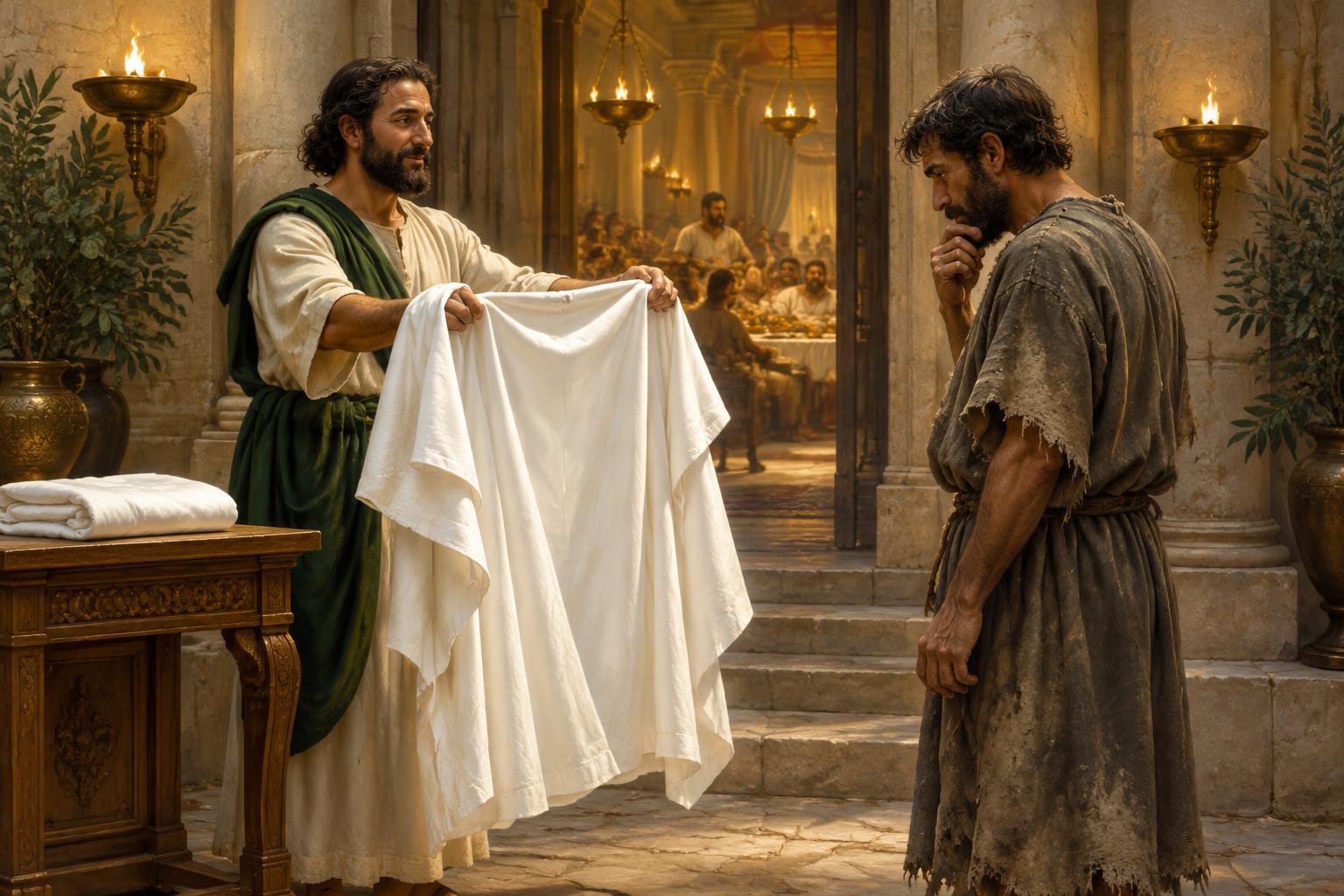
Symbolic artwork: an attendant offers a white linen mantle beside a guest's worn tunic. Matthew 22 does not specify a white robe or state that the king supplied garments; the contrast reflects Isaiah 61:10.
An invitation goes out to the roads. The servants gather everyone they find, “both bad and good,” and the wedding hall fills with guests. Then the king enters, notices one man without a wedding garment, and asks a searching question: “Friend, how camest thou in hither not having a wedding garment?” The man is speechless (Matthew 22:10–12).
The apparent contradiction is arresting. If strangers were invited straight from the roads, why should clothing become a reason for exclusion? Careful reading turns our attention from the price of a robe to the response the King's invitation requires.
The Invitation and the King's Inspection
In Matthew 22:1–14, Jesus compares the kingdom of heaven to a king arranging a wedding for his son. The first invited guests refuse to come. Some dismiss the invitation for their farms and businesses; others abuse and kill the messengers. The story becomes a warning about rejection and judgment before the invitation reaches the roads.
Its setting matters. Jesus has been confronting the chief priests and Pharisees, who recognize that His preceding parables speak about them (Matthew 21:45). This is not a warrant to condemn Jewish people collectively. Jesus, His disciples, and His first hearers were Jewish; the warning concerns resistance to God's call and also searches every later reader.
The newcomers are not gathered because they have already earned their places. “Both bad and good” enter the hall. Yet the king's inspection shows that accepting an invitation is not the same as treating the host with indifference. The generous welcome and the serious examination belong to the same story.
What Did the Wedding Garment Actually Look Like?
Matthew calls it a wedding garment—Greek endyma gamou—but gives no color, fabric, cut, or description of its decoration. We cannot confidently reconstruct one standardized outfit from these words. First-century clothing included tunics and outer garments, and surviving Roman-period textiles from the Judean Desert include wool and linen. Festive attire would signal respect for the occasion, but a universal bleached-white mantle with blue fringes is not established by this passage.
For a historically inspired illustration, a clean linen mantle contrasted with a worn everyday tunic is a reasonable artistic choice. Its whiteness comes especially from Scripture's imagery of cleansing and righteousness, not from a documented dress code in Matthew 22.
The palace scene accompanying this article therefore imagines a servant offering a white garment as a picture of grace. It is a symbolic interpretation, not a photograph of an ancient wedding custom. The contrast is not between valuable and inexpensive clothing, nor between people who can and cannot afford a feast: it is between receiving God's provision and relying on oneself.
Did the King Provide Garments at the Door?
Some Christian explanations propose that the host supplied robes, making the guest's failure a refusal of a gift. This can illuminate the story devotionally, but Matthew does not actually describe garments being distributed. We should not turn that inference into a proven custom of every first-century royal wedding.
Second Kings 10:22 does mention a keeper of a wardrobe bringing garments for the worshippers of Baal. That is a different setting, centuries earlier. It demonstrates garment provision in that particular account; it does not establish a Judean wedding vestry or explain every detail of Jesus' parable.
Similarly, the guest's silence does not tell us that he sold, lost, or removed an issued robe. Those are possible imagined explanations, not statements in the Gospel. What the story makes clear is that the king regards the absence as accountable, and the guest offers no reply. The judgment is severe: exclusion into outer darkness (Matthew 22:13). The parable is about the kingdom, not merely banquet etiquette.
The Robe of Righteousness: Gift Before Boasting
Isaiah supplies a powerful scriptural reflection: “He hath clothed me with the garments of salvation, he hath covered me with the robe of righteousness” (Isaiah 61:10). The speaker rejoices in what God has done. The robe is received; it is not woven from a claim to moral superiority.
Zechariah 3:3–5 offers a related image. Joshua the high priest stands in filthy garments; his iniquity is taken away, and he is clothed afresh. Read alongside these passages, the wedding garment can be understood as the righteousness and cleansing God provides. This is a Christian theological reading across Scripture, rather than a definition explicitly supplied by Matthew.
Isaiah 64:6 warns against confidence in our own righteousness. It should not be used to suggest that generosity, justice, and obedience are worthless. The issue is whether we make our achievements a substitute for God's mercy. The King's table is not a stage on which to boast about ourselves.
A Received Garment, a Transformed Life
The uploaded devotional study, Our Wedding Garments, emphasizes that the robe points beyond justification to consecration: a life surrendered to Christ. We can draw on that searching theme without adopting the source's particular divisions of the “Bride” and “great company,” or its claims about the timing of Christ's return.
Revelation 19:7–8 holds divine generosity and lived holiness together. The bride is granted fine linen, clean and white, and the linen is identified with the righteous acts of the saints. Ephesians 2:8–10 likewise speaks of salvation by grace through faith, not boasting in works, and of being created in Christ Jesus for good works.
These passages help resolve another apparent tension. Righteousness is God's gift, yet the life receiving that gift is called to bear fruit. Christian traditions describe the relation between justification and sanctification differently. The shared challenge is unmistakable: grace is not permission to cherish the very sin from which Christ delivers us.
“Many Are Called, but Few Are Chosen”
Jesus closes with this solemn sentence (Matthew 22:14). The story should not send us searching for a secret costume, a social rank, or a way to pronounce judgment on everyone else. It asks us to examine our own response to the King.
Have I mistaken proximity to religious things for surrender to God? Do I welcome the invitation while resisting the change it calls for? Am I trusting Christ's mercy, or presenting my reputation as sufficient clothing?
The white mantle in the painting is a reflection of that choice: not an expensive garment to purchase, but a visible reminder of righteousness received and a life renewed. The wonder of the invitation is that the roads are searched. The seriousness of the invitation is that the King Himself enters the hall.
Scripture and Further Reading
Matthew 22:1–14: the wedding feast and the garment.
Isaiah 61:10; Zechariah 3:3–5; Revelation 19:7–8; Ephesians 2:8–10.
Clothing and Textiles in the New Testament, BYU Religious Studies Center, for material and historical background.
Commentary on Matthew 22:1–14, Working Preacher, Luther Seminary, for a contemporary theological reading of this difficult parable.
This article is an original synthesis informed by the supplied Wedding Garment notes. Historical evidence, the Gospel's explicit wording, and devotional interpretation have been distinguished throughout.