 Cedar Biblical
Decoding · 6 min read
The Parable of the Lost Coin: What Luke 15:8–10 Really Means
What does the parable of the lost coin mean? Why would a woman sweep her whole house for one silver coin? Luke 15 hides a bridal picture of the word Christ entrusted to His church.
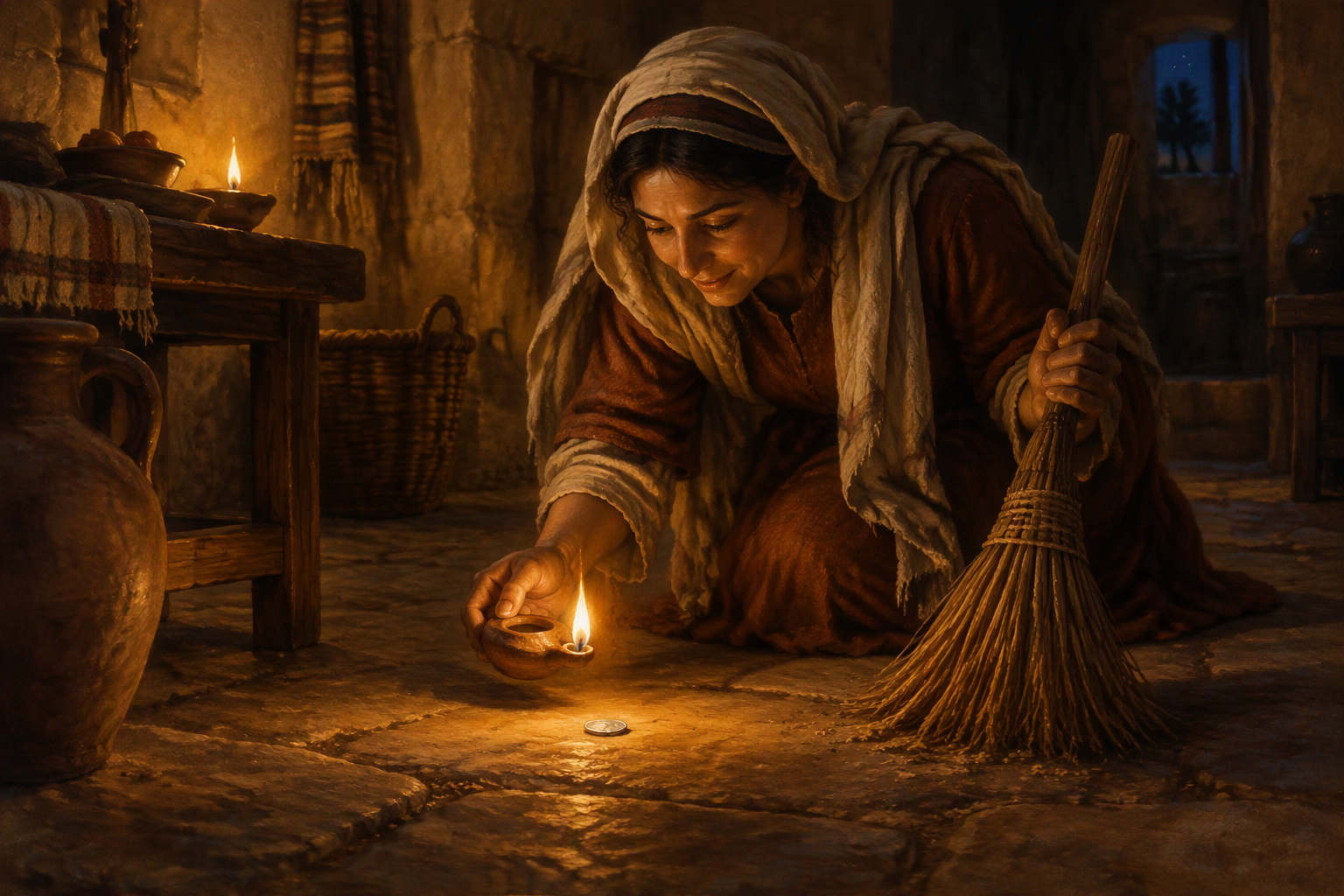
Doth not light a candle, and sweep the house, and seek diligently till she find it? (Luke 15:8). Artwork is imagined.
Of the three parables in Luke 15, the lost coin is the shortest and the easiest to pass over. A woman has ten pieces of silver, loses one, lights a lamp, sweeps the house, searches diligently until she finds it, and then calls her friends and neighbours to rejoice with her (Luke 15:8-9). At first glance her joy seems out of proportion. Who throws a celebration for one small coin? Yet Jesus closes the story with a solemn statement: "Likewise, I say unto you, there is joy in the presence of the angels of God over one sinner that repenteth" (Luke 15:10). The very exaggeration is the clue that something more precious than pocket change is at stake.
Why Did the Woman Search So Hard for One Silver Coin?
If a single small coin rolled under a cupboard in our own homes, most of us would glance around for a minute and give up. This woman does the opposite. She lights a lamp, which tells us the search happens in the dark, or in a dim, windowless home. She sweeps every corner. She does not rest until the coin is in her hand. Jesus always drew His parables from the life His hearers knew: the sower, the vine, the fishing net. So the question is not only what the coin was worth in money, but what it meant to her.
The Ten Silver Coins: A Betrothal Pledge?
A long-told explanation, repeated in many sermons and devotional books, connects the ten coins with betrothal. In this telling, a Jewish bride received a set of ten silver coins from her bridegroom, sometimes worn as a headpiece across the forehead, as a sign of her promised marriage. During the months between betrothal and wedding she was to keep herself faithful, and the coins were her visible pledge. To lose one was more than a financial loss; it could look like carelessness with the covenant itself.
We should be honest: Scripture does not describe this custom, and historians cannot confirm it for first-century Judea. Coin headdresses are known from later Middle Eastern cultures, and the reading is best held as a helpful illustration rather than proven history. Even so, it fits the emotion of the parable. It explains why she searched so desperately and why her friends would understand her joy.
Silver Is the Word of God
Throughout Scripture, silver pictures the purified word of the Lord: "The words of the LORD are pure words: as silver tried in a furnace of earth, purified seven times" (Psalm 12:6). Read with that in mind, the ten silver coins become a picture of the truth Christ entrusted to His people.
The Bible calls Christ the Bridegroom and His church the bride (Ephesians 5:25-27; Revelation 19:7). At His first coming the Bridegroom began a covenant with His people, first with the apostles, and placed His word in their hands. Then He went to prepare a place for them (John 14:2-3). The time between His going and His return is like the season of betrothal. The bride is not idle. Her calling is to keep the word, to let it shine, and to be found faithful when He comes.
Keeping the Silver Bright
Silver tarnishes when it is neglected. The truth we have received is not meant to sit in a drawer; it is meant to be reflected in how we live. There is a difference between holding up a Bible and saying, "This is how we should walk," and living so that others can see, "This is how I am walking." The first points to the word; the second shines it.
That is why the coin belongs to the forehead in the old telling: the word is to be kept in the mind and before the eyes. Moses told Israel to bind God's words "as frontlets between thine eyes" (Deuteronomy 6:8), and the redeemed in Revelation bear the Father's name in their foreheads (Revelation 14:1). The bride is meant to go out to meet the Bridegroom with His word written on her thoughts.
Light the Lamp, Sweep the House
When something of the truth slips away from us, through neglect, compromise or a slow drift, the parable shows how to recover it. First, light the lamp. "Thy word is a lamp unto my feet, and a light unto my path" (Psalm 119:105). We cannot find what is lost in the dark. Second, sweep the house. Repentance clears away the dust that has hidden what was precious. Third, search diligently. Restoration is not casual; it is wholehearted.

What Does the Parable of the Lost Coin Teach Us Today?
When the coin is found, the set is whole again. The woman cannot keep her joy to herself, and neither can heaven. Jesus told this story to people who murmured that He received sinners (Luke 15:2). His answer was that God does not shrug over what is lost. He searches, and He rejoices when even one comes home.
The marriage supper of the Lamb is coming: "Let us be glad and rejoice, and give honour to him: for the marriage of the Lamb is come, and his wife hath made herself ready" (Revelation 19:7). The question each of us must face is simple. Is the silver of His word complete and bright in our hands, or is a coin missing? If it is, the lamp is still within reach, and the Bridegroom is still waiting to rejoice over us.