 Cedar Biblical
Decoding · 16 min read
The Seven-Day Journey of Christ: Walking With Jesus From Bethany to Gethsemane
Day by day through the final week: the Passover lamb, Mary's alabaster jar, the Hebrew calendar of the cross, the Lamb entering Jerusalem on Nisan 10, and the prayer in Gethsemane.
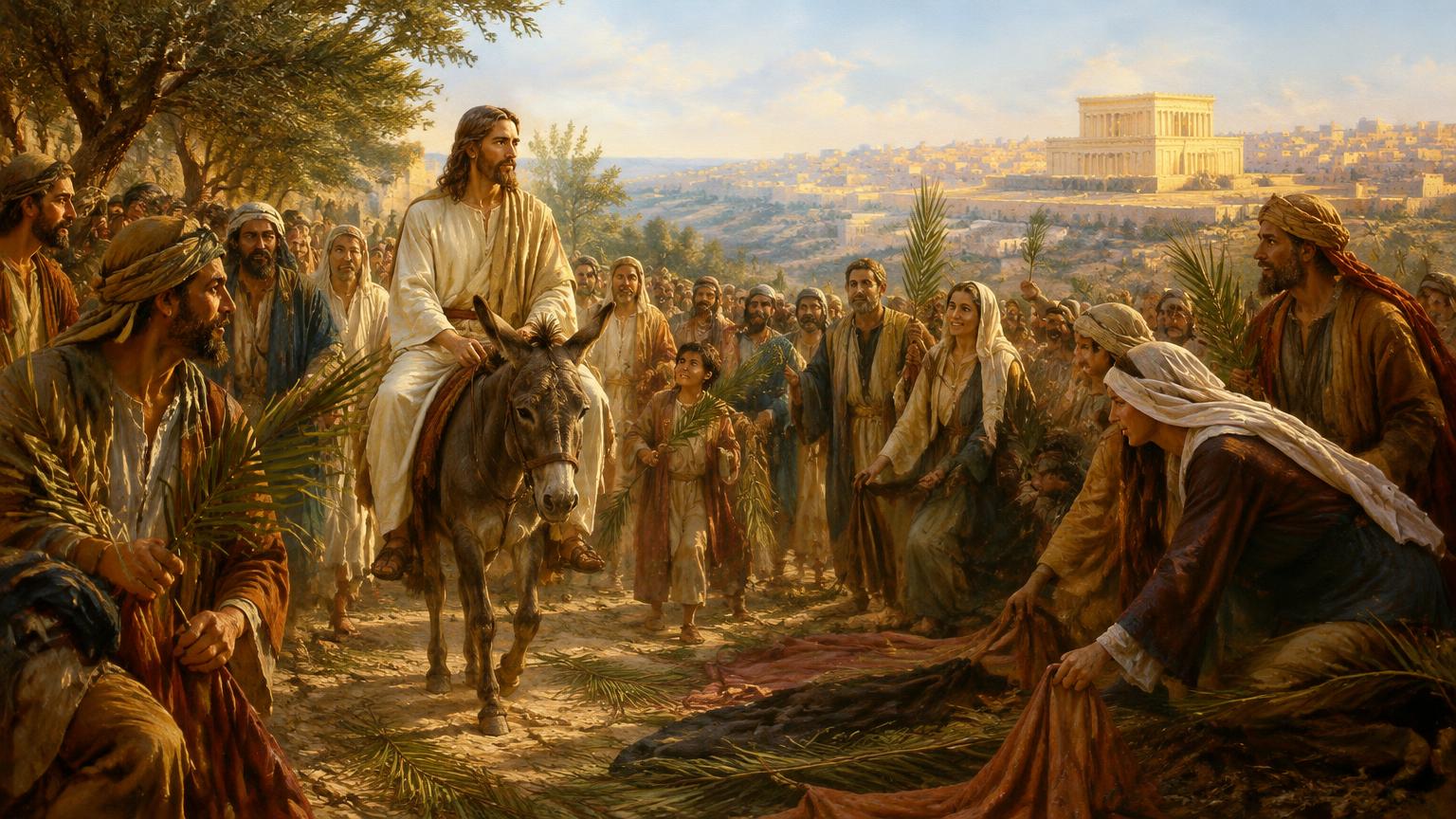
Your King is coming to you, lowly and riding on a donkey (Zechariah 9:9). Artwork is imagined.
In the last days before the cross, the Gospels slow down. Weeks of ministry pass in a few verses, but the final week fills whole chapters. This study walks with Jesus through those days, from the supper at Bethany to the garden of Gethsemane, keeping one eye on the Jewish calendar. Where the Gospel accounts seem to disagree, we stop and look closely at what each writer actually says.
Part I: The Passover Lamb
The Night That Shaped a Nation
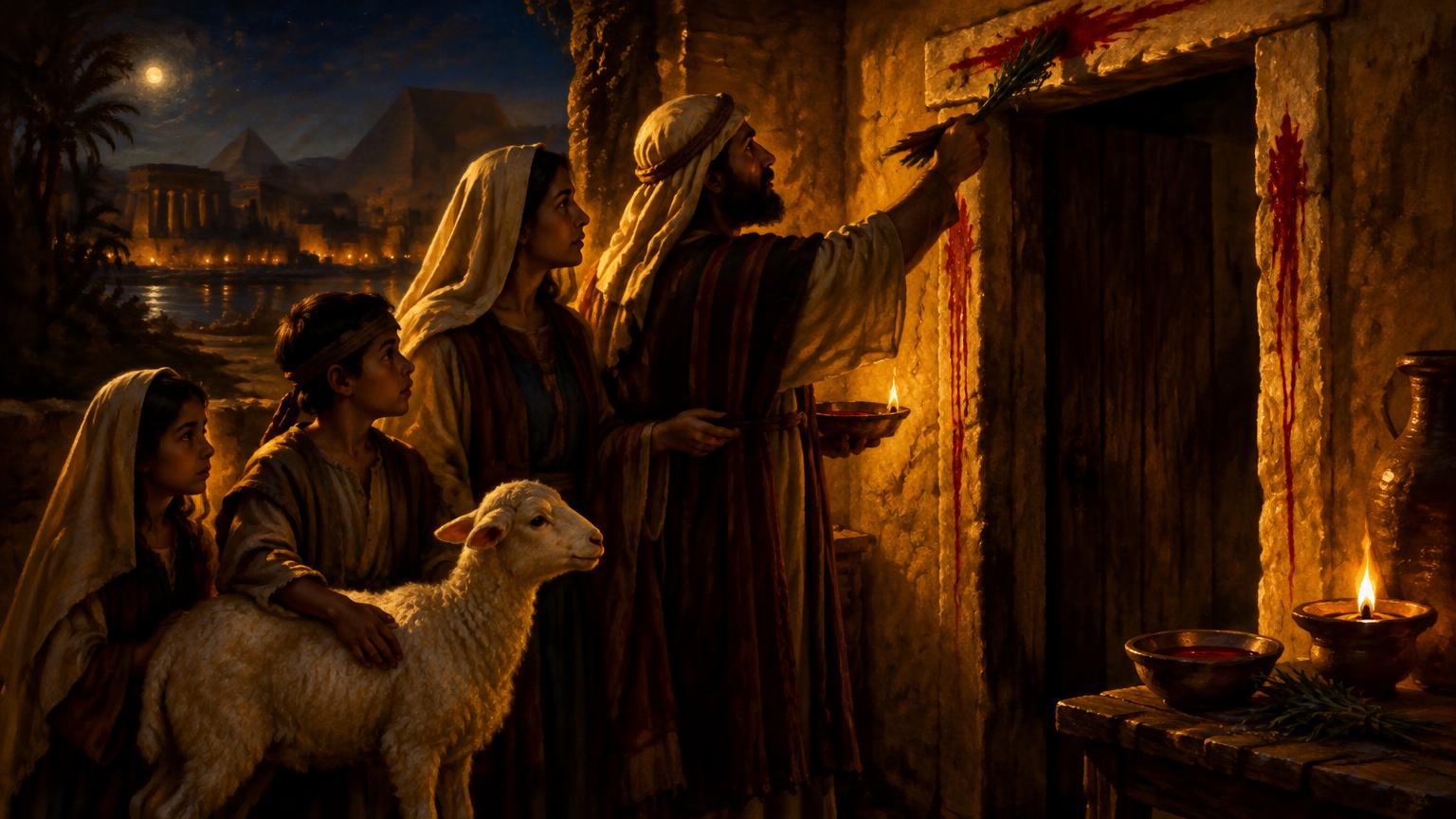
To understand the last week of Jesus, we have to begin in Egypt. The tenth plague was the death of the firstborn, and God gave Israel a single way of escape. On the tenth day of the first month, each household was to choose a lamb without blemish. They were to keep it until the fourteenth day, kill it at twilight, and mark the doorposts and lintel with its blood using a bunch of hyssop. "When I see the blood, I will pass over you" (Exodus 12:3–13).
Two details matter for everything that follows. The lamb was chosen on the tenth and slain on the fourteenth. For four days it lived inside the house, where the family could watch it and confirm it had no defect.
The Shadow and the Reality
The New Testament reads the Passover as a picture pointing forward. John the Baptist calls Jesus "the Lamb of God, who takes away the sin of the world" (John 1:29). Paul writes plainly, "Christ, our Passover lamb, has been sacrificed" (1 Corinthians 5:7). Peter speaks of "the precious blood of Christ, a lamb without blemish or spot" (1 Peter 1:19).
The writer of Hebrews calls the law "a shadow of the good things to come" (Hebrews 10:1). A shadow has the shape of the thing that casts it, but it is not the thing itself. The Passover lamb saved firstborn sons for one night. The Lamb it foreshadowed gives His life so that all who are dying in Adam may be made alive in Him (1 Corinthians 15:22).
Why Jesus Did Not Take the Easy Crown
The temptation in the wilderness shows the road Jesus refused. Satan offered Him "all the kingdoms of the world" without the cross (Matthew 4:8–9). Psalm 2 had already spoken of the nations given to the Son, to be broken "like a potter's vessel." Yet Isaiah describes the Servant very differently: "A bruised reed He will not break, and a smoking flax He will not quench" (Isaiah 42:3). Jesus chose the way of the lamb before the way of the throne. That choice sets His face toward Jerusalem for the final week.
Part II: The Alabaster Jar
Six Days Before the Passover
John tells us that "six days before the Passover, Jesus came to Bethany, where Lazarus was" (John 12:1). Bethany sat on the eastern slope of the Mount of Olives, less than two miles from Jerusalem (John 11:18). It was the last village before the city, and Jesus often stayed there during His visits.
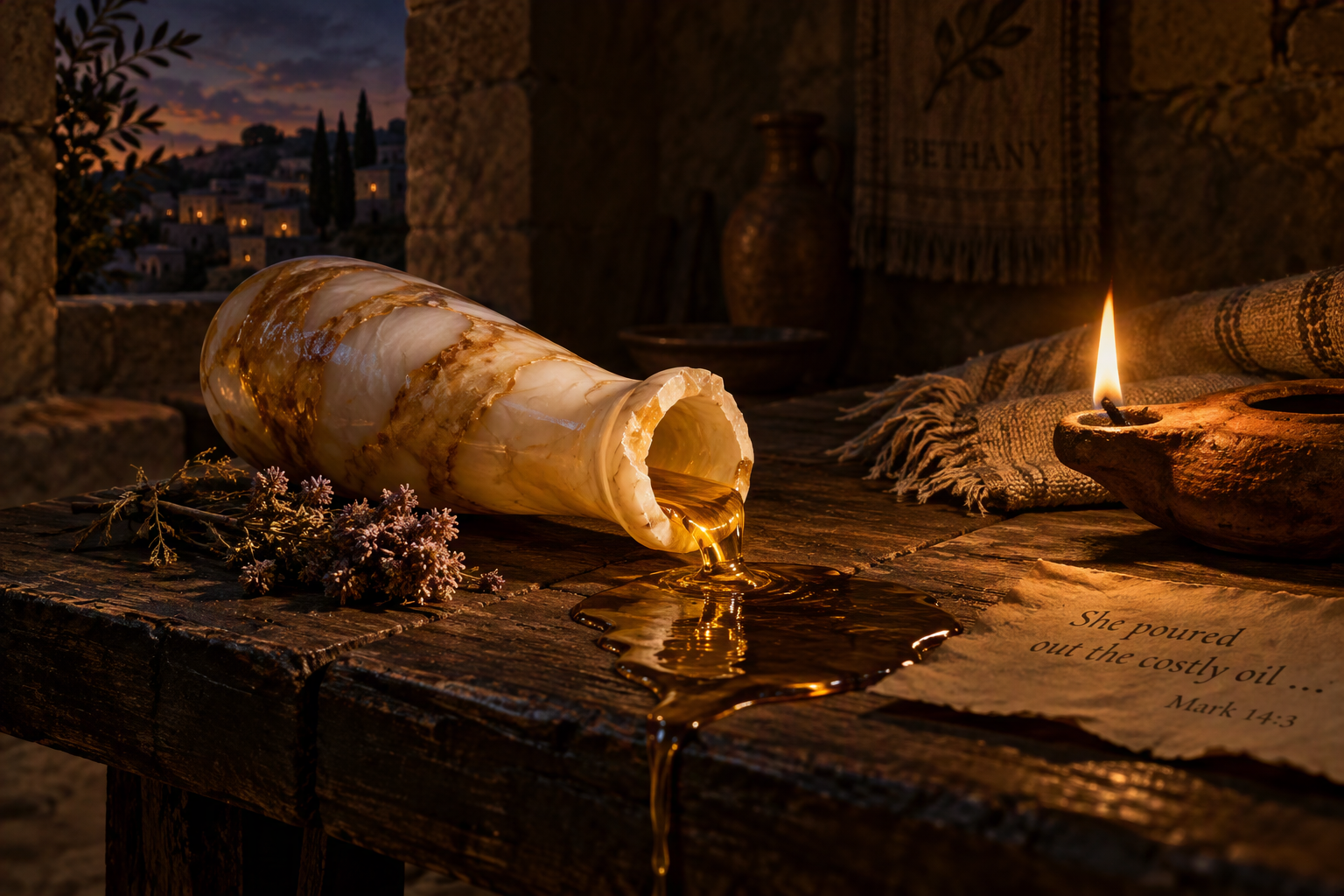
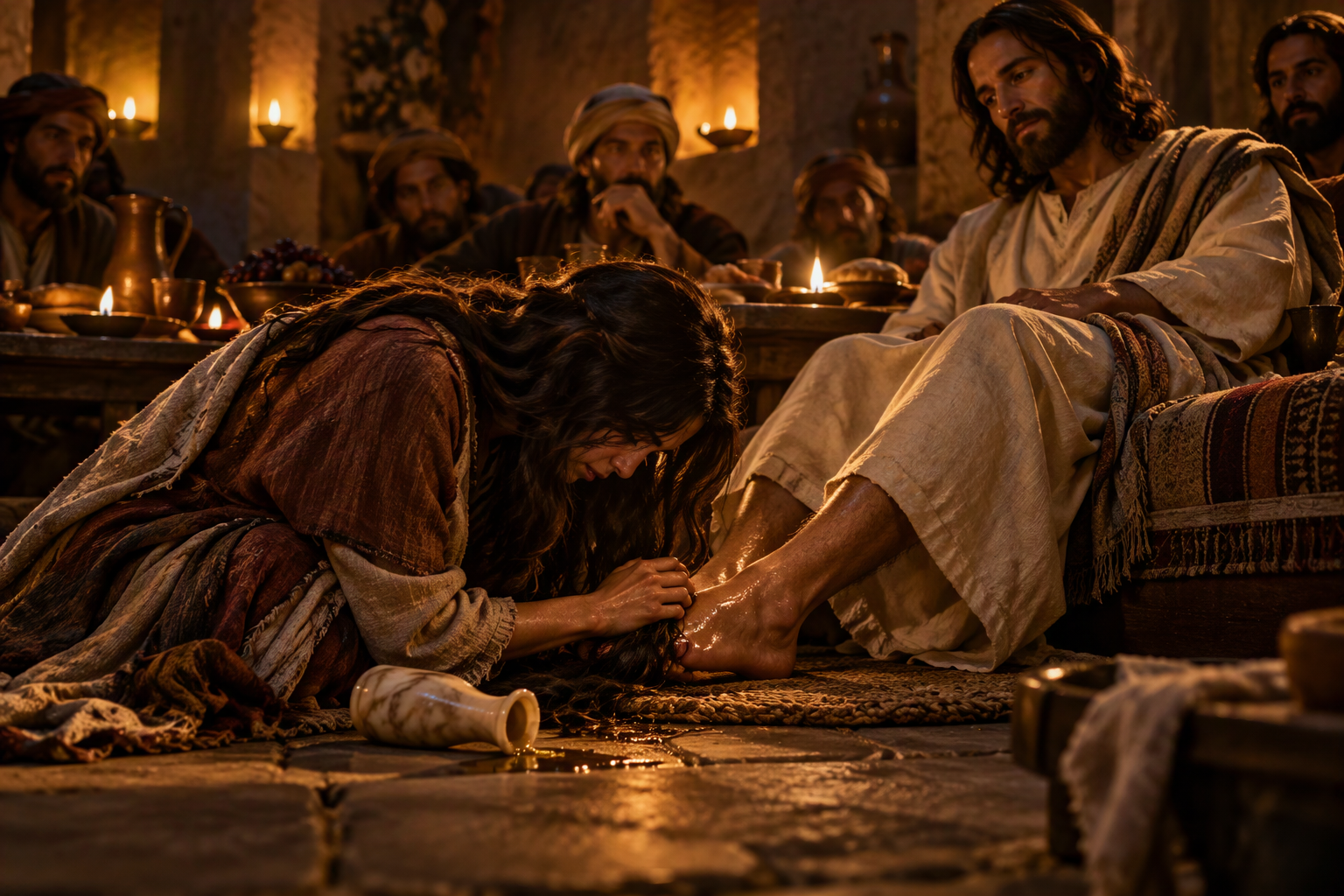
While He reclined at supper, a woman broke an alabaster jar of "very costly oil of spikenard" and poured it on Him (Mark 14:3). Spikenard (Nardostachys jatamansi) was imported from the Himalayas, which explains its enormous value. Mark records that it could have been sold for more than three hundred denarii, roughly a labourer's wages for a year (Mark 14:5; compare Matthew 20:2).
The Vessel and Its Measure
The word Mark uses for the jar is alabastron (Greek ἀλάβαστρον, Strong's G211), a term for a perfume flask. Such vessels could be made from translucent stone and have narrow necks. Mark says she "brake the box" (Mark 14:3), but does not specify whether she broke its neck, seal, or body. The artwork imagines the pouring; it cannot establish the vessel's exact construction.
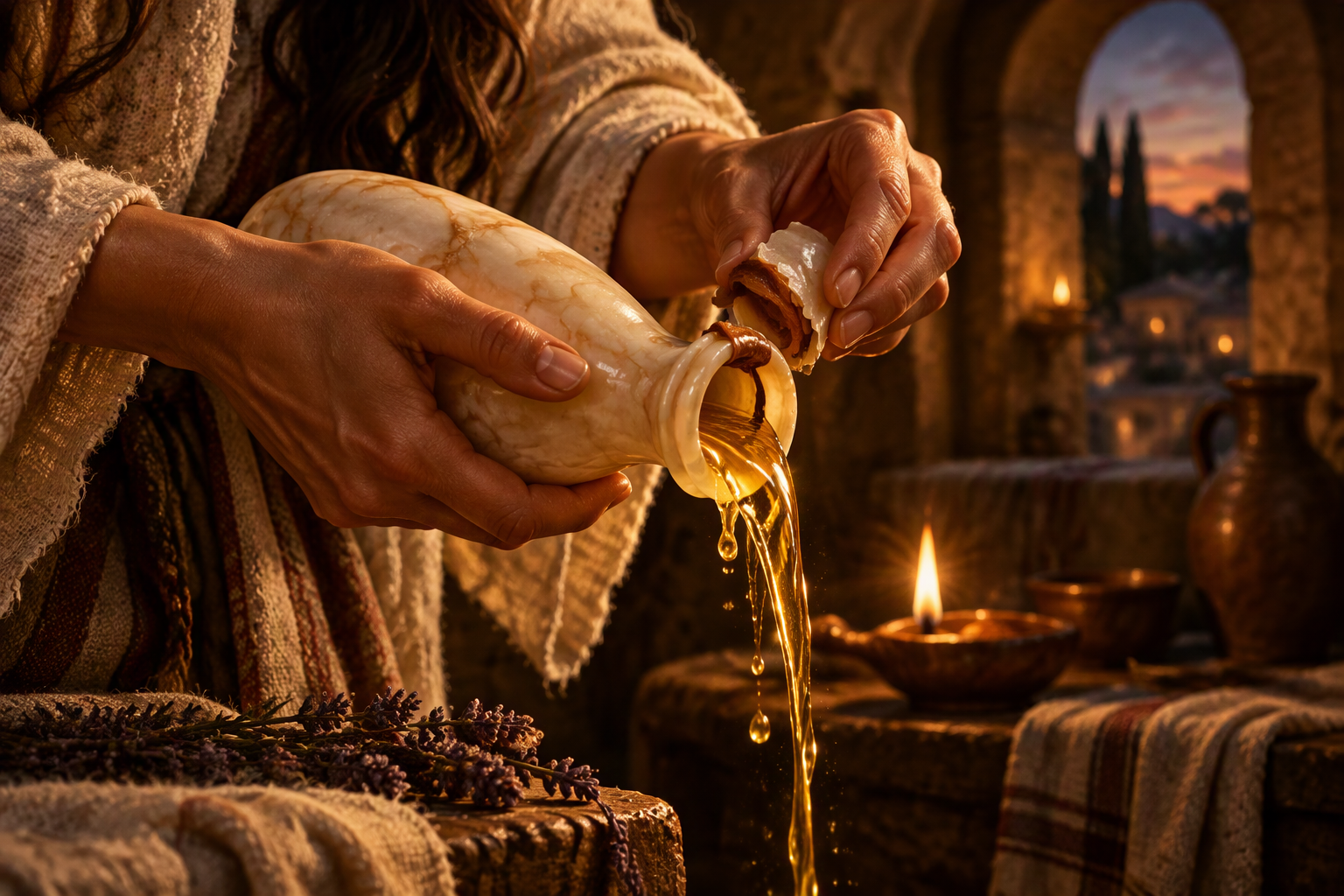
John gives the amount: "a pound of ointment of spikenard, very costly" (John 12:3). The Greek word is litra (λίτρα, Strong's G3046), approximately a Roman pound, about 327 grams. The quantity emphasizes the generosity of the gift; it does not establish that perfume ran from His head to His feet.
The Four Gospel Accounts Side by Side
- Matthew 26:6–13: In Bethany, house of Simon the leper; "an alabaster box of very precious ointment" poured on His head; the disciples ask, "To what purpose is this waste?"; Jesus says it was done "for my burial." - Mark 14:3–9: House of Simon the leper; "an alabaster box of ointment of spikenard very precious"; she broke the box and poured it on His head; valued at "more than three hundred pence." - John 12:1–8: Six days before the Passover; Mary takes "a pound (litra) of ointment of spikenard"; anoints His feet and wipes them with her hair; Judas names the value of three hundred pence. - Luke 7:36–50: A separate, earlier anointing in Galilee, at the house of Simon the Pharisee, by a woman known as a sinner, with "an alabaster box of ointment."
Three Accounts, One Evening: Resolving the Apparent Contradictions
Readers who set Matthew, Mark and John side by side notice three apparent differences.
Whose house was it? Matthew and Mark say the house of "Simon the leper" (Matthew 26:6; Mark 14:3). John mentions Lazarus, Martha and Mary (John 12:1–3). But John never says the house belonged to Lazarus; he says Martha served and Lazarus was "one of those who sat at the table." Simon was evidently a healed leper, since an active leper could not host a meal inside a village (Leviticus 13:46). The accounts fit together: a meal in Simon's house with the Bethany family present.
Who was the woman? Matthew and Mark simply say "a woman." John names her: Mary, the sister of Lazarus. Silence is not contradiction. John, writing later, supplies the name.
Head or feet? Matthew and Mark describe perfume poured on His head; John names Mary anointing His feet and wiping them with her hair (John 12:3). These actions can belong to the same occasion, as a common harmonization understands them, but none of these accounts says she poured oil from head to toe or wiped His legs. The claim that oil ran all the way down His body is an inference, not a narrated detail.
Two days or six? Matthew 26:2 says "after two days is the Passover," and the anointing follows in the narrative. But Matthew's "two days" belongs to the priests' plot (26:3–5), and the Bethany scene is introduced loosely, without a time marker. Matthew and Mark appear to place it there thematically, beside Judas's betrayal, while John gives the chronological setting.
A separate anointing in Luke 7 should not be confused with this one. At Simon the Pharisee's house, an unnamed woman washes His feet with tears, wipes them with her hair, kisses them, and anoints them (Luke 7:36–50). Luke does not identify her as Mary of Bethany or Mary Magdalene. John's Bethany scene mentions perfume and hair, not tears. In both scenes Jesus is reclining at a meal, making His feet accessible; the exact seating arrangement is not described.
"Why This Waste?"
Judas is often remembered as the only critic, but Matthew says "the disciples" were indignant (Matthew 26:8). Judas led the complaint, and John adds that his concern for the poor was a cover: "he was a thief, and had the money box" (John 12:6).
Jesus answers, "Let her alone. She has done a good work for Me... She has come beforehand to anoint My body for burial" (Mark 14:6–8). This is striking from the One who said, "Why do you call Me good? No one is good but One, that is, God" (Mark 10:18). When Jesus calls a deed good, it is good indeed. He also promises that wherever the gospel is preached, her act will be told in memory of her. Every time we read this passage, that promise is kept.
The Broken Jar and the Living Stone
The jar had to be broken before the fragrance filled the house (John 12:3). Paul uses a similar image: "We have this treasure in earthen vessels" (2 Corinthians 4:7). Peter calls believers "living stones" (1 Peter 2:5). The lesson is devotional rather than historical: a life surrendered to Christ releases what was sealed inside. Mary sat at His feet to hear His word (Luke 10:39), and now she pours out her most valuable possession at the same feet.
Part III: The Calendar of the Cross
From Evening to Evening
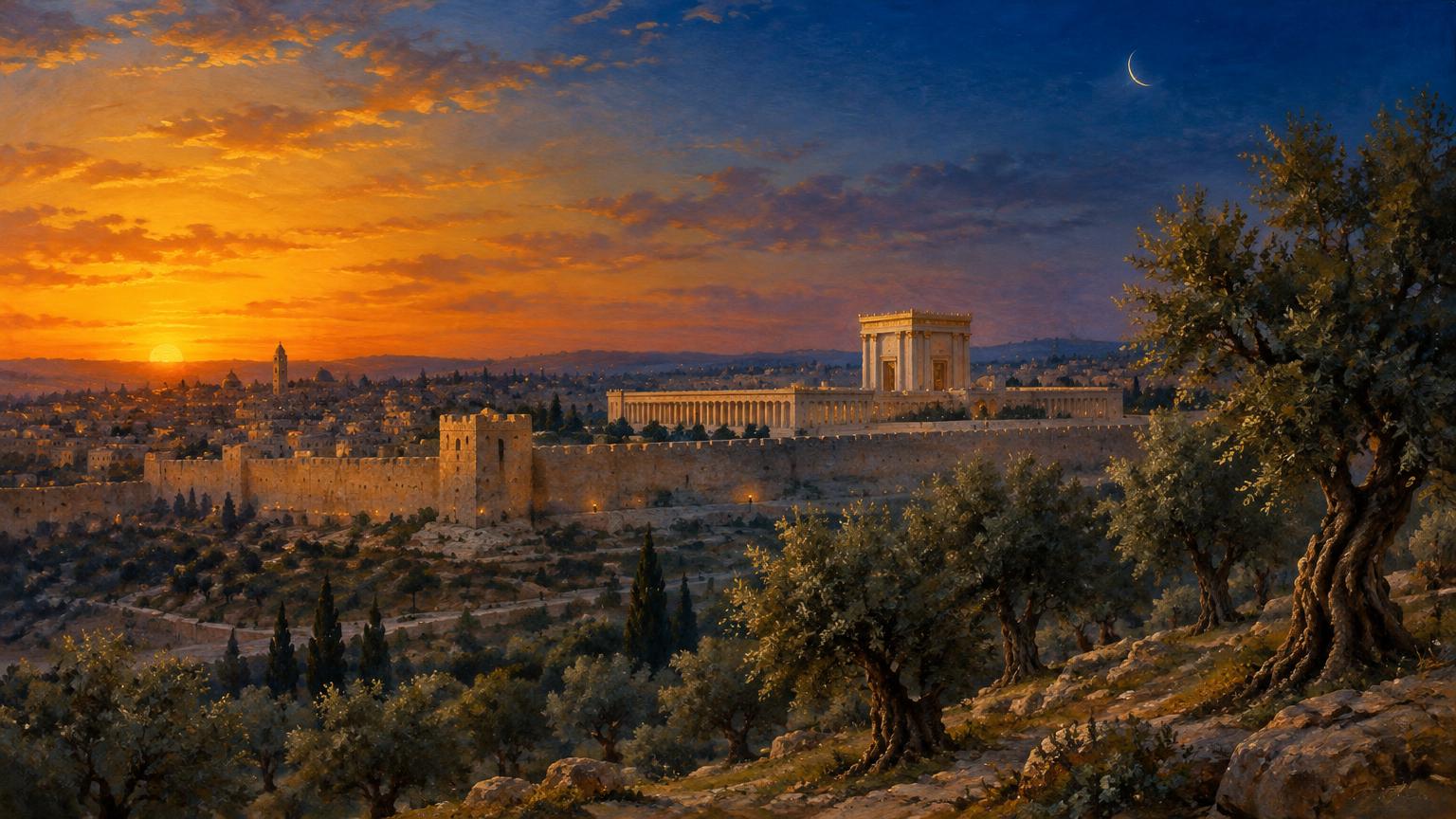
We count a day from midnight to midnight. Scripture counts it from evening to evening: "So the evening and the morning were the first day" (Genesis 1:5). Israel kept its Sabbaths "from evening to evening" (Leviticus 23:32). A Hebrew day began at sunset, so the night came before the daylight.
This matters for the Passion. The Last Supper, the arrest in Gethsemane, the trials and the crucifixion can all fall within one Hebrew day, even though for us they span two calendar dates.
Nisan: The First of Months
God told Moses, "This month shall be your beginning of months" (Exodus 12:2). That month was later called Nisan (Esther 3:7). Passover fell on Nisan 14, and the Feast of Unleavened Bread began on the fifteenth (Leviticus 23:5–6).
Counting backward from Nisan 14, many students lay out the final week like this. Working from John 12:1, Jesus arrived in Bethany around Nisan 8 or 9. The next day He entered Jerusalem (John 12:12). If that entry fell on Nisan 10, it matched the day Israel's households chose their lambs (Exodus 12:3). Over the next days He taught openly in the temple, where priests, Pharisees and Sadducees questioned Him and found no fault they could prove (Matthew 22:46). On Nisan 14 He died at the time the Passover lambs were slain.
A Note of Honest Caution
Scholars have long debated the exact dates of the Passion week. Some read the Synoptic Gospels as presenting the Last Supper as a Passover meal (Mark 14:12), while John places the crucifixion on "the Preparation Day of the Passover" (John 19:14). Proposed solutions include different calendars in use among Jewish groups, or different ways of naming the feast days. The parallel between the lamb chosen on the tenth and Christ's entry is a strong and widely noted pattern, but the precise day-by-day timetable remains a matter of careful reconstruction rather than certainty.
Part IV: Nisan 10, the Lamb Enters the City
Hosanna to the Son of David
Jesus rode into Jerusalem on a young donkey, fulfilling Zechariah 9:9: "Your King is coming to you... lowly and riding on a donkey." The crowds spread cloaks and palm branches on the road, crying "Hosanna! Blessed is He who comes in the name of the Lord!" (John 12:13; Psalm 118:25–26).
If this was Nisan 10, the timing is remarkable. As families across the land were setting apart their lambs, the city welcomed the Lamb of God through its gates. Over the next four days He would be watched, tested and questioned as closely as any Passover lamb was examined for blemishes.
The Fig Tree With Nothing but Leaves
Mark records that after a visit to the temple, Jesus returned to Bethany for the night. The next morning He was hungry and saw a fig tree in leaf. "He found nothing but leaves, for it was not the season for figs" (Mark 11:13). He said, "Let no one eat fruit from you ever again."
This seems unfair at first. Why curse a tree out of season? The answer lies in how fig trees grow. A fig in leaf normally carries small early fruit, called taqsh in Arabic-speaking Palestine, which appear with or before the leaves. A tree covered in leaves but without these early buds was signaling fruit it did not have. It would bear nothing that year.
The Bible supplies its own meaning for the fig. In Jeremiah 24, God shows the prophet two baskets, one of very good figs and one of very bad figs, and applies them to the people of Judah. Jesus's parable in Luke 13:6–9 describes a fig tree that bore no fruit for three years. The owner says, "Cut it down," but the vinedresser pleads, "Let it alone this year also." Christians have long seen in that vinedresser a picture of the Advocate who speaks on our behalf (1 John 2:1).
Cleansing the Temple
Immediately after the fig tree, Jesus entered the temple and drove out those buying and selling. "Is it not written, 'My house shall be called a house of prayer for all nations'? But you have made it a den of thieves" (Mark 11:17; Isaiah 56:7; Jeremiah 7:11). Mark frames the temple scene inside the fig tree story on purpose. Both looked impressive, and both lacked the fruit God was looking for.
The temple Jesus entered had been rebuilt and enlarged by Herod the Great, a project still in progress during His ministry (John 2:20). The New Testament later applies temple language to believers: "Do you not know that you are the temple of God?" (1 Corinthians 3:16). The searching question for us is the one Jesus asked of the temple and the tree: is there real fruit under the leaves?
Part V: "Let This Cup Pass From Me"
The Upper Room
On the day of preparation, Jesus sent Peter and John into the city to prepare the Passover (Luke 22:8). They were to follow a man carrying a water jar, an unusual sight since women usually carried water, to a large upper room already furnished (Luke 22:10–12).
There Jesus rose from supper, laid aside His garments, took a towel and washed the disciples' feet (John 13:4–5). Peter protested, but Jesus answered, "If I do not wash you, you have no part with Me." Then He gave them bread and the cup, His body broken and His blood of the new covenant (Luke 22:19–20). The Passover meal of Egypt became the memorial of a greater deliverance.
Into the Garden
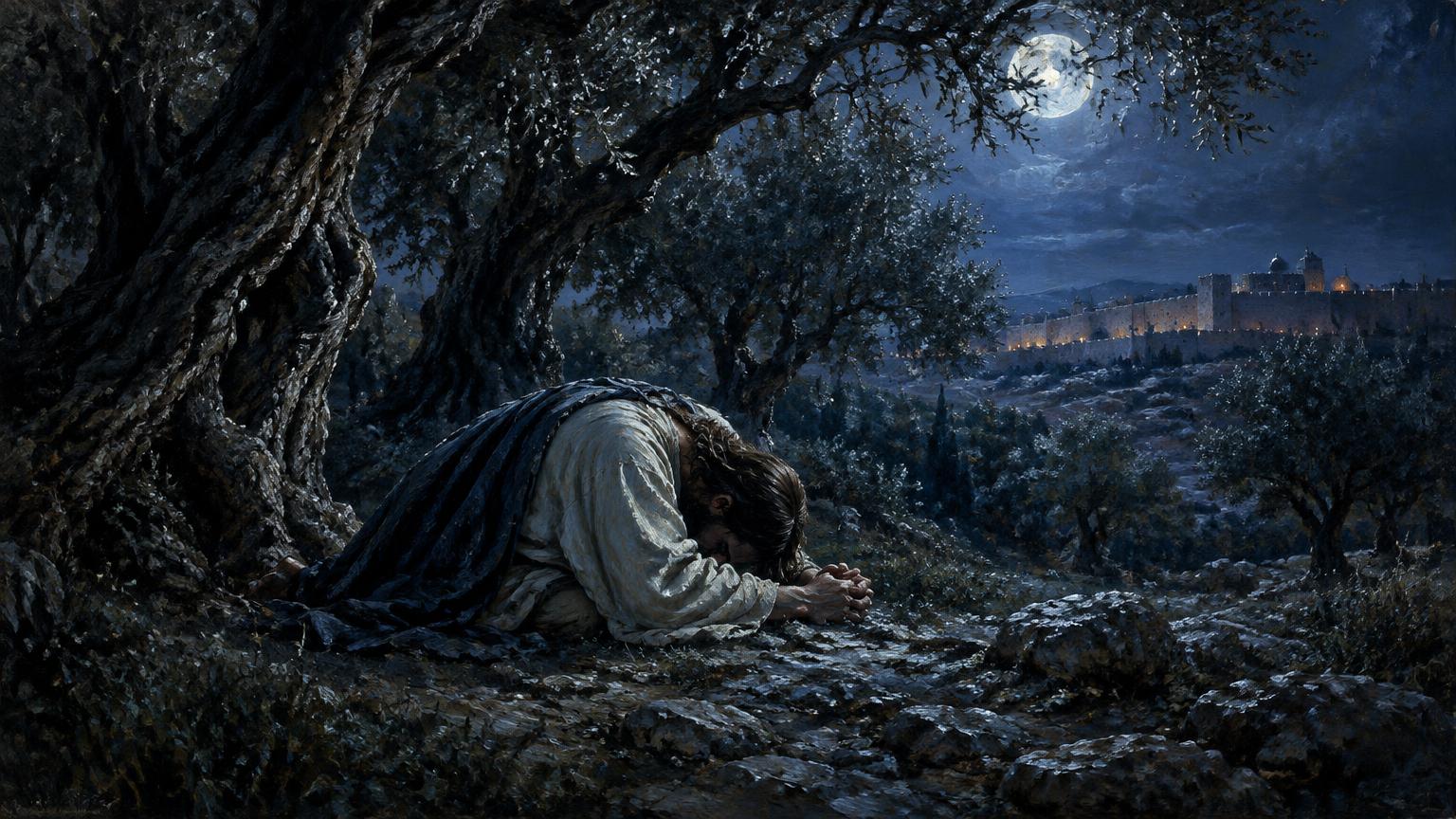
After singing a hymn, they went out to the Mount of Olives (Mark 14:26), to a place called Gethsemane. The name likely means "oil press." Olives were crushed there under great weight until their oil flowed, and on this night the Son of God was pressed down under the weight of what lay ahead.
"My soul is exceedingly sorrowful, even to death," He told Peter, James and John (Matthew 26:38). Then He went a little farther "and fell on His face, and prayed, saying, 'O My Father, if it is possible, let this cup pass from Me; nevertheless, not as I will, but as You will'" (Matthew 26:39).
Kneeling or Face Down?
Luke says Jesus "knelt down and prayed" (Luke 22:41). Matthew says He fell on His face, and Mark that He "fell on the ground" (Mark 14:35). These are not competing reports. A person in deep anguish may kneel and then sink to the ground. Together the Gospels show a prayer that began on His knees and ended with His face in the dust.
Luke adds that "His sweat became like great drops of blood falling down to the ground" (Luke 22:44). Whether Luke means actual blood or sweat falling heavily like drops of blood, the point is the intensity of His agony.
The Cup
In the prophets, the cup often stands for God's judgment against sin (Isaiah 51:17; Jeremiah 25:15). Jesus did not shrink from death as a coward. He faced, in full awareness, what it meant to bear the sin of the world. Three times He prayed, and three times He returned to find His disciples sleeping. "The spirit indeed is willing, but the flesh is weak" (Matthew 26:41).
The answer to His prayer was not a way around the cross but strength to walk through it. Luke records that "an angel appeared to Him from heaven, strengthening Him" (Luke 22:43). When Judas arrived with the crowd, Jesus rose and went out to meet them.
Walking the Road With Him
From Bethany to Gethsemane, the last week of Jesus moves with purpose. The Lamb is chosen, anointed, welcomed, examined and finally pressed like olives in the garden. Mary's broken jar, the barren fig tree, the cleansed temple and the bowed head in Gethsemane all ask the same question of every reader: will we pour out what we treasure most at His feet, and say with Him, "Not as I will, but as You will"?