 Cedar Biblical
Decoding · 8 min read
The Burned Scroll: Jeremiah 36 and the Indestructible Word of God
A king's penknife, a winter fire, and a scroll rewritten with many words added: the Word that no ruler could destroy.
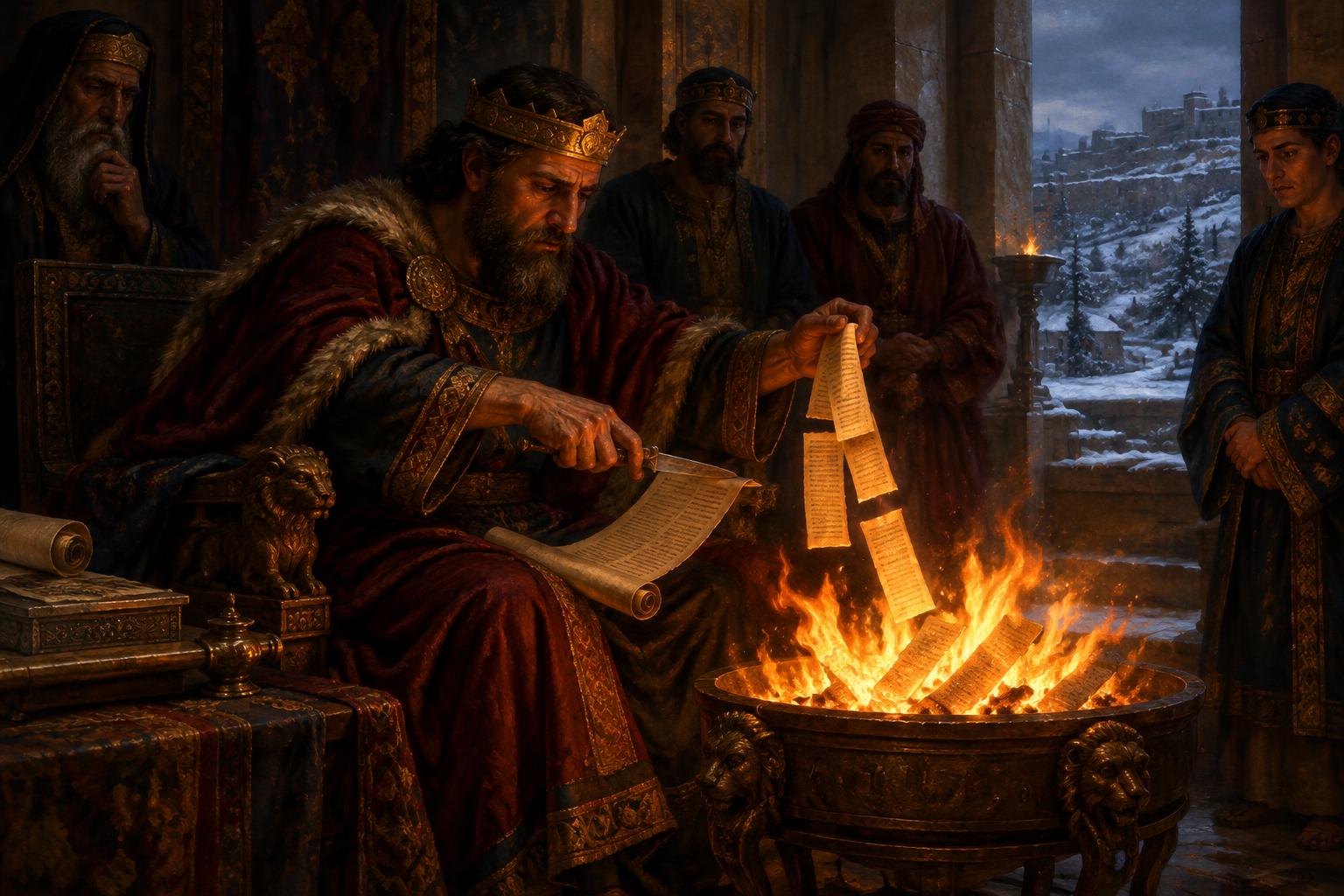
"Now the king sat in the winterhouse in the ninth month: and there was a fire on the hearth burning before him. And it came to pass, that when Jehudi had read three or four leaves, he cut it with the penknife, and cast it into the fire" (Jeremiah 36:22–23).
Few scenes in Scripture are as vivid. A king warms himself by a brazier while column after column of God's Word curls into ash. And yet the story ends not with the scroll's destruction but with its multiplication.
The Weeping Prophet
Jeremiah is often called the weeping prophet; tradition links him with Lamentations. He loved his nation and grieved over the judgments he was commanded to announce (Jeremiah 9:1). He ministered through the reigns of Josiah, Jehoahaz, Jehoiakim, Jehoiachin, and Zedekiah, the last turbulent decades before Babylon destroyed Jerusalem.
Two Kings, Two Responses to the Book
To understand Jehoiakim we must remember his father. When the young king Josiah heard the rediscovered book of the Law read aloud, he tore his clothes in repentance (2 Kings 22:8–11). He purged idolatry and kept a Passover unmatched since the judges (2 Kings 23:21–23). The Word read; the king trembled; the nation turned.
After Josiah fell at Megiddo, his son Jehoahaz reigned only three months before Pharaoh Necho deposed him and placed another son, Eliakim, renamed Jehoiakim, on the throne (2 Kings 23:31–34). The father humbled himself before the scroll. The son would burn it.
The Command to Write
In Jehoiakim's fourth year God told Jeremiah, "Take thee a roll of a book, and write therein all the words that I have spoken unto thee" (Jeremiah 36:2). The purpose was mercy: "It may be that the house of Judah will hear... that they may return every man from his evil way; that I may forgive their iniquity" (36:3). Jeremiah dictated; his faithful scribe Baruch wrote.
Restricted from entering the Temple, Jeremiah sent Baruch to read it publicly on a fast day (36:5–10). A young man named Michaiah heard and reported it to the princes in the scribe's chamber; they summoned Baruch, heard it, and were afraid. They told Baruch, "Go, hide thee, thou and Jeremiah" (36:19), and brought word to the king.
The Penknife and the Fire
The scroll was read to Jehoiakim. Every few columns he cut it and threw it into the fire, "until all the roll was consumed." The text notes, "Yet they were not afraid, nor rent their garments, neither the king, nor any of his servants" (36:24). The contrast with Josiah's torn robes is deliberate. Three officials pleaded with him not to burn it; he would not listen (36:25).
The Word Rewritten, and Enlarged
"Then took Jeremiah another roll, and gave it to Baruch... who wrote therein from the mouth of Jeremiah all the words of the book which Jehoiakim king of Judah had burned in the fire: and there were added besides unto them many like words" (Jeremiah 36:32). The king's knife produced a larger book. Jehoiakim himself received a personal sentence (36:30–31).
"The grass withereth, the flower fadeth: but the word of our God shall stand for ever" (Isaiah 40:8; 1 Peter 1:24–25).
A Pattern Through History
Many Bible students see in this chapter a pattern repeated through the history of the church. Again and again rulers and institutions have tried to silence the Scriptures, and again and again the Word has returned in greater measure.
When the Bible was confined to Latin and kept from ordinary people, John Wycliffe and his followers translated it into English in the 1380s. Decades after his death his bones were exhumed and burned, yet the translations spread. William Tyndale's printed New Testament was bought up and burned in London; Tyndale was executed in 1536, praying that the king of England's eyes would be opened. Within a few years an English Bible was ordered placed in every parish church. Martin Luther's German translation carried Scripture into homes across Europe. Like Baruch's second scroll, each attempt to destroy the Word was followed by its wider reading.
Some teachers connect such reformers with the "angels" of the seven churches in Revelation 2–3, seeing them as messengers to successive ages. That is one devotional framework among several, and readers may hold it loosely. The historical pattern itself, however, is plain.
The Book in Our Hands
Today we hold the Scriptures freely. The danger is no longer the king's penknife but our own neglect, quietly cutting away the parts we find uncomfortable and warming ourselves by other fires. Will we respond like Josiah, who tore his robe, or like Jehoiakim, who tore the scroll?
The scroll was burned. The Word was not. "Heaven and earth shall pass away, but my words shall not pass away" (Matthew 24:35).