 Cedar Biblical
Decoding · 6 min read
Decoding the Mystery of the Red Heifer: Shadow and Substance
Discover how the enigmatic Old Testament ordinance of the red heifer perfectly unveils the cleansing power of Jesus Christ's sacrifice.
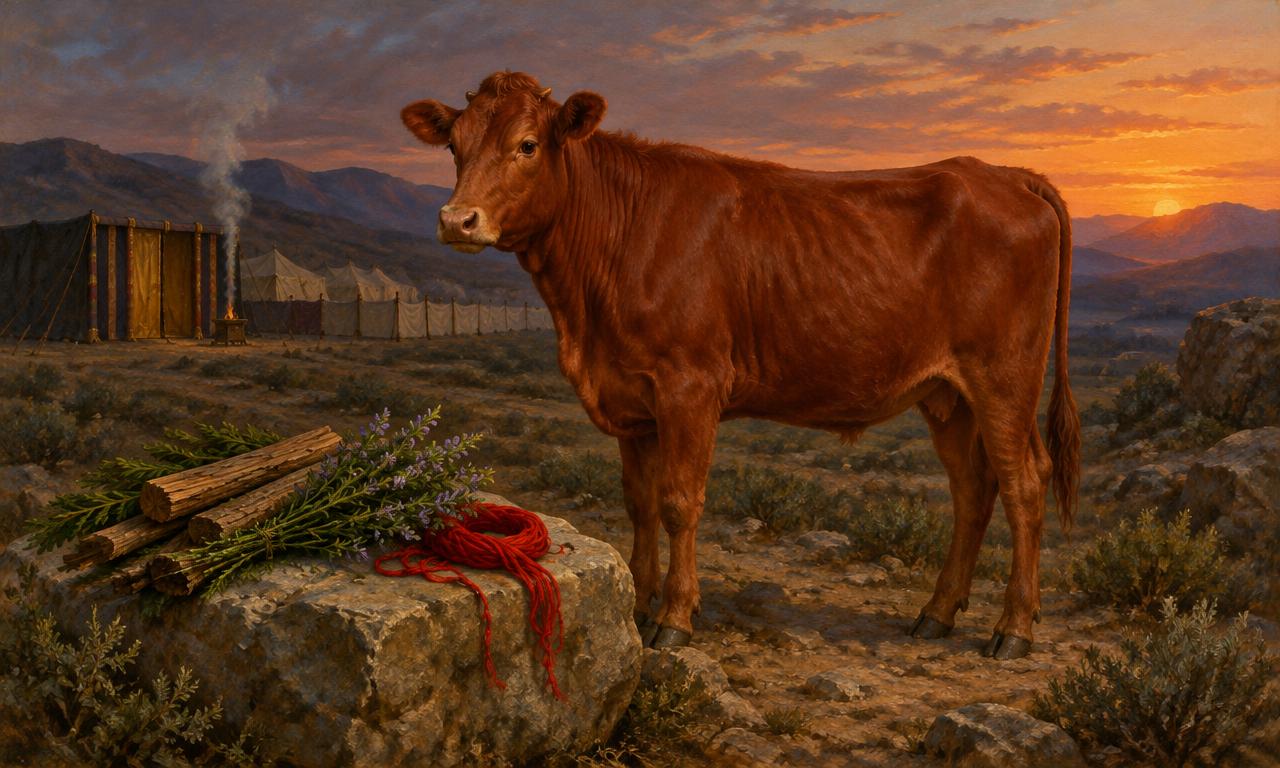
Throughout the Old Testament, the Almighty instituted numerous animal sacrifices, prescribing exact instructions for rams, goats, and bullocks. Yet, among all the offerings of the Levitical economy, only one sacrifice had its color specifically ordained by God: the red heifer. Furthermore, while standard offerings were brought directly to the altar within the tabernacle court, this unique creature was led completely outside the camp to be slaughtered and burned to ashes. To this day, rabbinic scholars view this ordinance as one of the deepest paradoxes of the Law. Careful spiritual discernment, however, reveals that every element of this ancient ceremony was an intricate prophetic shadow of our Lord Jesus Christ.
In modern prophetic circles, much speculation surrounds the red heifer. Ancient Jewish tradition claims that only nine red heifers were ever sacrificed from the days of Moses through the destruction of the Second Temple, and many anticipate a tenth heifer to facilitate the rebuilding of an earthly sanctuary. Yet the epistle to the Hebrews clearly dismantles the notion that believers must look for another animal sacrifice. The Apostle declares, "For if the blood of bulls and of goats, and the ashes of an heifer sprinkling the unclean, sanctifieth to the purifying of the flesh: How much more shall the blood of Christ, who through the eternal Spirit offered himself without spot to God, purge your conscience from dead works to serve the living God?" Looking for a modern heifer misses the substance entirely, for Christ has already accomplished the ultimate purification.
The Contagion of Death and the Uncovered Vessel
The ordinance of the red heifer in Numbers 19 was instituted specifically to address the defilement caused by death. Under the Law, whosoever touched a dead body was ceremonially unclean for seven days. If a man died in a tent, everyone who stood inside, everyone who entered, and even every open vessel without a covering became defiled. Touching a bone in an open field or walking upon an unmarked grave instantly imparted this seven-day uncleanness. Why did the Lord treat physical death with such severe judgment? Because God is the author of life, not of death. Death is the visible consequence of the curse, the outward proof of iniquity, and as Paul writes, the last enemy that shall be destroyed.
This legal reality mirrors the spiritual condition of all humanity. In the beginning, Adam committed iniquity by disobeying the commandment of the Lord, as Hosea reminds us: "they like Adam have transgressed the covenant." By that solitary transgression, spiritual death entered our global tent. The entire human race, existing in the loins of Adam, became defiled by that death. Moreover, the Law declared that any vessel lacking a tight lid became defiled by the atmosphere of death. Scripture repeatedly identifies mankind as vessels formed by the divine Potter. The open vessel portrays the unguarded heart. When our inner man is not kept with all diligence, sin and the spirit of disobedience freely rush in, just as rebellion entered through the open gate of Adam's heart.
The Heifer Without Yoke or Blemish
To cleanse this profound defilement, God commanded Israel to bring "a red heifer without spot, wherein is no blemish, and upon which never came yoke." The Hebrew linguistic roots offer profound insight into God's redemptive plan. The word for red, adom, shares its root with Adam and the red earth from which the first man was formed. Furthermore, our sins are described in Isaiah as scarlet and red like crimson. To redeem fallen Adam and atone for crimson sins, a red offering was designated.
This heifer had to be utterly unblemished, free from mixed hairs, and entirely unacquainted with any earthly yoke. This points straight to Jesus Christ. Our Lord possessed absolute moral perfection, knowing no sin. He never bore the yoke of this world, nor did He labor under the yoke of human vanity, self-will, or worldly ambition. From His baptism to His crucifixion, He walked in undivided consecration, saying, "I came down from heaven, not to do mine own will, but the will of him that sent me." He did not labor for an earthly kingdom; His entire existence was yielded to the Father's purpose.
The Fire Outside the Camp
Eleazar the priest was instructed to take the heifer outside the camp, slay her, and sprinkle her blood directly toward the front of the tabernacle seven times. Then, the entire animal—its flesh, hide, blood, and dung—was consumed in the fire. Nothing was reserved for the priests. While it burned, the priest cast three specific elements into the midst of the flames: cedar wood, hyssop, and scarlet wool.
Every detail was fulfilled at Calvary. As the author of Hebrews observes, "Jesus also, that he might sanctify the people with his own blood, suffered without the gate." Christ went outside the holy city to Golgotha, facing the presence of the Father, and poured out His soul unto death. In Scripture, the cedar tree depicts the upright righteous man, flourishing in divine integrity. Hyssop speaks of ceremonial purification and faith, echoing David's cry, "Purge me with hyssop, and I shall be clean." The scarlet wool represents our scarlet transgression laid upon Him, as dramatized when the soldiers mocked Him in a scarlet robe. Upon the cross, the Righteous One, having assumed our scarlet guilt, tasted the bitter cup of hyssop and offered Himself as a complete whole burnt offering, leaving nothing unfinished.
Resolving the Great Paradox
The fundamental mystery that baffled ancient commentators was the ritual paradox: the ashes of the heifer cleansed the defiled person, yet everyone who handled the heifer, gathered its ashes, or sprinkled the water became ceremonially unclean until evening. How could that which purifies make clean men unclean?
This tension finds its complete resolution in the substitutionary atonement of Christ. The holy Son of God, who was entirely pure, took upon Himself the contagion of our spiritual death. As the Apostle writes, "For he hath made him to be sin for us, who knew no sin; that we might be made the righteousness of God in him." Christ took our uncleanness and griefs upon Himself so that His purity might be imparted to us. He bore our curse outside the gate, absorbing our judgment that we might enter the camp of divine fellowship.
The Running Water and the Twofold Cleansing
The ashes of the red heifer were preserved in a clean place outside the camp and subsequently mixed with running, or living, water in a vessel. When someone was defiled by death, a clean person dipped hyssop into this water of separation and sprinkled the unclean person on the third day and on the seventh day. Only after this twofold application, along with the washing of clothes, was the individual pronounced clean.
The living water represents the Holy Spirit, poured forth after Christ's sacrifice was accepted. The ashes represent the finished work of Christ's once-for-all offering. When the Holy Spirit applies the finished sacrifice of Christ to our lives through the hyssop of personal faith, our dead conscience is purged.
Furthermore, the appointed timeline carries rich spiritual significance. On the third day of creation, life first sprang from the dark earth as grass and fruit trees emerged. On the third day, Jesus broke the bonds of death and rose from the grave. For the believer, the third-day sprinkling corresponds to spiritual rebirth and baptism, wherein we are buried with Christ and raised to walk in newness of life, having our sins washed away. Yet the legal purification was not completed on the third day alone; the unclean person had to return for the seventh day.
The seventh day points to ultimate perfection and the final bodily resurrection at the end of the age. Our regeneration in Christ is the indispensable beginning, but we must persevere in holiness until we are clothed with our glorified, spiritual body, fashioned like unto His glorious body. Under the Law, if an unclean man neglected to purify himself, he was cut off from the congregation of the Lord. In like manner, let us guard our hearts against disobedience, continually abiding in the cleansing virtue of Christ's blood, that we may stand faultless before His throne.