 Cedar Biblical
Decoding · 5 min read
Decoding Proverbs 6: Why Solomon Sent the Pledged Son to the Ant
Discover how Solomon’s warning on suretyship unlocks the spiritual mystery of the ant and reveals how believers escape the snare of spiritual slumber.
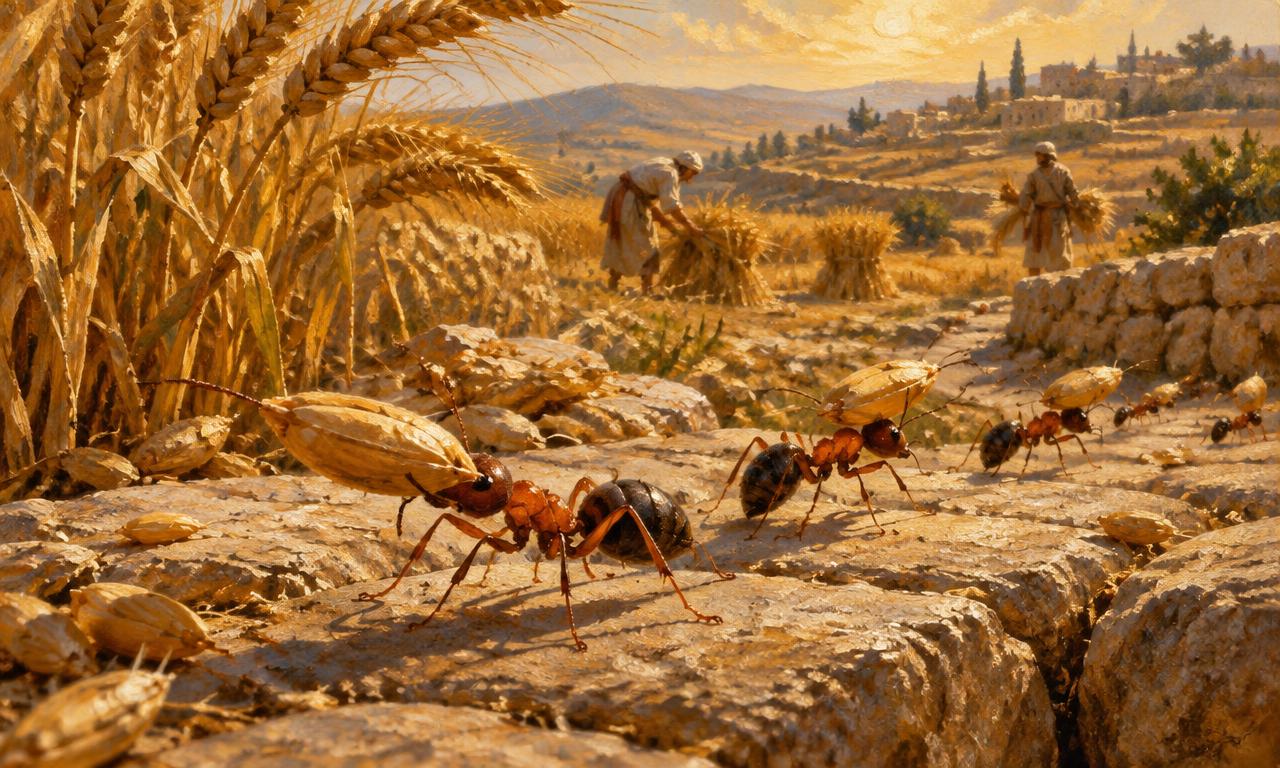
When reading the Book of Proverbs, many readers treat the opening verses of chapter six as disconnected proverbs stitched together at random. Solomon begins with an urgent warning about becoming surety for a friend and striking hands with a stranger, only to transition abruptly in verse six with the famous admonition: Go to the ant, thou sluggard; consider her ways, and be wise. On the surface, entering into a financial pledge seems entirely unrelated to the lethargy of a sluggard. Yet careful meditation reveals an intimate spiritual design connecting the two. Solomon is not shifting topics; he is showing how a solemn covenant demands sleepless vigilance lest the believer be caught in the invisible snares of the adversary.
The Snare of Suretyship and the Debt of Love
Solomon addresses his counsel directly to his son, representing those who have received the spirit of adoption as sons of God. The son has become surety for his friend and pledged his hand for a stranger, finding himself snared by the words of his mouth. In spiritual reality, every consecrated believer has entered into such an engagement. Christ is that heavenly Friend who called His disciples friends if they do whatsoever He commands them. We have entered into fellowship with His sufferings, taking upon us what the Apostle Paul termed chains in Christ. Through our baptismal vow, we confessed that it is no longer we who live, but Christ who liveth in us.
At the same time, we have struck hands in pledge for the stranger, representing the lost world to whom we owe the ministry of reconciliation as ambassadors for Christ. We are bound by the singular debt of Romans chapter thirteen: Owe no man any thing, but to love one another. Having made this sacred vow, the son stands accountable. If he becomes careless or falls into spiritual stupor, he risks being captured like a roe from the hand of the hunter and a bird from the snare of the fowler. The hunter assaults overtly with arrows, while the fowler sets subtle, invisible nets through the works of the flesh. To escape being overtaken, the son must not give sleep to his eyes nor slumber to his eyelids, but must humble himself before his Friend and run his spiritual race with tireless vigilance.
The Exceeding Wisdom of the Honey-Pot and Farming Ants
To instruct the believer on how to maintain this spiritual alertness, Solomon directs our gaze downward to one of the smallest creatures on earth. Proverbs chapter thirty observes that ants are little upon the earth, but they are exceeding wise, preparing their meat in the summer. God has endowed this minute creation with lessons that directly mirror the corporate life of the body of Christ. Among the thousands of species of ants, none live for themselves; their entire existence is governed by selfless harmony and unforced labour.
Consider the honey-pot ant, a living vessel within the colony. Other ants bring nourishment to this chosen ant, which stores honey and water in its abdomen until it swells to immense proportions. Unable to move, it hangs suspended in the darkness of the nest for months. When scarcity strikes the colony, the other ants feed from the storehouse of its body. It yields its physical mobility entirely for the survival of the brethren. In the church, God calls vessels to store up the pure word of truth through labour and study, not for personal ambition, but that bread may be freely distributed when spiritual famine touches the household of faith. As Christ laid down His life for us, so ought we to lay down our lives for the brethren.
Other varieties demonstrate the labour of spiritual farming. Leafcutter ants gather foliage into their subterranean chambers, carefully tending the growth of nourishment upon those leaves. They cultivate without a taskmaster or king, demonstrating that the bond of love naturally produces unified toil. The scripture compares our Christian ministry to farming, urging us in Hosea to sow to ourselves in righteousness and reap in mercy, breaking up our fallow ground. In the church, labor is never in vain when executed under the constraint of love.
Bearing Burdens and Wandering as Pilgrims
When ants encounter a leaf too heavy for a single worker, others hasten to lift it alongside their companion. They fulfill by natural instinct the apostolic command to bear ye one another's burdens, and so fulfil the law of Christ. Too often in the assembly, service is left to a solitary brother or sister while others observe in passive comfort. True love counts no task too menial, recognizing that every joint must supply its measure to build up the body.
Furthermore, nomadic army ants provide a striking picture of the wilderness journey of faith. These creatures possess no permanent dwelling upon the earth; from sunrise to sunset, they march forward. When night falls, they cling to one another, grasping hand to hand to construct a living shelter out of their own bodies, shielding the queen and the vulnerable young within. At dawn, they dismantle the structure and resume their pilgrimage. The writer of Hebrews reminds us that here have we no continuing city, but we seek one to come. Believers are sojourners and pilgrims, living stones built up into a spiritual house, bound together by the bond of perfectness.
Defenseless Sacrifices and the Scent of Christ
When a chasm or stream blocks their advancement, marching ants do not turn back in dismay. Instead, they lock their bodies together across the gap, forming a living bridge over which the weaker and burdened members safely pass. When fire or predators threaten the colony, certain soldier ants sacrifice themselves at the gate, refusing to retreat. Christ declared that greater love hath no man than this, that a man lay down his life for his friends. The ant exhibits zero self-preservation; it possesses no pride, no selfish ambition, and no vanity.
Remarkably, ants lack ears. They perceive danger and movement through vibrations, remaining completely deaf to the clamor of the external world. In like manner, the consecrated Christian must be deaf to backbiting, earthly flattery, and carnal provocation. Having died with Christ, we are called to be dead to the voice of the world, opening our hearing only to the voice of the Shepherd. When an ant discovers food, it leaves a trail of pheromones—a distinct scent—guiding the entire colony to the feast. Believers who possess the truth must not rely merely on loud assertions; they must release the sweet-smelling savour of Christ through holy conduct, letting their light shine that men may see their good works and glorify their Father in heaven.
The Prophetic Supercolony of the Kingdom
In nature, separate ant nests frequently war against one another. Yet scientists have discovered immense supercolonies, spanning thousands of miles across continents, where distinct populations live in total peace and cooperation without conflict. God has woven into this earthly marvel a shadow of the coming Kingdom of Christ. Under the reign of the Prince of Peace, the warring nations of the earth shall beat their swords into plowshares and their spears into pruninghooks. The knowledge of the Lord shall cover the earth as the waters cover the sea, gathering all into divine unity under Christ, the center of all things.
Solomon’s counsel remains urgent for every soul who has entered into covenant with God. Having pledged ourselves in baptism, we cannot afford to slumber while the fowler spreads his nets. Let us cast off spiritual sloth, consider the ways of the ant, and labor tirelessly in the love of Christ until the day dawns and our race is won.