 Cedar Biblical
Decoding · 5 min read
The Anatomy of a Betrayal: Untangling the Tragedy of Judas Iscariot
A careful examination of the Gospels untangles the motives of Judas, resolves prophetic citations, and clarifies whether the betrayer partook of the New Covenant meal.
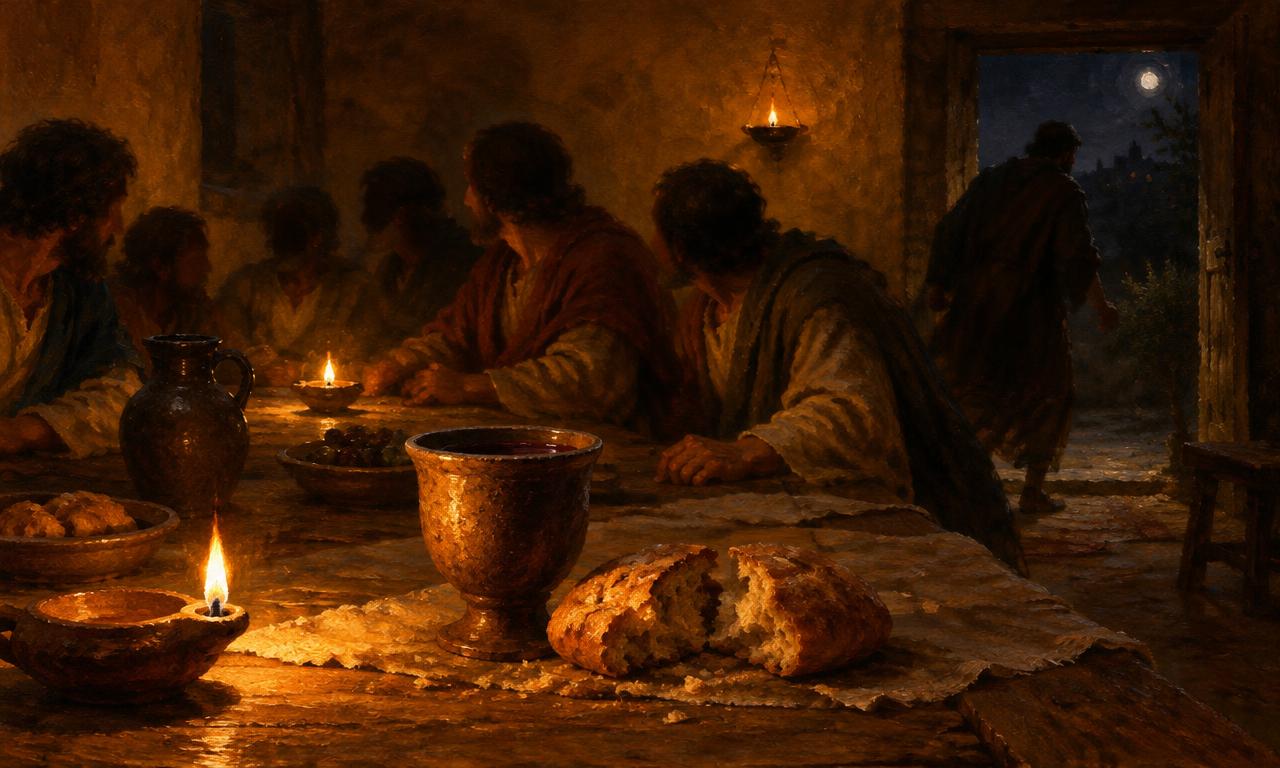
History remembers Judas Iscariot with uniform disdain, yet a surface reading of his fall often misses the intricate tapestry of political tension, spiritual decay, and fulfilled prophecy recorded in the Scriptures. To understand the betrayal in the Upper Room and the Garden of Gethsemane, one must trace the convergence of two distinct realities: the frantic desperation of the religious rulers in Jerusalem and the quiet, progressive hardening of a disciple's heart.
The Dilemma of the Sanhedrin
In the final week leading to the Passover, the chief priests, scribes, and elders faced an existential crisis. The resurrection of Lazarus had galvanized public devotion, and Christ's triumphal entry into Jerusalem—hailed as the Son of David—threatened both Roman tolerance and their own religious supremacy. Furthermore, Christ boldly entered the temple precincts and overturned the tables of commerce. This market in the Court of the Gentiles operated under the lucrative monopoly of the former high priest Annas. In cleansing the temple, Jesus struck directly at the ruling family's authority and revenue.
The authorities resolved that Jesus must die. Yet they were paralyzed by fear. The pilgrim-swelled city regarded Jesus as a prophet, and an open arrest risked an immediate riot. The question confronting the council was not one of identity—every priest recognized Jesus—but of opportunity. They needed someone who possessed intimate access to His movements, an insider who could notify them of a secluded moment away from the crowd. Into this vacuum stepped Judas.
The Catalyst of Indignation
The betrayal did not begin in the Upper Room. Days earlier in Bethany, Mary broke an alabaster flask of costly spikenard to anoint Jesus. The Gospel of John reveals that while several disciples grumbled at the apparent waste, Judas led the complaint, arguing that the ointment could have been sold for three hundred denarii and given to the poor. His piety was counterfeit; John unmasks him as a thief who regularly pilfered from the common treasury.
When Christ openly rebuked the criticism and commended Mary's devotion, Judas experienced humiliation and financial grievance. In his reckoning, Mary had wasted an exorbitant sum, and Jesus had endorsed the loss. Paul warns in Ephesians not to let the sun go down upon wrath, nor give place to the devil. Through lingering resentment and greed, Judas swung the door open to demonic influence. Immediately following the Bethany incident, Judas sought out the chief priests, asking what they would give him to deliver Jesus into their hands.
The Valuation of a Dead Slave
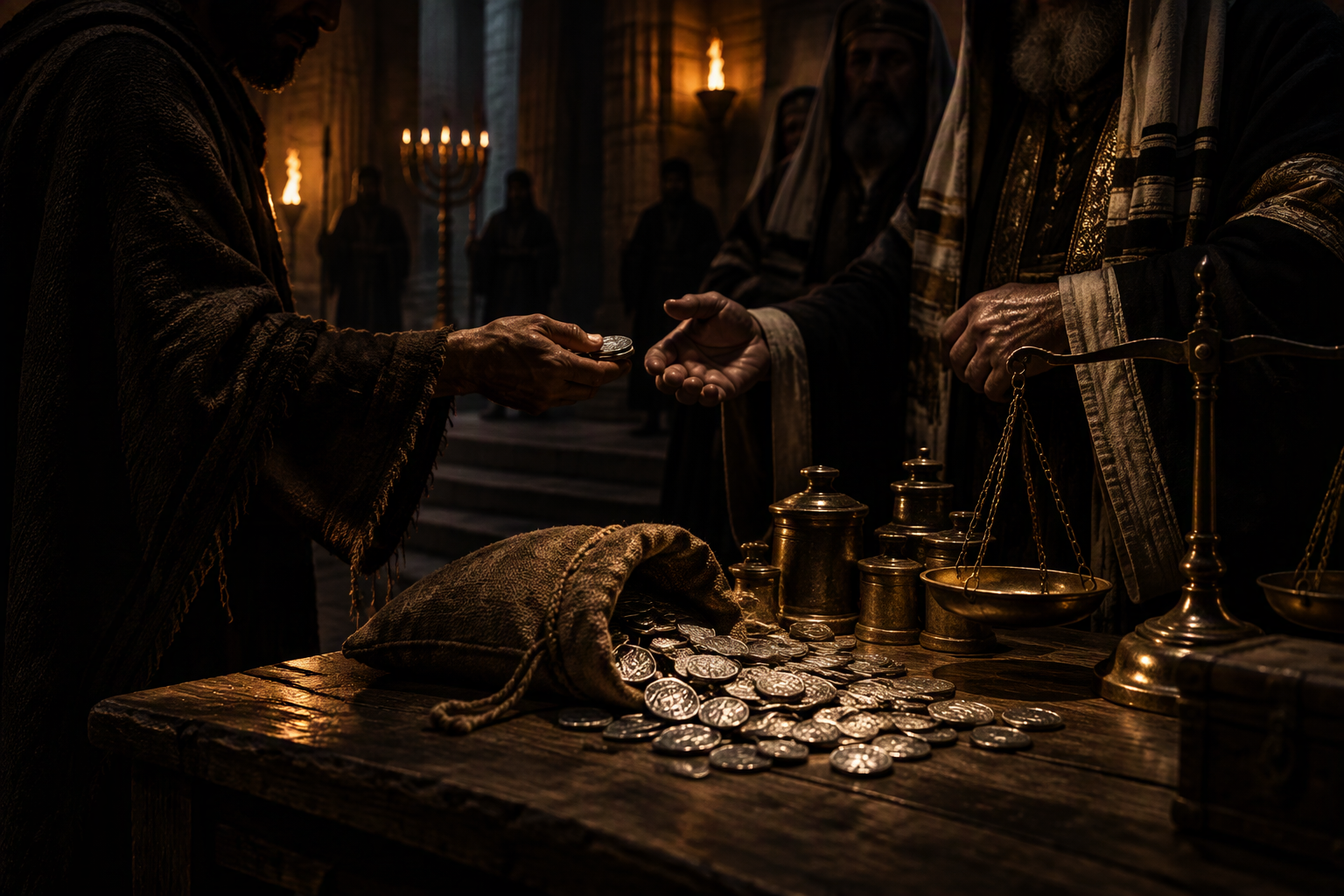
The Sanhedrin weighed out thirty pieces of silver. This specific sum carried profound biblical resonance. Under Mosaic law in Exodus 21, thirty shekels of silver was the mandated restitution paid to an owner if an ox gored a slave to death. It was not merely the price of a living servant, but the legal compensation for a dead, damaged slave. In accepting thirty pieces of silver, Judas consented to a transaction that assigned the Son of God the lowest possible commercial valuation under the Law.
Decoding the Prophecy: Jeremiah or Zechariah?
When Matthew records the tragic culmination of this transaction—the silver cast into the temple and used to purchase the potter’s field—he attributes the event to Jeremiah the prophet. Skeptics often point to this as an error, noting that the thirty pieces of silver cast into the house of the Lord are mentioned in Zechariah 11, whereas Jeremiah 32 records the purchase of a field for seventeen shekels.
A rigorous reading of the Hebrew Scriptures and first-century literary convention resolves this tension. Biblical authors frequently combined related prophetic motifs into a single composite citation, identifying the composite by the name of the more prominent or major prophet. Zechariah provides the prophetic detail of the shepherd valued at thirty pieces of silver thrown to the potter in the temple. However, Jeremiah 18 and 19 establish the theological framework: the prophet visits the potter’s house, buys a potter’s earthen flask, and brings judgment upon the Valley of Hinnom because innocent blood was shed there, transforming it into a burial ground for strangers. Matthew’s quotation centers primarily on the divine purpose of the potter's field as a cemetery for foreigners, making Jeremiah the thematic fountainhead of the prophecy. Far from an error, the citation demonstrates Matthew’s profound synthesis of the prophetic corpus.
The Chronology of the Upper Room
A persistent question concerns the Last Supper: did Judas actually partake of the Lord’s Supper, the sacred elements representing Christ’s body and blood? A casual reading of Luke 22 might suggest he did, because Luke places Jesus’ statement—that the hand of the betrayer is on the table—after the distribution of the bread and the cup.
However, Matthew, Mark, and John present a different chronological picture. Matthew and Mark state explicitly that while they were eating the meal, Jesus announced the presence of the betrayer and pointed to the one dipping his hand with Him in the dish, prior to instituting the bread and wine as His body and blood. John, writing as an eyewitness seated adjacent to Christ, provides the precise sequence: Jesus identified the betrayer privately to John by dipping a morsel and handing it to Judas. Upon receiving the morsel, Satan entered Judas, and Jesus said, What you do, do quickly. Judas departed into the night immediately.
Why does Luke present the announcement after the memorial elements? Luke frequently employs a thematic or topical structure rather than strict chronological sequencing. For instance, in Luke 3, he records John the Baptist being shut up in prison before narrating the baptism of Jesus. Similarly, in his Upper Room account, Luke mentions an initial Passover cup, then the bread, and then the post-supper cup, grouping the covenant meal as a single theological unit before turning his attention to the conversations regarding betrayal and leadership. The harmony of the Gospels demonstrates that Judas departed after receiving the dipped morsel during the Passover meal, prior to the institution of the New Covenant memorial.
The Dipped Morsel and the New Covenant
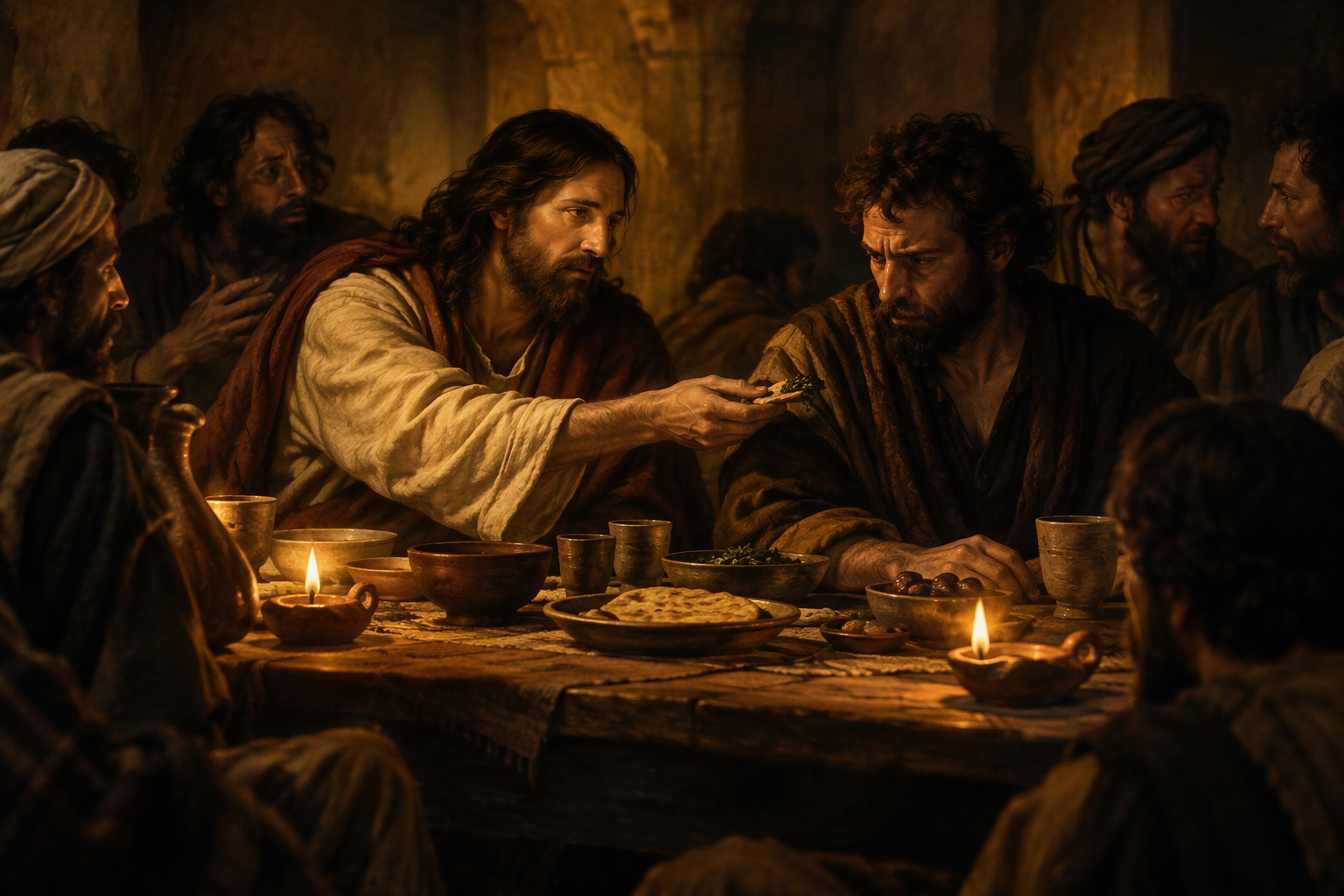
In the ancient Passover tradition, the host would dip a piece of unleavened bread with bitter herbs into a sauce and present it to an honored guest. By handing this morsel to Judas, Christ extended a final, profound gesture of love, honor, and appeal. Even with the knowledge of treason, Jesus did not humiliate Judas publicly before the eleven; He offered him the seat of honor. Yet Judas took the morsel without taking the grace.
Once Judas stepped into the dark, the ungodly was separated from the assembly of the righteous, fulfilling Psalm 1:5. Only after the traitor departed did the Lord inaugurate the New Covenant with the faithful eleven, breaking the bread and sharing the cup that signified His sacrificial atonement. Psalm 25:14 declares that the secret of the Lord is with those who fear Him, and He will show them His covenant. Judas maintained physical proximity to Jesus for years, heard His teachings, and witnessed His miracles. Yet because he lacked reverent fear, the reality of the New Covenant remained hidden from him to his destruction.
The tragedy of Judas serves as an enduring mirror. Proximity to sacred things cannot substitute for inward surrender. When indignation, financial deceit, and unrepented sin are harbored within, even the highest spiritual privileges cannot prevent a tragic departure into the night.