 Cedar Biblical
Hebrew Scripture Studies · 18 min read
The Road to Joshua's Field: The Ark, the House of the Sun, and the Great Stone
A three-part study of 1 Samuel 4–6: the glory departing at Ichabod, the cows on the highway to Beth-shemesh, and the cart halting by the great stone in the field of Joshua.
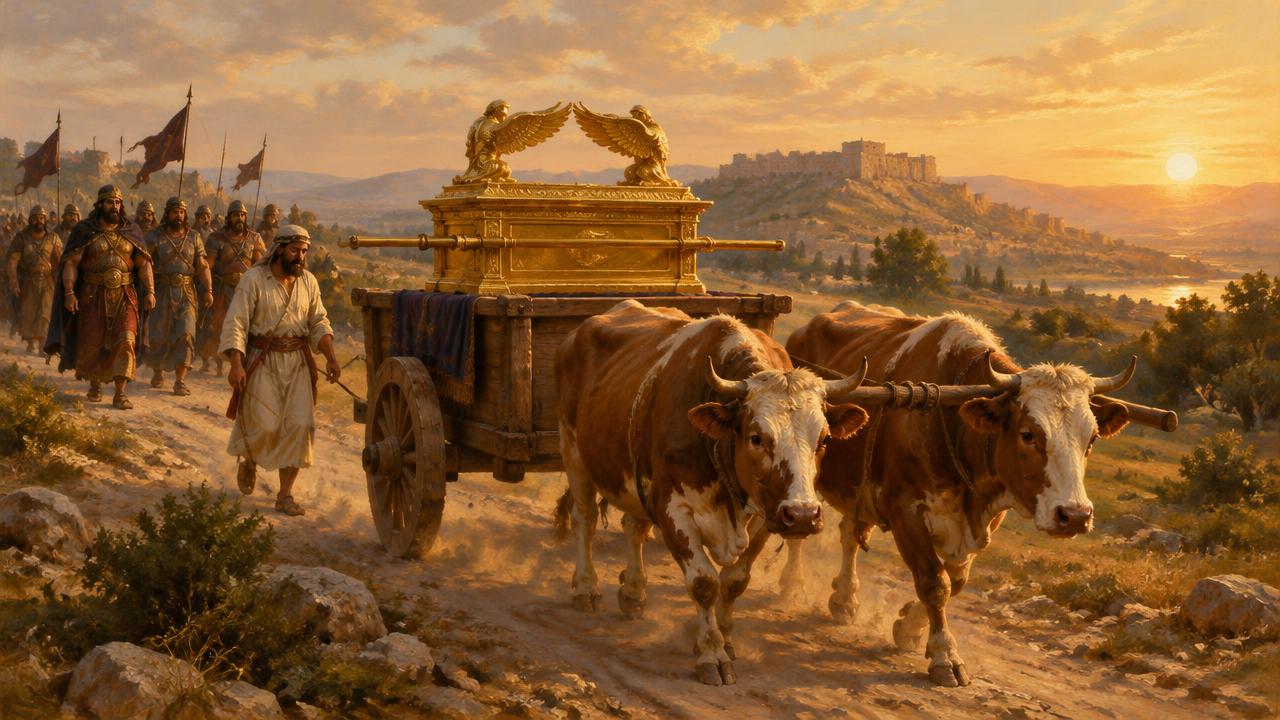
The cows took the straight way to Beth-shemesh, lowing as they went, and turned not aside (1 Samuel 6:12).
When the Ark of the Covenant left the land of the Philistines in 1 Samuel 6, two milk cows pulled it along the road to Beth-shemesh, and the cart stopped in the field of a man named Joshua. Many readers pass over this detail. This study reads the whole account in three movements: the glory departing, the highway to the House of the Sun, and the great stone in Joshua's field. Where the passage seems to contradict itself, we stop and look closely at what the text actually says.
Part I: The Ark Taken and the Glory Departed
The Catastrophe of Shiloh and the Departure of the Glory
The historical narrative of First Samuel opens under the long shadow of priestly compromise and spiritual decay. In the fourth chapter, Israel entered into battle against the Philistines at Ebenezer, treating the Ark of the Covenant not as the earthly throne of the Holy One of Israel, but as a mechanistic talisman of victory. The outcome was devastating: thirty thousand footmen of Israel fell, Hophni and Phinehas were slain, and the sacred chest—the earthly dwelling place of the divine Name—was captured by uncircumcised hands (1 Sam. 4:10–11). When news reached Shiloh, the aged high priest Eli fell backward from his seat and died of a broken neck. Yet the deepest theological wound of that dark day was voiced not by an elder or an army captain, but by the dying wife of Phinehas as she went into labor.
Naming her newborn son Ichabod ('I-kabod), she pronounced with her dying breath: "The glory is departed from Israel: for the ark of God is taken" (1 Sam. 4:22). In the Hebrew idiom, kabod signifies weight, heaviness, and majestic splendor; the negation prefixed to it laments the utter evacuation of the divine weight from the national life. For generations, Shiloh had stood as the sanctuary of the congregation, the place where God had set His name at the first (Jer. 7:12). The sudden departure of the Ark was not merely a military loss or a national humiliation; it was the formal cessation of the covenantal Shekinah from an apostate religious order. According to the sacred record, the Ark of the Lord remained in the country of the Philistines for seven months (1 Sam. 6:1). In typological reflections, this period of exile among the Gentiles has often been read as an emblem of the divine presence visiting the nations outside the formal boundaries of Israel, underscoring that the sovereign glory of God cannot be chained to a corrupt priesthood or confined within an empty religious system.
The Miracle of the Lowing Kine: Sovereign Direction Without a Driver
When the Philistines could no longer bear the plagues of judgment brought upon them by the Ark’s unbending holiness—their god Dagon shattered in his own temple and their cities struck with emerods—their diviners devised an empirical test to determine whether their affliction was truly the hand of Israel's God or mere chance (1 Sam. 6:2–9). They commanded that a new cart be constructed and that two milch kine ('alot), beasts that had never borne a yoke and whose tender calves were shut up at home, be harnessed to the cart. By all laws of animal psychology and natural instinct, these fresh mothers would refuse an untried yoke, violently turn back toward their crying calves, and scatter the cart in frantic distress.
Yet the text records a sovereign suspension of natural law: "And the kine took the straight way to the way of Beth-shemesh, and went along the highway, lowing as they went, and turned not aside to the right hand or to the left" (1 Sam. 6:12). Though no human hand held the reins, and though the Philistine lords followed merely as passive spectators, an invisible hand guided their course. Their persistent lowing attested to the genuine pull of their natural maternal affections, yet they walked in unrelenting obedience to a higher impulse, treading the direct path toward Beth-shemesh ("the House of the Sun").
This striking scene provides rich material for theological meditation. Certain interpretive traditions have seen in these two yoked kine a figure of consecrated believers—specifically the bridal company across the dispensation of the church—who are called to carry the precious burden of the divine presence in the closing hours of history. Under this reading, the absence of a visible human driver points to the direct governance of the Spirit of God, operating through the prophetic voice and the living Word rather than human ecclesiastical manipulation. Just as the Apostle John heard the announcement that "in the days of the voice of the seventh angel... the mystery of God should be finished" (Rev. 10:7), this interpretive perspective suggests that the true people of God are directed not by mortal personalities who have passed off the stage, but by the living, unadulterated message of the covenant. The kine moved steadfastly along the king's highway, neither veering into legalism on the right nor license on the left, bearing the weight of the Shekinah toward its appointed destination.
The Field of Joshua and the Altar of Total Consecration
The destination toward which Providence directed the kine was not arbitrary. The sacred cart crossed the border and came into the valley of Beth-shemesh, where the men of the village "were reaping their wheat harvest in the valley: and they lifted up their eyes, and saw the ark, and rejoiced to see it" (1 Sam. 6:13). The arrival of the glory coincided precisely with the season of the wheat harvest (qatsir chittim), an evocative biblical motif frequently associated with the end-time ingathering and the culmination of God's redemptive dealings with humanity.
The scripture notes with geographical and spiritual specificity that "the cart came into the field of Joshua, a Beth-shemite, and stood there, where there was a great stone" (1 Sam. 6:14). Typologically, the name Joshua (Yehoshua, signifying "Yahweh is salvation") shares its etymological root and identity with Jesus. The Ark did not wander into a wasteland, nor did it rest in the fields of the contentious; it halted precisely within the property of Yehoshua. Furthermore, it rested beside an 'eben gedolah—a "great stone." Students of biblical typology frequently identify this prominent stone with the foundational Christological symbols of scripture: the Rock of Ages, the Stone of Stumbling to the disobedient, and the Capstone or Headstone brought forth with shoutings of "Grace, grace unto it" (Zech. 4:7). The message of the covenant brings the traveler directly to the presence of the true Joshua and grounds the soul upon the immoveable foundation of the Cornerstone.
Yet the arrival at this place of revelation demanded an immediate and costly response. The men of Beth-shemesh split the wood of the new cart, slew the two faithful kine, and "offered the kine a burnt offering unto the Lord" (1 Sam. 6:14). Herein lies a profound devotional lesson: the vessels that carry the glory cannot preserve their own lives for future domestic utility. The beasts that had overcome their natural instincts to transport the covenant of God were now laid upon the altar as an 'olah—a whole burnt offering ascending in sweet-smelling smoke before Yahweh. To be identified with the bearing of the Ark is to surrender all self-preservation. It is an Old Testament portrait of the Pauline injunction: "I beseech you therefore, brethren, by the mercies of God, that ye present your bodies a living sacrifice, holy, acceptable unto God, which is your reasonable service" (Rom. 12:1). True fellowship with the Headstone in the field of Joshua cannot be sustained on sentimentality; it requires the altar of complete surrender.
Presumption at the Great Stone: Resolving the Crisis of Beth-shemesh
The initial joy of the harvest at Beth-shemesh was abruptly interrupted by a terrifying display of divine justice. First Samuel 6:19 records that the Lord "smote the men of Beth-shemesh, because they had looked into the ark of the Lord, even he smote of the people fifty thousand and threescore and ten men." The sheer magnitude of this judgment presents a profound interpretive difficulty to the modern reader: why would God strike down the very people who had welcomed the Ark with sacrificial joy during their harvest?
Careful contextual and canonical study resolves this apparent tension. First, the Law of Moses strictly forbade anyone—even the Levites of Kohath who carried the sacred furniture—from gazing upon the holy vessels uncovered, under penalty of death: "they shall not go in to see when the holy things are covered, lest they die" (Num. 4:20). The Ark of the Covenant was the throne of the unapproachable holiness of God; it was shielded even from the High Priest by a cloud of incense on the Day of Atonement. The inhabitants of Beth-shemesh, treating the sacred chest with profane curiosity, stripped it of its divine terror and treated it as a marvel or a domestic trophy. In doing so, they committed the same foundational sin as Eli's sons: the desacralization of the holy.
Regarding the staggering casualty count, text-critical scholarship and ancient Jewish witnesses have observed that the unusual phrasing in the Masoretic text (shib'im 'ish chamishim 'elef 'ish) likely reflects a scribal conflation, with several early manuscripts, including the Septuagint and the writings of Josephus (Antiquities 6.1.4), recording the number as seventy men rather than fifty thousand and seventy. Regardless of the numerical variant, the spiritual principle stands immutable. The grief-stricken inhabitants cried out: "Who is able to stand before this holy Lord God? and to whom shall he go up from us?" (1 Sam. 6:20).
The tragedy at Beth-shemesh confirms that mere proximity to the covenant or verbal rejoicing in its presence does not exempt one from the demands of God's holiness. The Ark cannot be inspected by carnal intellect or embraced through profane familiarity. It points forward to the absolute necessity of the mediator. The field of Joshua, with its altar and its great stone, foreshadowed that fallen man can only abide the presence of the consuming fire through atoning blood and absolute, reverent obedience. The glory that departed from Shiloh in judgment cannot be recovered by human casualness; it is known only by those who, like the unguided kine, yield their natural wills entirely to the pathway of the cross.
Part II: The Highway to Beth-shemesh and the Strong Tower
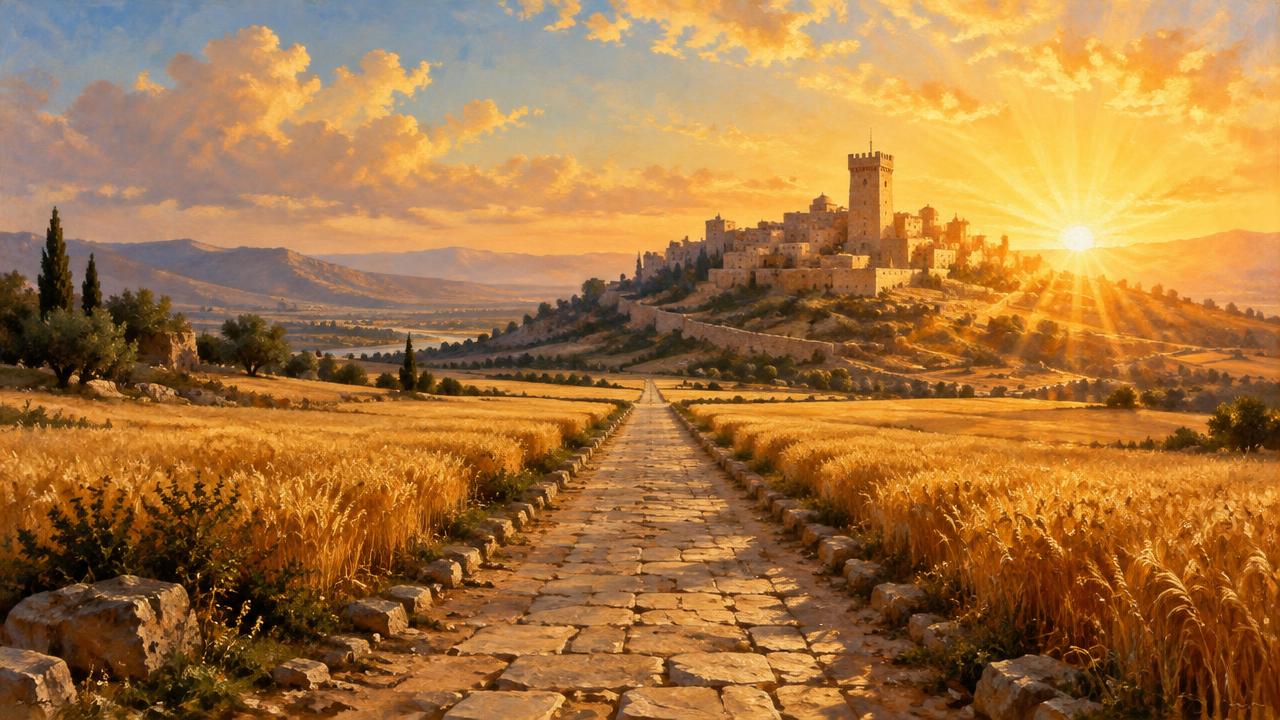
The Highway to Beth-shemesh and the House of the Sun
In the historical narrative of First Samuel, the return of the Ark of the Covenant from the land of the Philistines constitutes one of the most striking demonstrations of divine providence in the Old Testament. Having wrought devastation upon the shrines of Dagon and plagued the cities of Ashdod, Gath, and Ekron, the captured Ark was placed upon a newly hewn cart drawn by two milch kine that had never known a yoke (1 Sam. 6:7–10). Left entirely without human steerage, the kine took the straight way along the highway toward Beth-shemesh, lowing as they went, turning neither to the right hand nor to the left, while the lords of the Philistines followed behind them unto the border (1 Sam. 6:12).
The destination itself is rich in spiritual significance. Beth-shemesh (Bêṯ-Šemeš), literally rendered the "House of the Sun," was an ancient Levitical city set within the tribal allotment of Judah and Dan (Josh. 21:16). When the cart came to a halt, it rested specifically in the field of Joshua, a Beth-shemite, beside a great stone where sacrifices of thanksgiving and burnt offerings were immediately offered unto the Lord. Typologically, this arrival at the "House of the Sun" directs the discerning reader forward toward the prophetic promise of Malachi 4:2, where the Lord proclaims that unto those who fear His name, the "Sun of righteousness" shall arise with healing in His wings. The Ark—the localized throne of the divine presence—did not lodge in the dark temples of the Philistines, nor did it tarry in the wilderness; it traveled by an unswerving path to the threshold of the Sun, pausing within the field bearing the name of Joshua (Yehoshua), the prophetic Hebrew prototype of Jesus.
Yet, this solemn arrival at Beth-shemesh raises an immediate and formidable tension within the biblical text. While the inhabitants rejoiced to see the Ark returning amidst their wheat harvest, the narrative abruptly shifts into severe judgment: the Lord smote the men of Beth-shemesh because they looked into the Ark of the Lord, striking down a great multitude (1 Sam. 6:19). This apparent paradox—that a city named the House of the Sun, receiving the very symbol of divine mercy, should become a place of slaughter—demands careful theological resolution. The text demonstrates that geographic proximity to the sacred, or even an inheritance within a priestly city, is insufficient to shield man from the consuming fire of God's holiness. The Ark was covered with the mercy seat (kappōreṯ), sprinkled with blood; to strip away that covering out of vain curiosity was to approach the unmediated Law without an ordained mediator, exposing human unrighteousness to absolute holiness. The highway to Beth-shemesh, therefore, leads not to casual religious spectacle, but to a sphere of holy awe where only imputed and imparted righteousness can endure the brilliance of the divine presence.
The Progressive Revelation of the Name: From El Shaddai to the Rampart of Refuge
To understand how man may safely abide in the presence of this consuming glory, the Scriptures set forth the progressive disclosure of the divine character through His holy names. When the Lord first called Abram out of Ur of the Chaldees, He demanded a total separation: "Get thee out of thy country, and from thy kindred, and from thy father’s house, unto a land that I will shew thee" (Gen. 12:1). For twenty-four years, Abraham walked in the path of separation, yielding his earthly allegiances and learning obedience through faith.
It was not until Abraham reached the age of ninety-nine years—shortly before the miraculous conception of Isaac—that the Lord appeared to him with a profound self-disclosure: "I am the Almighty God; walk before me, and be thou perfect" (Gen. 17:1). In the original text, the title revealed is El Shaddai. The root Shaddai has long been studied by Hebrew grammarians and devotional commentators alike; while frequently translated as "Almighty" to emphasize transcendent omnipotence, ancient etymological traditions also connect it with sufficiency, nourishment, and sustaining life, picturing God as the all-sufficient sustainer who pours His strength into human frailty.
This progressive unveiling did not cease with the patriarchs. Centuries later, God declared unto Moses: "I appeared unto Abraham, unto Isaac, and unto Jacob, by the name of God Almighty, but by my name JEHOVAH was I not known to them" (Ex. 6:3). The covenant name YHWH (Yod-He-Vav-He) did not negate El Shaddai; rather, it built upon it, unveiling the unchangeable, self-existent Redeemer who enters history to deliver His covenant people. Israel never abandoned the memory of El Shaddai. In the Aaronic benediction recorded in Numbers 6:23–26, when the priests lifted their hands to place the divine name upon the children of Israel, ancient rabbinic practice formed a deliberate space between the fingers resembling the Hebrew letter Shin (ש). This letter, serving as the sacred signifier of Shaddai, visually sealed the congregation under the wings of the Almighty.
As redemptive history advanced, the revelation of the Tetragrammaton expanded into the compound covenant titles—Jehovah-Jireh, Jehovah-Rapha, Jehovah-Nissi, Jehovah-Shalom, Jehovah-Raah, Jehovah-Tsidkenu, and Jehovah-Shammah. It is precisely to this composite revelation of God's redemptive faithfulness that the sage Solomon refers in the book of Proverbs: "The name of the LORD is a strong tower: the righteous runneth into it, and is safe" (Prov. 18:10). The divine name is not a mere vocal utterance or an amulet; it is an architectural fortress of covenant mercies. Within its ramparts, every facet of human spiritual poverty is met by the fullness of the divine attributes.
The Portal of Righteousness: Entering Through the Daleth of Tsidkenu
A crucial question arises from the proverb: how does a fallen creature cross the threshold into this strong tower? Solomon specifies that "the righteous runneth into it, and is safe." Access is restricted by the absolute holiness of the fortress itself.
In devotional and typological studies of the Hebrew language, many interpreters have noted the structural beauty of Psalm 119, where each eight-verse stanza is governed by a successive letter of the twenty-two letters of the Hebrew alphabet, beginning with Aleph (א) and concluding with Tav (ת). Just as Christ declares Himself to be the "Alpha and the Omega, the beginning and the ending" (Rev. 1:8), so in the Hebraic mindset, the entire scriptural revelation from Aleph to Tav bears witness to the Person and work of the Messiah.
Within this framework, a compelling interpretive reading emerges when examining the compound names of YHWH to discern the portal of entry into the strong tower. Among the redemptive titles, the prophet Jeremiah points directly to the messianic King: "And this is his name whereby he shall be called, THE LORD OUR RIGHTEOUSNESS" (Jehovah-Tsidkenu, Jer. 23:6). This reading suggests that within the very calligraphy and construction of Tsidkenu lies the spiritual architecture of the door. The term stems from the root Tsedek (צדק), beginning with the letter Tsade (צ). In scribal tradition, Tsade represents the tzaddik—the righteous individual depicted in a posture of humility and bent submission. Standing immediately alongside or within the path of righteousness is the letter Daleth (ד), which anciently signified a door or an open portal.
Through this interpretive lens, one cannot enter the strong tower through presumption, self-effort, or ritualistic familiarity. The door (Daleth) opens exclusively to the one who assumes the posture of the Tsade—the penitent soul who bows low, renouncing his own self-derived morality to receive the imputed righteousness of the Messiah. To pass through Jehovah-Tsidkenu is to enter the "House of the Sun," where the believer meets the true Sun of Righteousness face to face without dread of destruction. The Philistines could only follow the Ark unto the border of Beth-shemesh; possessing no covenant standing, they could go no further. The believer, however, clothed in the righteousness of God through faith in Jesus Christ, finds the portal swing open into divine security.
The Mark of the Just: Consecration, Mercy, and Reverent Approach
The resolution of the disaster at Beth-shemesh ultimately speaks to the nature of authentic righteousness. The men of Beth-shemesh were smitten not because God is capricious, but because they treated the vessel of His holiness with profanity, peering beneath the veil with unhallowed familiarity. True entrance into the strong tower produces an inward transformation that mirrors the holiness of the God who shelters it. Righteousness is never a mere verbal assertion; it is validated by a heart renewed in mercy, truth, and reverent fear.
The New Testament provides the supreme exemplar of this character in Joseph of Nazareth. When confronted with the apparent disgrace of Mary’s pregnancy, the Scripture records: "Then Joseph her husband, being a just man, and not willing to make her a publick example, was minded to put her away privily" (Matt. 1:19). It is striking that Joseph’s justice—his righteousness—was manifested not in vindictive exposure or public condemnation, but in protective mercy. A truly righteous person, having entered the gate of Jehovah-Tsidkenu, does not seek to humiliate, expose, or destroy his brother. He guards his speech, shuns malice, and covers the infirmities of others with the mantle of charity, knowing how deeply he himself depends upon the blood-sprinkled mercy seat.
This standard aligns precisely with the solemn vision of judgment set forth by Christ in Matthew 25:34–40, where the righteous are recognized not by high-minded theological declarations, but by the tangible fruits of their faith: feeding the hungry, giving drink to the thirsty, sheltering the stranger, clothing the naked, and visiting the sick and imprisoned. These acts are the outward manifestation of those who have truly entered the door.
The highway to Beth-shemesh remains open for the church today. The cart has stopped in the field of our Joshua; the Sun of Righteousness shines upon those who revere His covenant. Let every soul that seeks refuge in the strong tower of the Divine Name cast aside all religious arrogance, bow low before the open door of Jehovah-Tsidkenu, and walk in that genuine holiness which reflects the mercy, humility, and purity of the God who dwells within.
Part III: The Field of Joshua, the Great Stone, and the Offering
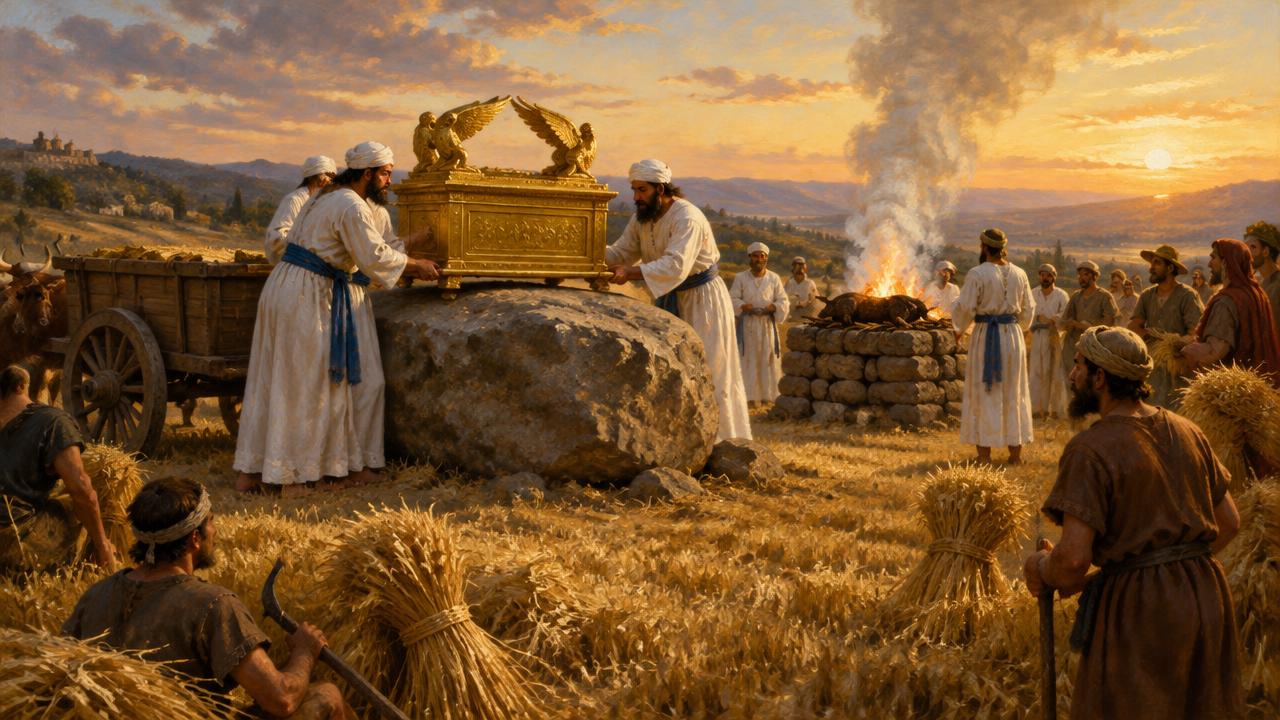
The Cart Halting in the Field of Joshua
The return of the Ark of the Covenant from the land of the Philistines reaches its geographic and spiritual climax in the border town of Beth-shemesh, recorded in 1 Samuel 6:14: "And the cart came into the field of Joshua, a Beth-shemite, and stood there, where there was a great stone: and they clave the wood of the cart, and offered the kine a burnt offering unto the Lord." After months of exile in Ashdod, Gath, and Ekron (1 Samuel 5), and following a miraculous, unguided journey across the border highway, the lowing kine did not wander aimlessly. They were arrested by divine providence in the inheritance of a man named Joshua.
In biblical typography, names and locations carry profound freight. The Hebrew name Joshua (Yehoshua), signifying "Yahweh is salvation," is the exact Old Testament equivalent of the name Jesus. The Ark—the localized throne of God's manifest presence, housing the tablets of the Law, the golden pot of manna, and Aaron’s rod that budded (Hebrews 9:4)—ceased its wandering specifically within the field of Yehoshua. This movement foreshadows the ultimate trajectory of God's redemptive purpose: the glory of God, long alienated from human rest because of covenant failure (1 Samuel 4:21–22), ultimately finds its designated resting place within the domain of the true Joshua, Jesus Christ. The Ark did not halt in the fields of the kings, nor among the encampments of the mighty, but in the field of Joshua, reminding the church that the sacred fellowship of divine presence is realized exclusively within the inheritance of our Savior.
The Mystery of the Great Stone and the Covenant by Sacrifice
Stationed within Joshua’s field was an enduring landmark: "a great stone" (aben gedolah). This monumental rock served as an altar of execution and a witness of covenant transition. In prophetic literature, the rock or stone consistently points to the Messiah Himself. He is the Stone of Israel (Genesis 49:24), the Stone of stumbling and Rock of offence (Isaiah 8:14), the Stone rejected by the builders that became the head of the corner (Psalm 118:22), and the Capstone or Headstone brought forth with shoutings of "Grace, grace unto it" (Zechariah 4:7).
At this great stone, an immediate and total sacrifice took place. The Beth-shemites did not preserve the new cart for their own agricultural utility, nor did they keep the two milch kine for milk or breeding. They cleaved the wooden vehicle to kindle the fire, and they slaughtered the very animals that had faithfully borne the glory of God, offering them as an ascending holocaust (‘olah) unto the Lord. The arrival of divine glory at the stone demanded an absolute surrender of all that had transported it.
This dramatic offering illustrates the theological principle set forth in Psalm 50:5: "Gather my saints together unto me; those that have made a covenant with me by sacrifice." The Hebrew term for a vow or consecration, nadar (נָדַר), evokes the deliberate, solemn yielding of one's possession or person unto God. An interpretive devotional reading of the Hebrew consonantal root—comprising the letters Nun (נ), Dalet (ד), and Resh (ר)—suggests an evocative typological picture: Nun, traditionally associated in pictographic reflections with the sprout or seed; Dalet, the door or pathway; and Resh, the head or chief. Through this lens, the consecrated seed of God (Nun) passes through the door of self-denying sacrifice (Dalet) in order to be united to the supreme Head and Capstone (Resh). While linguistically distinct from the etymology of Nazareth (Netzer, the branch), early devotional traditions often linked the total dedication of the Nazirite vow with Christ the Lord, who entered through the portal of the cross to be exalted as Head over all things to the church (Ephesians 1:22).
To merely hear of the Headstone or celebrate the arrival of the Ark remains an external exercise without the altar. True covenant relationship with Christ the Capstone requires what the Apostle Paul terms a "living sacrifice, holy, acceptable unto God, which is your reasonable service" (Romans 12:1). Just as the kine yielded their maternal instincts, their labor, and finally their very lives upon the splintered wood of their own cart, the believer's union with Christ demands the surrender of personal ambition, time, and comfort upon the altar of daily obedience.
Christ the Bridegroom and the Sacrificial Consecration of the Bride
The sacrifice of the two kine at the foot of the great stone offers an arresting prophetic portrait of Christ the Bridegroom and the bridal company. The kine possessed every natural reason to turn back. They had never borne a yoke; their tender calves were shut up at home; their bodies ached with milk (1 Samuel 6:10–12). Yet, impelled by the sovereign Spirit of God, they walked the straight path to Beth-shemesh, weeping as they went, looking neither to the right hand nor to the left. They bore the presence of God at profound personal cost.
In this self-abandonment, they mirror first the Lord Jesus Christ, the heavenly Bridegroom. He took upon Himself the yoke of redemptive suffering, went straight to Golgotha without deviation, and offered Himself unreservedly upon the wood of the cross outside the gate (Hebrews 13:12). But the picture extends further to the Bride of Christ. The church, called out of the world and joined to her Head, is summoned to mirror this same selfless consecration. The Bride does not view her devotion to Christ as a casual theological allegiance; she is identified with Him in sacrificial death.
In Song of Solomon 2:14, the Bridegroom calls His beloved "in the secret places of the stairs," inviting her into hidden communion and self-denial. The Bridegroom's cross is matched by the Bride's daily taking up of her own cross (Luke 9:23). When believers enter into deliberate vows of prayer, dedicating their early hours and sacrificing their ease to watch with Christ, they cease being mere spectators of the Ark. They become participants in the bridal consecration. The meeting between the cart and the great stone demonstrates that the glory of the Bridegroom cannot be embraced where the cross of self-denial is refused. Communion with the Capstone occurs only where life is poured out in complete surrender.
The Peril of Presumption: Resolving the Judgment at Beth-shemesh
The narrative of 1 Samuel 6 does not conclude with unmingled celebration; it introduces a profound theological tension that demands careful examination. Shortly after the sacrifice on the great stone, the text records a terrifying visitation of divine judgment: "And he smote the men of Beth-shemesh, because they had looked into the ark of the Lord, even he smote of the people fifty thousand and threescore and ten men: and the people lamented, because the Lord had smitten many of the people with a great slaughter" (1 Samuel 6:19).
This abrupt transition from joy to lethal judgment poses a severe difficulty to the modern reader. How could the same divine presence that brought deliverance and consecrated worship suddenly strike down the very Israelites who received it? The resolution lies in the canonical boundaries established in the Mosaic Law concerning the holiness of God. In Numbers 4:15 and 4:20, God explicitly commanded that even the Levites of Kohath "shall not go in to see when the holy things are covered, lest they die." The Ark of the Testimony was not a curious religious artifact or a monument for casual inspection; it was the footstool of the unapproachable holiness of Yahweh, veiled behind the curtain of the sanctuary and approached only once a year with sacrificial blood (Leviticus 16:2).
The men of Beth-shemesh committed the fatal sin of presumption. Intoxicated by familiarity and curious irreverence, they treated the sovereign glory of God as an object of visual entertainment. Furthermore, scholars note that textual and historical variants suggest the phrase "fifty thousand and threescore and ten men" likely reflects an ancient scribal idiom or an enumeration meaning "seventy men, fifty out of a thousand," indicating a precise judgment upon the leaders who breached the holy boundary. Regardless of the numerical calculation, the spiritual lesson remains unyielding: God's mercy does not nullify His majestic holiness.
The "great stone of Abel" remained in the field of Joshua as a witness (1 Samuel 6:18). To those who approached with humble obedience, cleaving the cart and offering the sacrifice, the stone was a place of acceptable worship. To those who approached with profane curiosity and unhallowed gaze, the proximity of God became consuming fire. Herein lies the duality of Christ, the true Headstone: He is the precious Cornerstone of salvation to them that believe, but unto the disobedient, He is "a stone of stumbling, and a rock of offence" (1 Peter 2:7–8). True bridal devotion draws near to the Capstone in the field of Joshua, not with light-minded presumption, but with the awe of a heart that has laid its all upon the altar.