 Cedar Biblical
Hebrew Scripture Studies · 8 min read
The Mystery of Shin: The Consuming Fire, the Almighty, and the Prince of Peace
Psalm 119:161-168 and the twenty-first Hebrew letter: the letter on the doorpost, the great peace nothing can offend, and the Sar Shalom.
Introduction
The twenty-first stanza of Psalm 119 — verses 161 through 168 — unfolds beneath the letter Shin (שׁ), the twenty-first letter of the Hebrew alphabet, bearing the numerical value of three hundred. The stanza opens under fire: "Princes have persecuted me without a cause: but my heart standeth in awe of thy word" (Psalm 119:161). It rises to one of the most beloved promises in the entire psalter: "Great peace have they which love thy law: and nothing shall offend them" (Psalm 119:165).
That word "peace" is shalom — and it begins with Shin. So does Shaddai, the Almighty. So does Shechinah, the dwelling presence of God. So does Sar Shalom, the Prince of Peace. The twenty-first letter is the letter of divine power, consuming fire, and perfect peace — the letter that Israel has written on her doorposts for three thousand years.
The Pictograph: Teeth and Tongues of Fire
The ancient pictograph of Shin is two front teeth — the Hebrew word for tooth is shen. Teeth press, crush, and break down; they reduce strong food to nourishment the body can receive. From this picture flow the letter's great themes: pressure, consuming, and transformation. What passes through the teeth is never the same again.
But the shape of Shin — three branches rising from a single base — has also been read since antiquity as tongues of flame leaping upward. Fire, like teeth, consumes and transforms. And when the two pictures are held together, the letter declares a profound truth: the fire of God does not merely destroy; it refines, purifies, and makes fit for His presence. "For our God is a consuming fire" (Hebrews 12:29) — yet the bush that burned with fire "was not consumed" (Exodus 3:2).
The three branches of Shin, united at one base, have long been cherished as a picture of unity in plurality. Jewish tradition sees in them the three patriarchs — Abraham, Isaac, and Jacob — bound together in one covenant. Christian readers have also seen in the three flames rising from a single root a whisper of the triune God: three Persons, one essence, one fire.
Shin on the Doorposts: The Letter of Shaddai
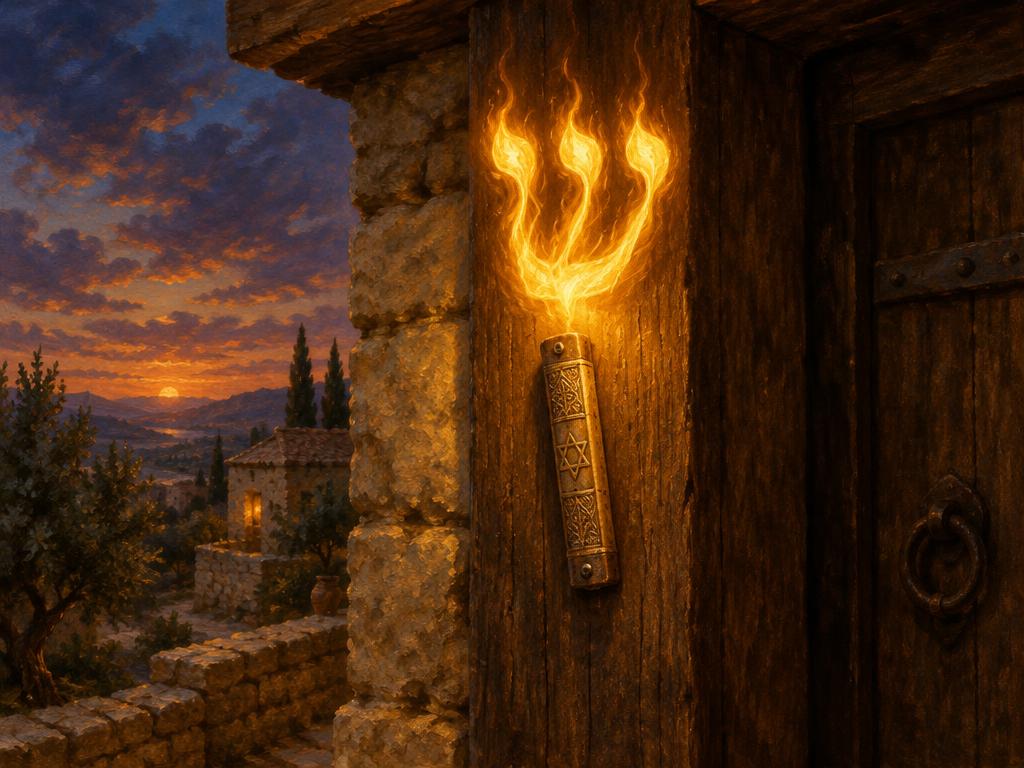
Every observant Jewish home carries Shin at its entrance. The mezuzah — the small case fixed to the doorpost containing the words of Deuteronomy 6 — is marked with the letter שׁ, standing for Shaddai, the Almighty. The tefillin worn in prayer are likewise stamped with Shin. The letter of the Almighty guards the threshold of the house and rests upon the forehead and hand of the worshipper.
The name El Shaddai is the name by which God first revealed Himself to the patriarchs: "I am the Almighty God (El Shaddai); walk before me, and be thou perfect" (Genesis 17:1). It is the name of all-sufficiency — the God who is enough. When Abraham had nothing but a promise, Shaddai was enough. When Jacob sent his sons into Egypt not knowing whether he would see Joseph again, he sent them with the blessing: "And God Almighty (El Shaddai) give you mercy before the man" (Genesis 43:14).
The letter on the doorpost thus preaches a daily sermon: the house that shelters under Shaddai needs no other defender. "He that dwelleth in the secret place of the most High shall abide under the shadow of the Almighty (Shaddai)" (Psalm 91:1).
The Stanza: Persecuted by Princes, Standing in Awe
The Shin stanza is the prayer of a man persecuted by the powerful. "Princes have persecuted me without a cause" (v. 161). The opposition comes from the top — from those with position, influence, and the machinery of power. Yet the psalmist's response is remarkable: "my heart standeth in awe of thy word." He does not say his heart stands in awe of the princes. The fear of man has been displaced by a greater awe.
This is the secret of the stanza's peace. When the heart is occupied with the greatness of God's word, the threats of men shrink to their true size. "The LORD is on my side; I will not fear: what can man do unto me?" (Psalm 118:6). Isaiah heard the same counsel: "Sanctify the LORD of hosts himself; and let him be your fear, and let him be your dread" (Isaiah 8:13).
From that awe flows joy: "I rejoice at thy word, as one that findeth great spoil" (v. 162). The word of God is not merely endured; it is celebrated like treasure seized after battle. And from joy flows praise: "Seven times a day do I praise thee because of thy righteous judgments" (v. 164). Seven — the number of completeness. Praise has become the full-time occupation of a heart at peace.
Great Peace: The Shalom That Nothing Offends
The crown of the stanza is verse 165: "Great peace have they which love thy law: and nothing shall offend them." In Hebrew, the phrase is shalom rav — abundant, manifold, great peace. And the promise is startling: "nothing shall offend them" — literally, they have no stumbling block. The Hebrew word is mikshol, a stone in the path that trips the walker.
Notice what the verse does not promise. It does not promise that those who love God's law will have no persecuting princes, no false accusers, no affliction. The stanza itself is full of all three. It promises that none of these will become a stumbling block to them. The very stones that trip others become stepping stones for those who love the law. "And he shall be for a sanctuary; but for a stone of stumbling and for a rock of offence to both the houses of Israel" (Isaiah 8:14) — the same stone, two destinies, and the difference is love.
This is the peace that passes understanding (Philippians 4:7) — not the absence of conflict but the presence of a heart so anchored in the word of God that offense cannot find a foothold. Jesus pronounced the beatitude of this verse over His own ministry: "And blessed is he, whosoever shall not be offended in me" (Matthew 11:6).
Shin and the Number Three Hundred: The Deliverers
In Hebrew numerals, Shin carries the value three hundred — and the number three hundred runs through Scripture's great deliverances like a golden thread. When God saved Noah and his house from the flood, the ark that bore them was three hundred cubits long (Genesis 6:15). When Gideon faced the Midianite host, God reduced his army until only three hundred men remained — and with those three hundred, armed with trumpets and torches hidden in pitchers, the Lord routed a multitude (Judges 7:7). When Moses descended Sinai after the golden calf, about three thousand fell — yet the consecrated Levites who stood on the Lord's side became the tribe of the priesthood.
The pattern is consistent: when Shaddai fights, numbers do not matter. The Almighty does not need the many; He needs the yielded. The letter of three hundred teaches that divine power is made perfect not in human strength but in surrendered weakness — "Not by might, nor by power, but by my spirit, saith the LORD of hosts" (Zechariah 4:6).
Christ, the Sar Shalom — the Prince of Peace
Every strand of Shin gathers into the Messiah. Isaiah saw Him seven centuries before Bethlehem: "For unto us a child is born, unto us a son is given: and the government shall be upon his shoulder: and his name shall be called Wonderful, Counsellor, The mighty God, The everlasting Father, The Prince of Peace — Sar Shalom" (Isaiah 9:6). The letter of peace and the letter of power meet in one Name.
He is the fulfillment of the mezuzah's sermon. On the night of the first Passover, Israel marked her doorposts with the blood of the lamb, and the destroyer passed over (Exodus 12:13). Centuries later, the true Lamb stood before Pilate, and His blood marked a greater doorpost — the cross — so that all who shelter beneath it are passed over by judgment forever. "Christ our passover is sacrificed for us" (1 Corinthians 5:7).
He is the one who baptizes "with the Holy Ghost, and with fire" (Matthew 3:11). At Pentecost, the ancient pictograph of Shin came alive: "And there appeared unto them cloven tongues like as of fire, and it sat upon each of them" (Acts 2:3). The letter of tongues of flame descended upon the upper room, and three thousand were added to the church in a single day.
And He is the one who crushed the serpent. At Calvary the teeth of the enemy closed upon the heel of the Seed — but in that very crushing, the serpent's head was broken (Genesis 3:15). What was meant to consume Him became the means of our redemption. The fire fell upon the sacrifice, and the sacrifice rose from the ashes on the third day.
Conclusion: Keeping the Precepts
The stanza ends where all true peace ends — in obedience: "I have kept thy precepts and thy testimonies: for all my ways are before thee" (Psalm 119:168). The peace of Shin is not a passive tranquility; it is the active, watchful life of a man who knows that all his ways are open before the eyes of the Almighty — and who finds in that very thought not terror but comfort.
The letter on the doorpost, the fire on the altar, the teeth that break the bread, the peace that nothing offends — all of it points to Christ. He is Shaddai in flesh, the all-sufficient One. He is the Sar Shalom, whose peace He left with us: "Peace I leave with you, my peace I give unto you: not as the world giveth, give I unto you. Let not your heart be troubled, neither let it be afraid" (John 14:27).
Great peace have they which love thy law — and the law's fulfillment is a Person. To love Him is to enter the shalom of Shin, and to find that nothing — no prince, no persecution, no stone in the path — can separate us from the love of God which is in Christ Jesus our Lord.