 Cedar Biblical
Hebrew Scripture Studies · 8 min read
The Mystery of Samekh: Leaning on the Unbroken Circle of Grace
Psalm 119:113-120 and the fifteenth Hebrew letter: the prop beneath the falling, the hiding place and shield, and the everlasting arms underneath.
Introduction
The fifteenth stanza of Psalm 119 — verses 113 through 120 — stands beneath the letter Samekh (ס), the fifteenth letter of the Hebrew alphabet, carrying the numerical value of sixty. The stanza opens with a declaration of holy separation: "I hate vain thoughts: but thy law do I love" (Psalm 119:113). At its heart beats one of the most tender prayers in the psalter: "Uphold me according unto thy word, that I may live: and let me not be ashamed of my hope. Hold thou me up, and I shall be safe: and I will have respect unto thy statutes continually" (Psalm 119:116–117).
The Hebrew verb behind "uphold me" is samakh — the very name of the letter. Samekh is the letter of support: the prop beneath the falling, the hand under the weary, the circle of protection around the beloved. Of all twenty-two letters, it is the one that most tenderly answers the question every falling soul has asked: when I can no longer hold myself up, who will hold me?
The Pictograph: A Prop, a Shield, a Closed Circle
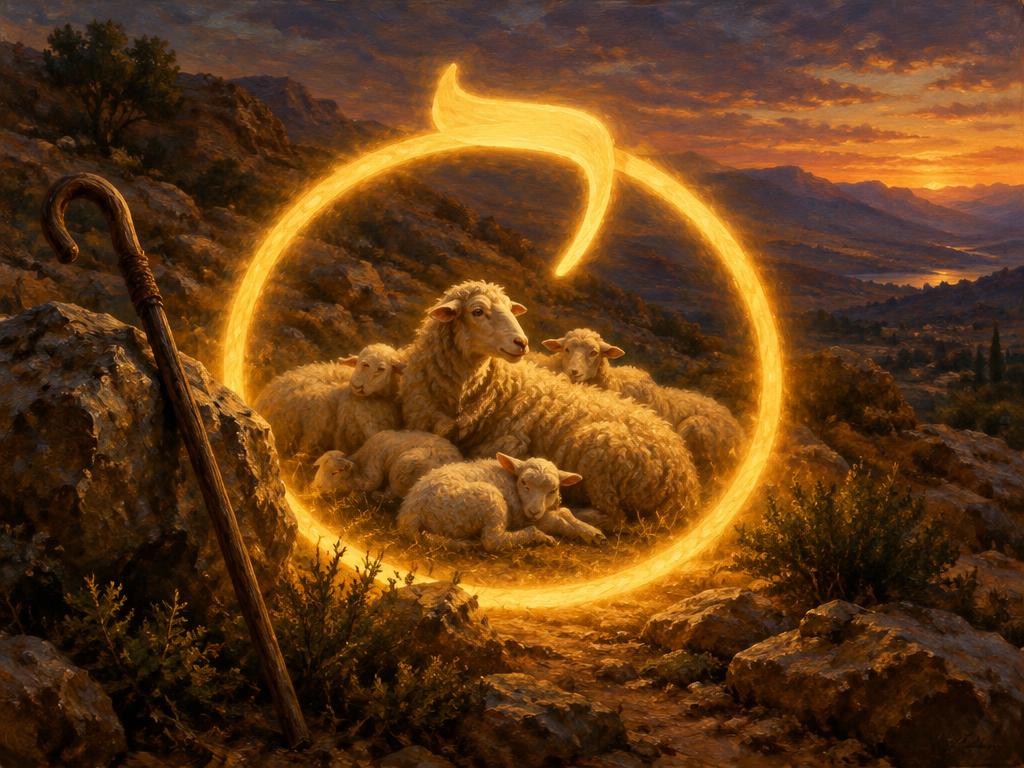
The ancient pictograph of Samekh is a prop or support — a crutch leaned upon, a pillar bearing weight, a thorn-bush shield encircling a flock. In the square script of the scrolls, the letter is drawn as a complete, unbroken circle. Where most Hebrew letters are open forms, Samekh closes upon itself: a ring with no gap, a wall with no breach.
From this shape flows the letter's deepest comfort. The believer is not merely supported from below; he is surrounded on every side. "As the mountains are round about Jerusalem, so the LORD is round about his people from henceforth even for ever" (Psalm 125:2). The angel of the Lord "encampeth round about them that fear him, and delivereth them" (Psalm 34:7). The circle of Samekh is the geometry of divine protection — no angle left exposed, no flank unguarded.
The root samakh runs through the whole vocabulary of leaning. When the priest brought a sacrifice, he laid his hand upon the head of the offering — samakh — leaning the full weight of his sin upon the substitute (Leviticus 1:4). When Moses commissioned Joshua, he laid his hands upon him — samakh — transferring the weight of leadership (Numbers 27:18). To lean, to lay, to uphold, to sustain: all are the work of the fifteenth letter.
Nun Falls, Samekh Upholds: The Alphabet's Sermon
Jewish teachers have long observed a sermon hidden in the order of the alphabet itself. The fourteenth letter, Nun (נ), is the letter of the falling one — from the root naphal, to fall. And immediately after Nun comes Samekh: after the falling one, the upholding One. The alphabet preaches the gospel in sequence: man falls; God upholds.
This is precisely the promise of Psalm 145:14, a verse built on the letter's own root: "The LORD upholdeth (somekh) all that fall, and raiseth up all those that be bowed down." Note the comprehensiveness: all that fall. Not all who stumble slightly, not all who fall gracefully — all who fall. The support of Samekh is not reserved for the strong; it is designed for the collapsing.
The prophet Micah staked his hope on this very truth: "Rejoice not against me, O mine enemy: when I fall, I shall arise; when I sit in darkness, the LORD shall be a light unto me" (Micah 7:8). The righteous man is not the man who never falls — "a just man falleth seven times, and riseth up again" (Proverbs 24:16) — but the man beneath whom the everlasting arms are waiting. "The eternal God is thy refuge, and underneath are the everlasting arms" (Deuteronomy 33:27).
The Stanza: A Hiding Place and a Shield
The Samekh stanza is the prayer of a man who knows where his support lies. "Thou art my hiding place and my shield: I hope in thy word" (Psalm 119:114). Two images stand side by side: the hiding place — the secret shelter where the pursued find refuge — and the shield — the defense carried into the open field. God is both: the fortress we flee to and the armor we fight in.
But the stanza is honest about the cost of this shelter. "Depart from me, ye evildoers: for I will keep the commandments of my God" (v. 115). The circle of Samekh has a door, and the door opens toward holiness. The man who would be upheld must be willing to separate. "I hate vain thoughts: but thy law do I love" (v. 113) — the Hebrew for "vain thoughts" speaks of divided, double-minded thinking, the heart trying to lean on two supports at once. Samekh cannot bear the weight of a divided heart; it is a support for those who lean with their whole weight.
This is why the stanza's central prayer is so urgent: "Uphold me according unto thy word, that I may live" (v. 116). The psalmist does not ask to be upheld according to his own strength, his own merit, or his own resolutions — but "according unto thy word." The support is as reliable as the promise it rests on. And because the word of God cannot fail, the soul that leans upon it cannot finally fall.
"Hold Thou Me Up, and I Shall Be Safe"
Verse 117 carries the prayer one degree further: "Hold thou me up, and I shall be safe: and I will have respect unto thy statutes continually." The first petition asked for life; this one asks for safety — and then makes a vow. The upheld man does not treat his upholding as a license for carelessness. Being held becomes the very ground of his obedience: "I will have respect unto thy statutes continually."
There is a beautiful theology of grace embedded here. The psalmist does not say, "I will keep thy statutes, and then thou shalt hold me up." The order is reversed: hold me up, and then — upheld, secured, safe — I will have respect unto thy statutes. Obedience is the fruit of upholding, not its price. "By the grace of God I am what I am" (1 Corinthians 15:10).
The stanza closes with a trembling note of reverence: "My flesh trembleth for fear of thee; and I am afraid of thy judgments" (v. 120). The God who upholds is not a crutch to be used casually; He is the consuming fire before whom flesh trembles. The same hand that supports the falling also "trieth the righteous" (Psalm 11:5). True security never cancels reverence — it deepens it.
Leaning on the Beloved: The Bride's Picture
The Song of Solomon gives us the letter's most beautiful portrait: "Who is this that cometh up from the wilderness, leaning upon her beloved?" (Song of Solomon 8:5). The bride comes up out of the wilderness — but not marching in her own strength. She is leaning. The whole weight of her weakness rests upon the arm of her beloved.
This is the Christian life in one picture. The wilderness is real; the journey is long; the traveler's strength is insufficient. But the bride does not need sufficient strength — she needs a sufficient Beloved. Her leaning is not her shame; it is her glory. It is the visible proof that she has one who can bear her weight.
The Apostle John leaned the same way: "Now there was leaning on Jesus' bosom one of his disciples, whom Jesus loved" (John 13:23). At the last supper, in the shadow of the cross, the beloved disciple's place was not at a distance but on the bosom of the Lord. The letter Samekh invites every believer to that same posture: not merely believing in Christ from afar, but leaning the whole weight of soul, sin, sorrow, and hope upon Him.
Christ, the Pillar and the Foundation
The fifteenth letter finds its fulfillment in the Messiah, who is the believer's support in every sense the letter carries.
He is the pillar that cannot be moved. The church is "the pillar and ground of the truth" (1 Timothy 3:15) only because it rests upon Him — "for other foundation can no man lay than that is laid, which is Jesus Christ" (1 Corinthians 3:11). Every other prop gives way; every other support buckles. But the soul that leans on Christ leans on the Rock of Ages.
He is the sacrifice upon whom our hands were laid. In the old covenant, the offerer laid his hand — samakh — upon the head of the substitute, and the sin was transferred. At Calvary the transaction was completed in reverse: "The LORD hath laid on him the iniquity of us all" (Isaiah 53:6). God Himself laid the full weight of the world's sin upon the head of the true Lamb — and the Lamb bore it without breaking.
He is the good Shepherd beneath the falling sheep. "He shall feed his flock like a shepherd: he shall gather the lambs with his arm, and carry them in his bosom" (Isaiah 40:11). When the sheep cannot walk, the Shepherd does not scold it for weakness; He carries it. "I give unto them eternal life; and they shall never perish, neither shall any man pluck them out of my hand" (John 10:28). The circle of Samekh is the closed hand of the Son and the Father: "My Father, which gave them me, is greater than all; and no man is able to pluck them out of my Father's hand" (John 10:29).
And He is the one who was himself upheld in His darkest hour. In Gethsemane, "there appeared an angel unto him from heaven, strengthening him" (Luke 22:43). The eternal Son, in the days of His flesh, was ministered to and sustained — and so He knows by experience what it is to be upheld, and "is able to succour them that are tempted" (Hebrews 2:18).
Conclusion: The Unbroken Circle
The letter Samekh leaves every reader with an invitation and a question. The invitation is the psalmist's own: lean. Stop bearing the weight you were never made to carry. "Cast thy burden upon the LORD, and he shall sustain thee: he shall never suffer the righteous to be moved" (Psalm 55:22). "Casting all your care upon him; for he careth for you" (1 Peter 5:7).
The question is the one the alphabet itself asks: what are you leaning on? Every soul leans on something — its own strength, its own righteousness, its own plans. But only one support has ever borne the full weight of a human soul without giving way, and He proved it at Calvary, where the whole weight of the world's sin was laid upon Him, and He did not break.
After Nun, the falling, comes Samekh, the upholding. That is the alphabet's promise, the psalmist's prayer, and the believer's experience: "The LORD upholdeth all that fall, and raiseth up all those that be bowed down" (Psalm 145:14). Fall into His hands — and find the circle closed around you, from henceforth even for ever.