 Cedar Biblical
Hebrew Scripture Studies · 8 min read
The Mystery of Resh: Christ the True Head and the Chief Cornerstone
Psalm 119:153-160 and the twentieth Hebrew letter: the head that bows or rebels, the Rosh Pinnah the builders rejected, and the quickening cry of the afflicted.
Introduction
In the great acrostic of Psalm 119, the twentieth stanza — verses 153 through 160 — stands under the banner of the letter Resh (ר), the twentieth letter of the Hebrew alphabet, carrying the numerical value of two hundred. The stanza opens with a cry from the depths: "Consider mine affliction, and deliver me: for I do not forget thy law" (Psalm 119:153). It closes with one of the grandest declarations in all of Scripture: "Thy word is true from the beginning: and every one of thy righteous judgments endureth for ever" (Psalm 119:160). The Hebrew word for "beginning" in that final verse is rosh — the very name of the letter itself.
Resh means head. In Hebrew, rosh denotes the head of the body, the head of a people, the first place, the summit, the chief. Rosh Hashanah is the head of the year; Bereshit — "In the beginning" — is built upon the same root. The letter of the head is the letter of authority, of first things, and of the solemn choice every human head must make: to bow before the true King, or to walk in the pride of self-rule.
The Pictograph: The Head of a Man
The ancient pictograph of Resh is the profile of a human head. Of all the letters, it is the one that most directly pictures a person — and therefore the one that most directly confronts the reader. Every other letter describes something God has made; Resh describes the creature made in His image, standing at the crossroads of decision.
The scribes of Israel noted that Resh is drawn as a head bowed forward, and that it closely resembles Daleth (ד), the letter of the door and of the poor man. The difference is in the shoulder: Daleth carries a sharp corner, Resh a rounded one. In rabbinic reflection, the two letters stand side by side as dal and rash — the poor and the needy — and the question the alphabet asks is this: what will the head do? Will it bow through the door of humility to receive from God, or will it turn away to become its own authority?
The Two Roads of Resh: Rosh or Rasha
Here lies the letter's most searching lesson. The same Resh that begins rosh — head, chief, first — also begins rasha (רָשָׁע), the wicked one. The letter of headship contains both destinies within it. A head exalted in submission to God becomes a crown; a head exalted in defiance of God becomes the seat of wickedness.
Scripture traces both roads. Of the righteous man, Psalm 1 declares he "shall be like a tree planted by the rivers of water" — but "the ungodly (resha'im) are not so: but are like the chaff which the wind driveth away" (Psalm 1:3–4). The difference between the two is not talent, opportunity, or circumstance. It is the orientation of the head: one delights in the law of the Lord; the other walks in the counsel of the ungodly.
The first man chose the road of rasha when he reached for headship apart from God — "ye shall be as gods" (Genesis 3:5). The second Adam chose the road of the bowed head: "He humbled himself, and became obedient unto death, even the death of the cross" (Philippians 2:8). And because He bowed, God "hath highly exalted him, and given him a name which is above every name" (Philippians 2:9). The road down became the road up. The bowed head became the crowned Head.
The Stanza of the Afflicted: "Consider Mine Affliction"
The Resh section of Psalm 119 is the prayer of a man under pressure from those who hold earthly headship. "Princes have persecuted me without a cause," the next stanza will say; here the psalmist pleads, "Consider mine affliction, and deliver me" (v. 153), "Plead my cause, and deliver me" (v. 154), "Great are thy tender mercies, O LORD" (v. 156).
Three times in the stanza sounds the refrain "quicken me" — make me alive, revive me (vv. 154, 156, 159). The afflicted man does not ask merely for escape; he asks for life. He knows that deliverance without quickening would leave him a free man with a dead heart. What he wants is the life that flows from the head — and he knows where that head is: "Thy word is true from the beginning" (v. 160).
There is a profound comfort here for every believer under affliction. The psalmist's confidence is not that his case is strong, but that his Advocate is: "Plead my cause, and deliver me" (v. 154). The Hebrew picture is of a kinsman-redeemer, a go'el, who takes up the cause of one too weak to plead for himself. Job clung to the same hope in his darkest hour: "For I know that my redeemer liveth, and that he shall stand at the latter day upon the earth" (Job 19:25).
Salvation Is Far from the Wicked
The stanza pauses to state a solemn contrast: "Salvation is far from the wicked: for they seek not thy statutes" (Psalm 119:155). Notice the reason given. Salvation is not far from the wicked because God is unwilling; the same psalm overflows with His tender mercies. It is far because "they seek not thy statutes." The distance is chosen, not imposed.
Yet even here the letter of the head offers hope. The head that is far can turn. "Let the wicked forsake his way, and the unrighteous man his thoughts: and let him return unto the LORD, and he will have mercy upon him; and to our God, for he will abundantly pardon" (Isaiah 55:7). The very word for repentance in Hebrew thought is a turning of the head — a change of direction back toward the King.
Christ, the Rosh Pinnah — the Chief Cornerstone
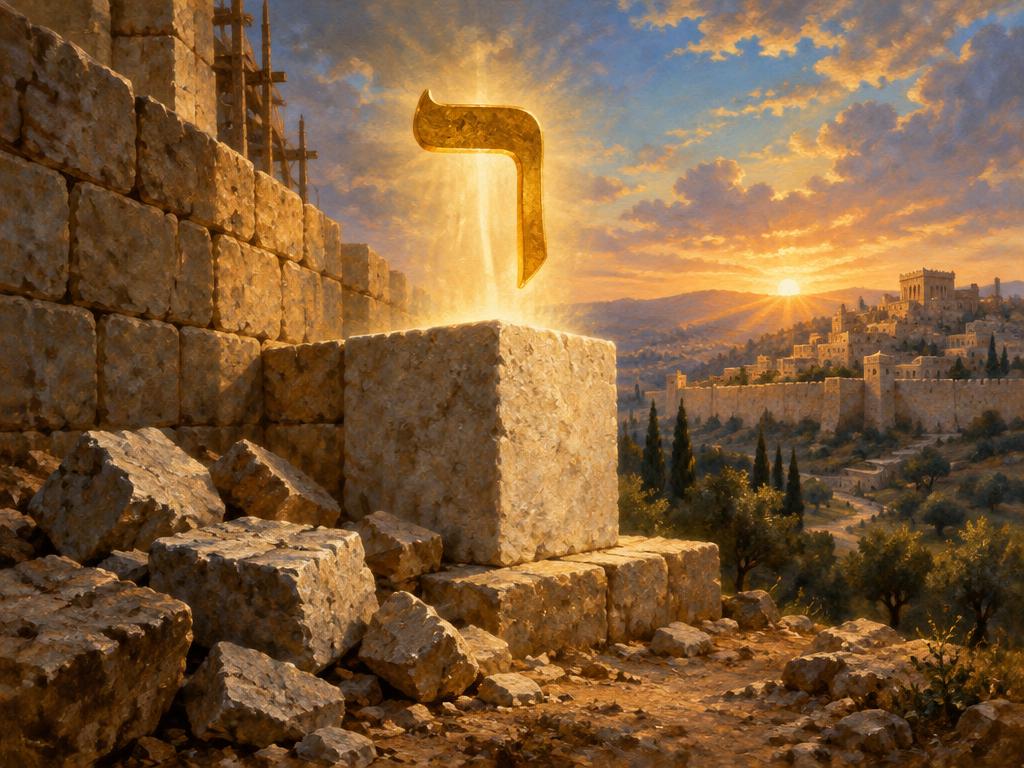
The messianic glory of Resh shines brightest in Psalm 118: "The stone which the builders refused is become the head stone of the corner" (Psalm 118:22). In Hebrew, the phrase is rosh pinnah — the head of the corner. The letter of the head is embedded in one of the most quoted messianic prophecies in the New Testament.
The builders — the religious heads of Israel — examined the stone and rejected it. It did not fit their blueprint. But God took the refused stone and made it the rosh, the head, of the whole building. Jesus applied the verse to Himself before the chief priests: "Did ye never read in the scriptures, The stone which the builders rejected, the same is become the head of the corner?" (Matthew 21:42). Peter preached it to the Sanhedrin: "This is the stone which was set at nought of you builders, which is become the head of the corner. Neither is there salvation in any other" (Acts 4:11–12).
And Paul unfolds the full measure of His headship: "And he is the head of the body, the church: who is the beginning, the firstborn from the dead; that in all things he might have the preeminence" (Colossians 1:18). Head of the body. The beginning — rosh. The firstborn from the dead. In all things, preeminent. Every meaning the letter Resh ever carried gathers into one Person.
The Head That Was Wounded for Us
There is one more mystery in the letter of the head. In Eden, God pronounced the sentence upon the serpent: "It shall bruise thy head, and thou shalt bruise his heel" (Genesis 3:15). The head of the serpent would be crushed — but the crushing would come at a cost. The victorious Seed would be wounded in the battle.
At Calvary, the prophecy was fulfilled. The true Rosh — the Head of the corner, the Head of the church — bowed His head and gave up the ghost (John 19:30). The crown He wore that day was woven of thorns, the mockery of earthly headship pressed into the brow of the King of glory. But by bowing, He crushed. By dying, He destroyed "him that had the power of death, that is, the devil" (Hebrews 2:14). The serpent's head was broken under the wounded heel of the Son of God.
And now the risen Christ stands as the believer's head in every sense: the source of our life ("quicken me"), the pleader of our cause ("plead my cause"), and the truth from the beginning ("thy word is true from the beginning" — "in the beginning was the Word," John 1:1).
Conclusion: Bowing the Head
The letter Resh asks every reader the oldest question in the world: who is your head? The alphabet itself will not let us remain neutral, for the same letter that spells rosh spells rasha. Every head belongs to one kingdom or the other.
The psalmist of the Resh stanza shows us the way. Afflicted, persecuted, surrounded by those who forget God's word, he does not lift up his own head in pride — he lifts up his eyes to the One who considers his affliction, pleads his cause, and quickens him by tender mercies. "But thou, O LORD, art a shield for me; my glory, and the lifter up of mine head" (Psalm 3:3).
The head that bows before the true Head will be lifted up. That is the mystery of Resh: "Humble yourselves therefore under the mighty hand of God, that he may exalt you in due time" (1 Peter 5:6).