 Cedar Biblical
Hebrew Scripture Studies · 8 min read
The Mystery of Aleph: Christ the Mediator, the Silent Lamb, and the Second Adam in Psalm 119
How the shape, silence and meaning of the first Hebrew letter point to the redeeming work of Jesus Christ.
The Grand Structure of Psalm 119 and the Hebrew Alphabet
Psalm 119 stands as the longest chapter in the Holy Scriptures, uniquely structured as an elaborate acrostic hymn dedicated to the glory, purity, and power of God’s Word. The psalm is divided into twenty-two distinct sections, each corresponding precisely to one of the twenty-two letters of the Hebrew alphabet. Within each section, eight verses unfold, with each verse traditionally beginning with that section's designated letter.
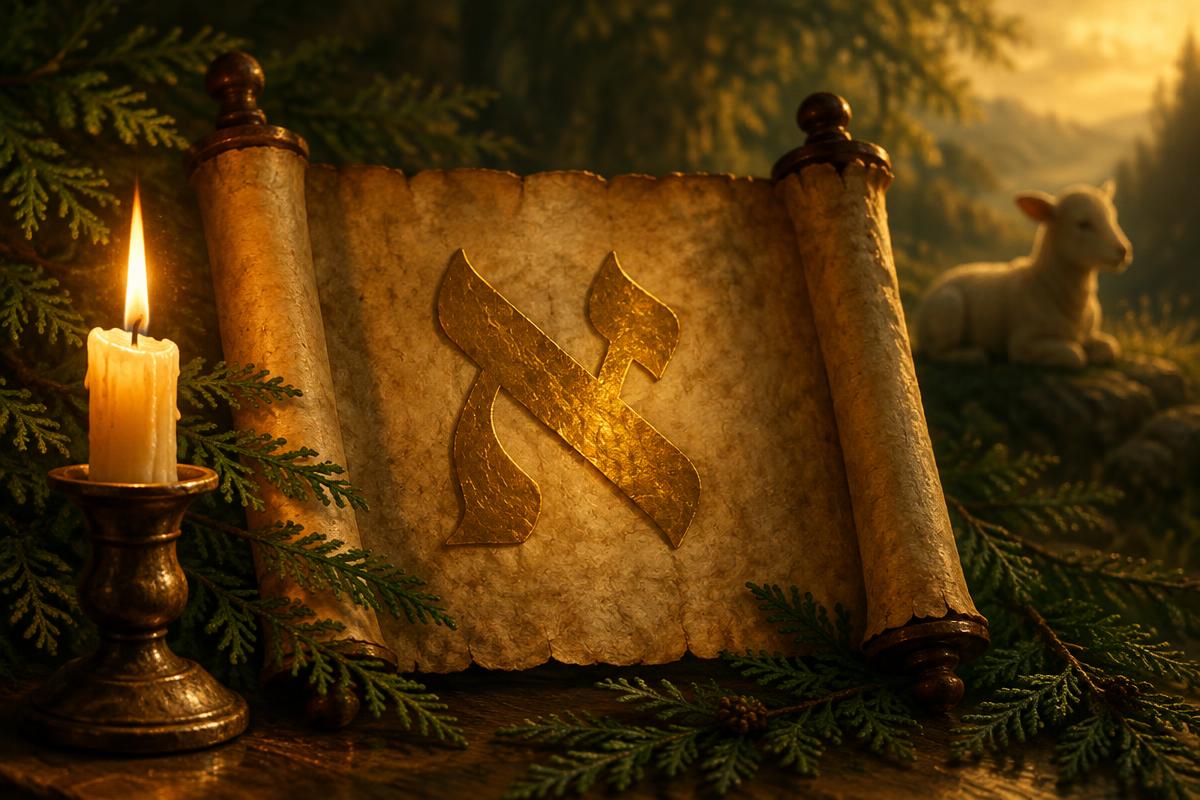
The opening section of this majestic psalm begins under the banner of the very first Hebrew letter, Aleph. Psalm 119:1 declares: "Blessed are the undefiled in the way, who walk in the law of the LORD." Over this verse sits Aleph, introducing not merely a grammatical marker, but an ancient doorway into the character of God and the mystery of redemption.
At the other end of the psalm, preceding verse 169, stands the twenty-second and final Hebrew letter, Tav. This arrangement immediately brings to mind the sovereign declaration of our Lord in the book of Revelation, where He proclaims that He is the Alpha and the Omega, the beginning and the end. While "Alpha" and "Omega" represent the first and last letters of the Greek alphabet—much like saying "from A to Z" in modern English—in the original Hebrew framework of the Old Testament, the Messiah is revealed as the Aleph and the Tav. He is the author, the finisher, the commencement, and the consummation of all divine revelation.
The Meaning and Significance of Aleph: Power, Strength, and the Leader
In the Hebrew language, every letter carries deep symbolic resonance, pictographic roots, and distinct spiritual meanings. While the letter Aleph holds numerous nuances across the biblical corpus, three primary meanings stand out: power, strength, and a leader or guide.
As the first letter, holding the numeric position of one, Aleph fundamentally conveys primacy, sovereign authority, and the foundational strength upon which everything else rests. When Psalm 119 opens with Aleph, the Holy Spirit is directing our gaze toward the ultimate source of power and spiritual leadership. True blessedness does not begin with human striving; it begins with the sovereign leader who leads His people into undefiled paths.
Furthermore, ancient pictographs and historical writing systems demonstrate how fundamental motifs of intersecting angles and branches carry ancient memory. Yet within the sacred script preserved by Jewish scribes, Aleph was given a specific, holy design that prefigures the Gospel of Jesus Christ.
The Anatomy of Aleph: Upper Yod, Lower Yod, and the Connecting Vav
Jewish rabbinic tradition has long recognized that the visual shape of the Hebrew letter Aleph is composed of three distinct constituent letters: an upper point or curve, a lower point or curve, and a diagonal stroke that runs through the center, binding the two together.
When examined closely, the upper stroke is the Hebrew letter Yod. The Hebrew word yod signifies a hand—specifically denoting action, presence, and divine authority. In this scribal arrangement, the upper Yod represents the upper hand, pointing to heaven, the celestial realm, and the sovereign presence of Elohim.
The lower stroke is also a Yod, representing the lower hand. This lower Yod symbolizes the earthly realm, the dust of creation, and mortal mankind dwelling below.
Between these two hands sits the diagonal stroke that connects them. This middle line is the Hebrew letter Vav. In Hebrew pictography and grammar, Vav is drawn as an upright peg, stake, or nail. Its grammatical function in the Hebrew language is that of a conjunction—the word "and"—which serves exclusively to join separate entities together. Thus, visually and spiritually, the letter Aleph consists of heaven above (the upper Yod) and earth below (the lower Yod), bridged and held together by a nail (the Vav).
Reconciling Heaven and Earth: The Mediatorial Work of the Messiah
This visual composition of Aleph provides a striking prophetic picture of the cross of Jesus Christ. For centuries, the separation between heaven and earth, between a holy God and fallen humanity, seemed insurmountable. Man had fallen into the lower realm through transgression, alienated from the life of God.
Yet the Apostle Paul writes of the grand cosmic reconciliation accomplished through the Messiah. Colossians 1:20 declares: "And, having made peace through the blood of his cross, by him to reconcile all things unto himself; by him, I say, whether they be things in earth, or things in heaven."
How was this eternal peace established? How were heaven and earth joined together? It was accomplished through the nail—the Vav—driven through the hands and feet of our Lord on the cross of Calvary. When Yeshua was nailed to that tree, His shed blood formed the living bridge between the upper realm of the Father and the lower realm of man.
Paul echoes this reality in 1 Timothy 2:5, writing: "For there is one God, and one mediator between God and men, the man Christ Jesus." The letter Aleph physically depicts this one mediator. Elohim is above; mankind is below; and Christ Jesus stands in the midst as the mediator, binding heaven and earth together in Himself. As the Lord Jesus stated in John 5:39: "Search the scriptures; for in them ye think ye have eternal life: and they are they which testify of me." Even the individual strokes of the Hebrew alphabet testify of His person, His office, and His sacrifice.
The Sound of Aleph: The Silent Lamb of God
Beyond its visual composition, the phonetic nature of Aleph carries an equally profound spiritual truth. In the Hebrew alphabet, each of the twenty-two letters possesses its own consonant sound. For instance, the letter Tav carries the "T" sound; Bet carries the "B" sound.
Yet the letter Aleph is unique: it is fundamentally silent. Grammatically, it functions as a glottal stop, having no inherent vocal sound of its own; it merely carries the vowel sound assigned to it, resting in quiet humility.
This inherent silence within the letter of supreme power and leadership reveals the very nature of true divine leadership. The world equates authority with loud clamor, boastful speech, and aggressive posturing. But the true Leader—the Aleph Himself—demonstrated His ultimate power through silence.
When the Lord Jesus Christ walked toward the agony of the cross, He did not raise His voice in rebellion, self-defense, or vitriol. The prophet Isaiah foresaw this exact demeanor in Isaiah 53:7: "He was oppressed, and he was afflicted, yet he opened not his mouth: he is brought as a lamb to the slaughter, and as a sheep before her shearers is dumb, so he openeth not his mouth."
Why did Yeshua remain silent before His accusers and executioners? Because He is the living Aleph. He possessed all power, all strength, and divine supremacy, yet He exercised that authority through holy restraint and quiet surrender to the Father’s will.
From Aleph to Adam: The Mystery of Creation and the Second Adam
A deeper study of the linguistic components related to Aleph reveals the overarching narrative of human creation and redemption. When we examine the linguistic elements of the name, we discover striking biblical parallels.
In Hebrew, the word af refers to the nose or nostrils, recalling the momentous event in Genesis when God formed man from the dust of the ground and breathed into his nostrils the breath of life. The letter Lamed, resting within the concept of Aleph, carries the historical pictograph of an ox goad or shepherd’s staff, pointing to the divine Shepherd who guides and sustains life.
When God created the first human being, He breathed His own breath into mortal clay. In the Hebrew language, the word for blood is dam. When the divine life represented by the Aleph was joined with flesh and blood, humanity came into being. Linguistically, when the letter Aleph is placed before the Hebrew word dam (blood), it spells the name Adam.
Adam was thus formed as a vessel of dust and blood, animated by the divine breath. Yet through the fall, Adam’s blood became corrupted by sin. The first Adam brought condemnation, mortality, and spiritual separation into the world.
A careful distinction must be maintained here concerning our identity. While scripture occasionally uses elevated language—such as Jesus citing Psalm 82:6 in John 10:34, where judges are addressed in their representative capacity—Scripture makes abundantly clear that mankind never becomes deity in essence. The creature remains the creature, and the Creator remains the Creator. Rather, as 2 Peter 1:4 affirms, believers are made "partakers of the divine nature" through grace, adoption, and regeneration, being conformed into the holy image of the Son. We are sons and daughters of God by spiritual rebirth, not miniature deities.
Because the first Adam fell into corruption, a divine rescue was necessary. The great spiritual Aleph—God the Son—condescended to step into human history. As Hebrews 2:14 beautifully records: "Forasmuch then as the children are partakers of flesh and blood, he also himself likewise took part of the same; that through death he might destroy him that had the power of death, that is, the devil."
Christ took upon Himself flesh and blood (dam). The eternal Word became the Second Adam, entering human existence to succeed where the first man failed. As 1 Corinthians 15:45 and 47 explain: "The first man Adam was made a living soul; the last Adam was made a quickening spirit... The first man is of the earth, earthy: the second man is the Lord from heaven."
Walking in the Way of the Aleph: Humility under God’s Hand
In early Hebrew script, the letter Tav was penned in the shape of a cross. Thus, the prophetic journey of the silent Aleph culminates at the Tav—the cross of Golgotha. The first letter yields its rights and journeys willingly toward the cross, completing the full alphabet of redemption.
For the believer walking through trials, spiritual battles, and persecution, this truth carries immense practical power. When adversity strikes, human nature instinctively reacts with noise, panic, anger, and retaliation. Yet looking unto Jesus, the Aleph and the Tav, we are called to a different standard. True spiritual authority in the midst of suffering is found in quietness and confidence in the Lord.
The Apostle Peter exhorted the suffering church with these words in 1 Peter 5:6: "Humble yourselves therefore under the mighty hand of God, that he may exalt you in due time."
When the storms of life rage and adversaries seek to crush your spirit, do not respond in fleshly clamor. Rest quietly beneath the mighty hand of God. Entrust your soul to the faithful Creator, who, like a silent lamb, endured the cross and despised the shame. The God who began the good work as your Aleph will bring it to glorious completion as your Tav, lifting you up in His perfect time.