 Cedar Biblical
Decoding · 14 min read
The Harvests of the Kingdom: From the Sower's Seed to the Final Reaping
Why does God gather wheat but burn chaff, preserve exiles as good figs, and let weeds grow? A study of repentance, restoration and final judgment, from the prophets to Revelation.
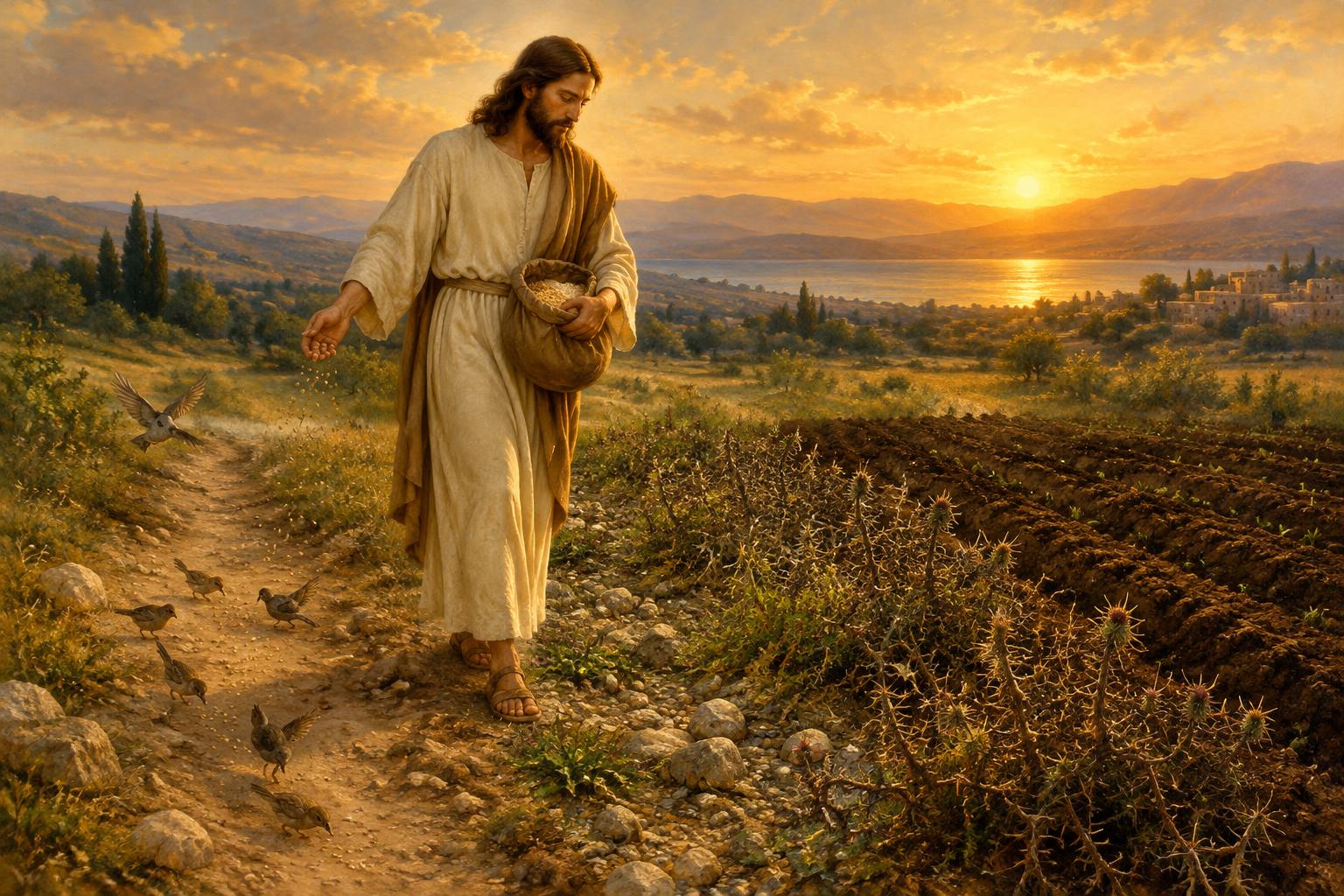
Some seed fell by the wayside, some on stony places, some among thorns, and some on good ground (Matthew 13:3-8). Artwork is imagined.
Few images run through Scripture as steadily as the harvest. Seed is sown, the crop grows, and at the appointed time the reaper separates what is precious from what is worthless. Jesus took that familiar rhythm of the farming year and used it to unveil the secrets of the Kingdom of God.
At first glance His harvest parables seem to repeat one another, or even to clash. In one, the soil is the problem; in another, an enemy sows weeds among the crop. John the Baptist speaks of wheat and chaff; Jesus speaks of wheat and tares. Jeremiah sees good and bad figs, and the Lord at last divides sheep from goats. Are these different pictures of the same moment? Careful digging begins with who is speaking, to whom, and how each passage explains its own symbols. The supplied teaching connects these scenes with turning points in God's plan; that timeline is an interpretation to examine, not a chronology explicitly laid out by every passage.
This study follows the teaching of a three-part Bible study series on the harvests. Where the series offers an interpretation rather than the plain words of Scripture, that is marked so readers can weigh it for themselves.
Why Jesus Spoke in Parables
"All these things Jesus spoke to the multitude in parables; and without a parable He did not speak to them" (Matthew 13:34). Yet Mark adds a striking detail: "when they were alone, He explained all things to His disciples" (Mark 4:34).
The disciples asked why He did not speak plainly to everyone. His answer was sobering: "It has been given to you to know the mystery of the kingdom of God; but to those who are outside, all things come in parables" (Mark 4:11). He then quoted Isaiah 6:9-10, where the prophet is sent to a people whose hearts have grown dull, whose ears are heavy, and whose eyes are shut (Matthew 13:13-15).
This looks like a contradiction: the One who came to heal seems to speak so that some will not turn and be healed. The series reads it in light of Israel's history. After the plagues of Egypt, the Red Sea, the manna and Sinai, the people still turned to the golden calf (Hebrews 3:8-10). A response produced by spectacle alone would have faded as quickly. The parable sifts the hearer: those who truly seek press in and ask, and to them more is given (Matthew 13:12). Jesus also reminded the disciples how privileged they were: "many prophets and righteous men desired to see what you see" (Matthew 13:17).
The First Harvest: The Sower and the Four Soils
"Behold, a sower went out to sow" (Matthew 13:3). In the soils parable, the seed is the word of God (Luke 8:11). In the separate wheat-and-tares parable, Jesus identifies the sower as the Son of Man and the good seed as the children of the kingdom (Matthew 13:37-38). The series draws the passages together around Christ's ministry, but their definitions must not be interchanged. Jesus' earthly mission focused on the lost sheep of Israel (Matthew 15:24), while also reaching Gentiles; after the resurrection He commissioned disciples to all nations (Matthew 28:19). The soils describe responses to the word, not fixed ethnic or religious classes.
The wayside. This is not seed accidentally dropped on the road. The sower stands at the field and scatters, and some lands on the footpath beaten hard by years of walking. Nothing can sink in, and the birds, which Jesus identifies with Satan, take it at once (Mark 4:15). The series links this hard path to many of Israel's religious leaders: they saw a withered hand restored in the synagogue, then immediately plotted with the Herodians how to destroy Him (Mark 3:1-6). Stephen later called the council "stiff-necked and uncircumcised in heart and ears" (Acts 7:51). Hebrews issues the abiding warning: "Today, if you will hear His voice, do not harden your hearts" (Hebrews 3:15).
The stony places. The seed does not fall on bare rock. It falls on a thin layer of moist soil over bedrock, so it springs up fast, but its roots cannot reach the water beneath. When the sun rises, it withers (Matthew 13:5-6, 21). After the feeding of the five thousand, crowds wanted to make Jesus king by force (John 6:15). When He told them they sought Him for the bread, and called Himself the bread from heaven, "many of His disciples went back and walked with Him no more" (John 6:26, 66). The series identifies the rock as human tradition and self-righteousness: "You reject the commandment of God, that you may keep your tradition" (Mark 7:9; Romans 10:3). The remedy is to be "rooted and built up in Him" (Colossians 2:6-7).
Among thorns. Here the soil has depth and the plant grows, but the cares of this world and the deceitfulness of riches choke it until it bears nothing (Matthew 13:22). The series offers Judas, who walked with Jesus and shared His mission yet was overcome by love of money, and Demas, who forsook Paul, "having loved this present world" (2 Timothy 4:10).
The good ground. Luke describes these hearers precisely: they "having heard the word with a noble and good heart, keep it and bear fruit with patience" (Luke 8:15). An honest heart is the same in private as in public. A good heart sincerely asks what pleases God. Such hearers understand the word as addressed to them, as the crowd at Pentecost were "cut to the heart" (Acts 2:37). They guard what they hear, and they wait patiently, as a farmer does not dig up his seed every week to check on it. Jesus saw this in Nathanael: "an Israelite indeed, in whom is no deceit" (John 1:47).
The good soil yields thirty, sixty and a hundredfold. The emphasis is abundant fruit; Isaac also reaped a hundredfold in the setting of Genesis 26 (Genesis 26:12). The series adds a devotional connection: Abraham was one hundred when Isaac was born (Genesis 21:5), Isaac was sixty when the twins were born (Genesis 25:26), and Numbers 4:3 assigns a thirty-to-fifty age range to a particular group of Levites doing tabernacle service. Luke says Jesus was about thirty when His ministry began (Luke 3:23). Numbers 8:24 gives twenty-five for another description of Levitical service, so thirty is not a universal priestly starting age. The series also links the courtyard pillars of Exodus 27 with the hundred silver sockets of Exodus 38:27. These numerical parallels are devotional observations, not Jesus' stated explanation of the harvest yields or a formula for becoming an heir of the promise.
The Second Harvest: Wheat and Chaff
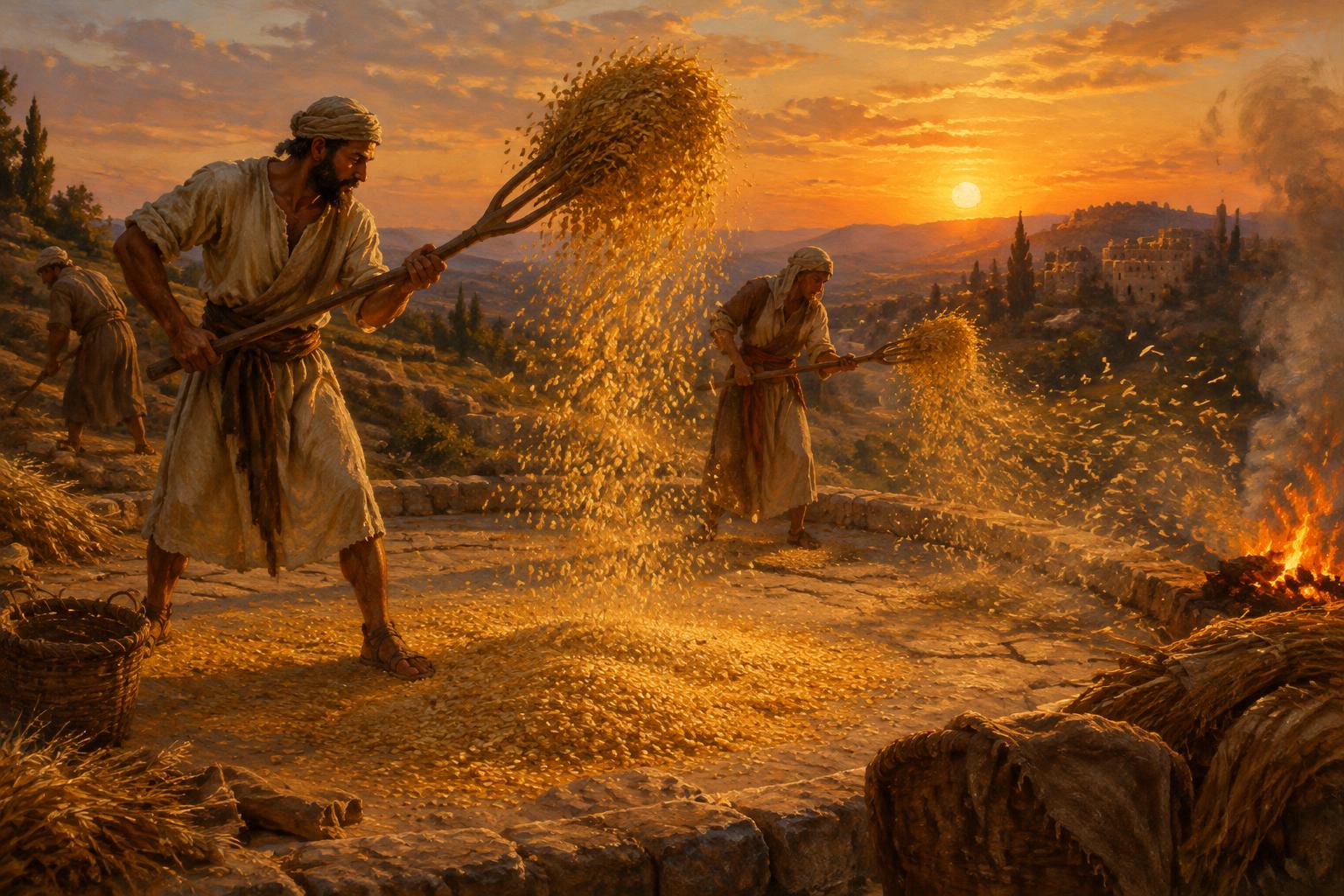
A sown field must eventually be reaped. John the Baptist announced the reaper: "He will baptize you with the Holy Spirit and fire. His winnowing fan is in His hand, and He will thoroughly clean out His threshing floor, and gather His wheat into the barn; but He will burn up the chaff with unquenchable fire" (Matthew 3:11-12).
John spoke these words to Pharisees and Sadducees coming to his baptism, whom he called a "brood of vipers" (Matthew 3:7). His sentence pairs two baptisms with two destinies: the Spirit with the wheat gathered in, and fire with the chaff consumed.
The baptism of the Spirit came at Pentecost. Pentecost was itself a harvest feast, held fifty days after the firstfruits offering (Leviticus 23:15-17). On that day the Spirit fell on the waiting disciples with "divided tongues, as of fire" (Acts 2:3), and Jews from many nations heard the gospel in their own languages. What Babel scattered, Pentecost gathered, and about three thousand were baptized (Acts 2:41). Fire throughout Scripture marks God's presence: the burning bush, the pillar of fire, Sinai ablaze, the fire that fell on the tabernacle altar and at the dedication of Solomon's temple (Leviticus 9:24; 2 Chronicles 7:1). Now the living temple is God's people (1 Corinthians 3:16). Believers are called firstfruits (James 1:18).
What of the fire for the chaff? The series understands John's warning as a judgment that fell on unrepentant Jerusalem within that generation. Jesus foretold, "When you see Jerusalem surrounded by armies, then know that its desolation is near" (Luke 21:20). History records the Jewish revolt from AD 66, and the Roman siege under Titus that destroyed the temple by fire in AD 70. The series connects this with the parable of the wedding feast, in which the king "sent out his armies, destroyed those murderers, and burned up their city" (Matthew 22:7). Many Christian interpreters share this reading, though others see John's unquenchable fire as pointing chiefly to final judgment.
The series therefore places this harvest at a turning of the ages: the transition from its proposed "Jewish age" to a "gospel age." These are the teaching's organizing labels. Galatians 4:4 speaks of the fullness of time, but does not itself supply that entire timeline. Nor should Jerusalem's tragedy be made into a claim that all Jewish people or their descendants are cursed: Jesus, His apostles and the first believers were Jewish, and Romans 11:1 and 28-29 forbid treating Israel as simply rejected by God. Jewish communities also continued in the land after AD 70; the war did not remove every Jewish inhabitant.
A Harvest Before the Exile: The Two Baskets of Figs
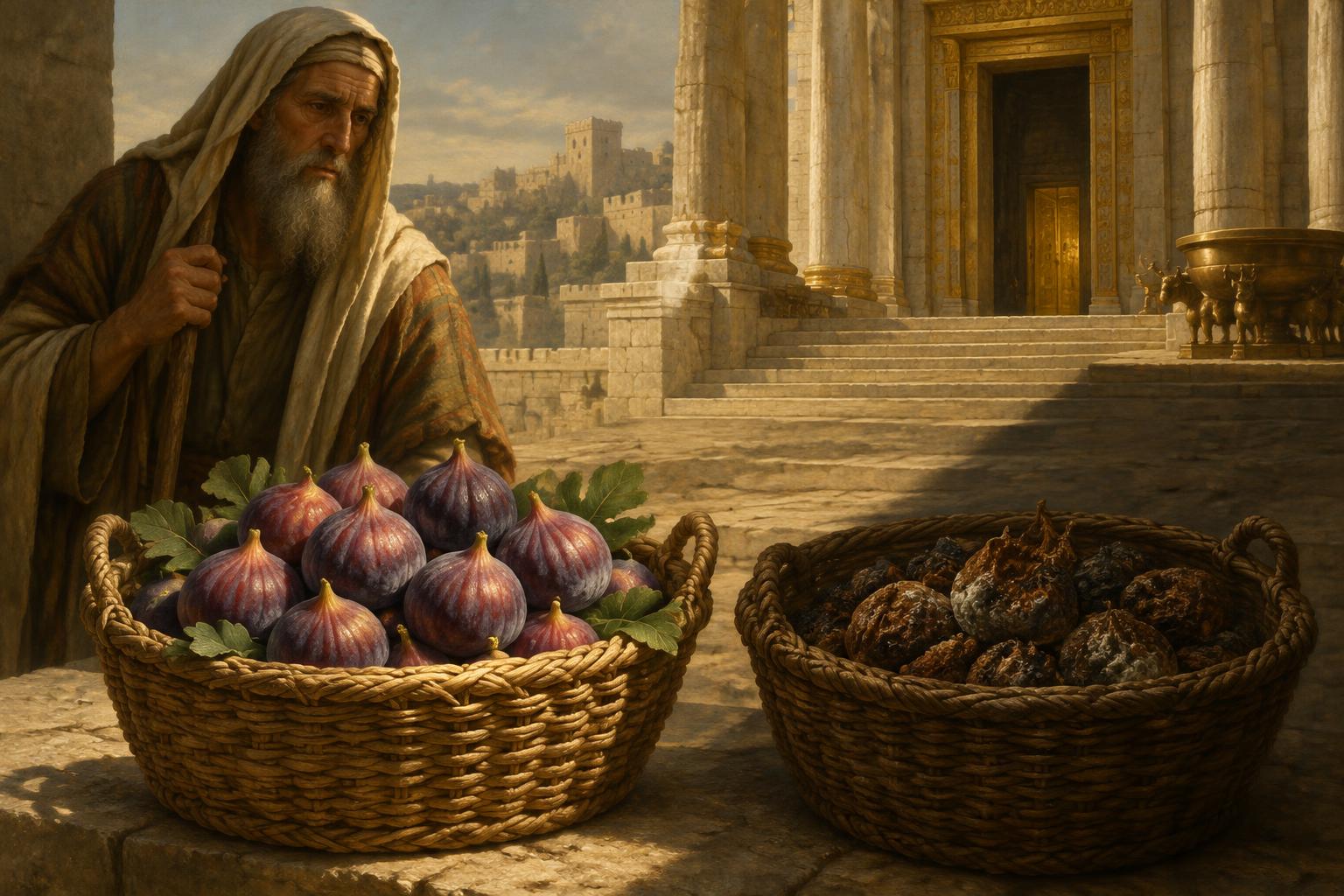
Why should separation come at the end of an age? The series turns to Jeremiah for an earlier pattern. After Nebuchadnezzar carried King Jeconiah and Judah's officials and craftsmen to Babylon, the Lord showed Jeremiah two baskets of figs set before the temple: one with "very good figs, like the figs that are first ripe," the other with figs "so bad they could not be eaten" (Jeremiah 24:1-3).
The interpretation is unexpected. The good figs are the captives taken to Babylon, whom God would watch over for good (Jeremiah 24:5). The bad figs are King Zedekiah, his officials, and those who remained in Jerusalem or fled to Egypt (Jeremiah 24:8). Those left behind might have assumed they were the favored ones, yet God judged the opposite. Exile became the place of repentance.
The vision follows the deportation of Jehoiachin in 597 BC; Zedekiah still ruled until Jerusalem fell in 587/586 BC. Thus it belongs to the monarchy's final crisis, not a moment when the monarchy had already entirely ended. The series connects it with the "times of the Gentiles" of Luke 21:24. That is a thematic connection: Jesus does not explicitly identify Jeremiah's baskets as the beginning of that period. The central promise of Jeremiah 24 is restoration: God will give the exiles a heart to know Him, and they will return to Him with their whole heart (Jeremiah 24:6-7). Hard circumstances are not proof of abandonment.
The Third Harvest: Wheat and Tares
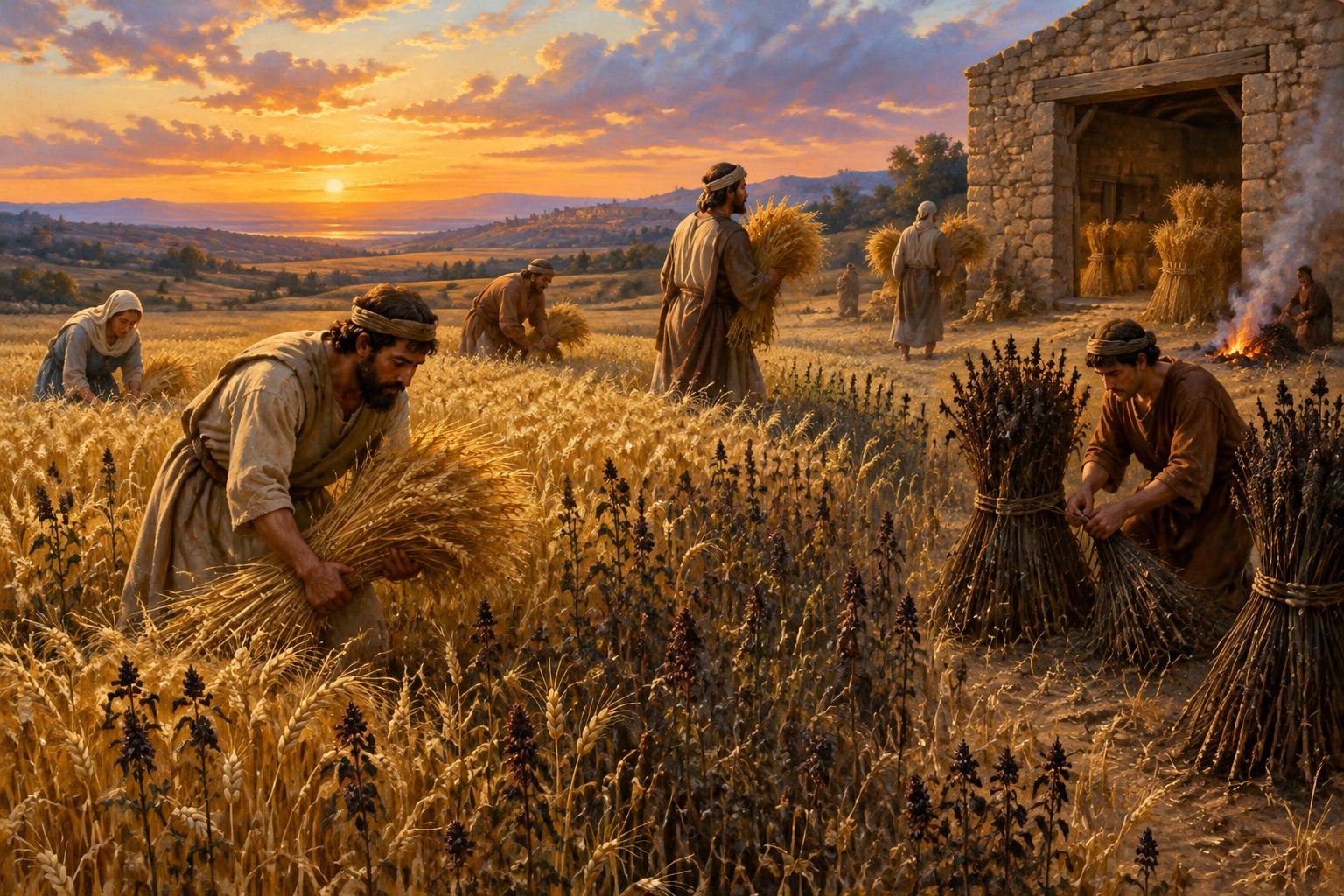
A second agricultural parable now comes into view. "The kingdom of heaven is like a man who sowed good seed in his field; but while men slept, his enemy came and sowed tares among the wheat" (Matthew 13:24-25). Notice the difference from the sower. There, one seed fell on different soils. Here, the soil is good, but a second seed has been planted beside the first.
Jesus again explains: the sower is the Son of Man, the field is the world, the good seed are the sons of the kingdom, the tares are the sons of the wicked one, and the enemy is the devil (Matthew 13:37-39). The tares, often identified with darnel, look like wheat in their early growth, and their roots intertwine. So the master forbids early weeding: "Let both grow together until the harvest" (Matthew 13:30).
Jesus names the timing: "The harvest is the end of the age, and the reapers are the angels" (Matthew 13:39). The series places this at the close of its "gospel age" and associates the sleeping workers with the passing of the apostles. Paul did warn of destructive teachers after his departure (Acts 20:29-30), and Diotrephes already resisted apostolic authority (3 John 9-10). These passages illuminate the danger, but Matthew does not explicitly equate the workers' sleep with the apostles' deaths.
The series also proposes human messengers as the reapers. Hebrew malakh and Greek angelos can refer to messengers: Malachi 2:7 calls the priest God's messenger, and James 2:25 calls Rahab's visitors messengers. But a word's possible meanings do not establish its meaning in every context. Matthew 13:41 says the Son of Man sends His angels, and 13:49 repeats their role in final judgment; the customary reading is heavenly angels. Matthew 9:37 calls disciples harvest laborers in mission, but does not identify them as the final judges of others. Christians may discern teaching and fruit without claiming authority to condemn people as tares.
Still More Harvests: Fish, Sheep and Goats
The dragnet gathers fish of every kind; once full, it is drawn ashore and deliberately sorted (Matthew 13:47-50). Jesus' explanation names the separation of wicked from righteous at the end of the age. The series relates the sorting to the clean-fish laws of Leviticus 11:9-12, but Matthew does not specify scales or fins as the parable's criterion.
When the Son of Man comes in glory, He separates the nations "as a shepherd divides his sheep from the goats" (Matthew 25:31-33). This passage also tells us what the judgment exposes: feeding the hungry, welcoming the stranger, clothing the naked and visiting the sick and imprisoned. The identity of "the least of these My brethren" is debated, but the King's concern with concrete mercy is unmistakable. These verses should not disappear beneath a discussion of the calendar.
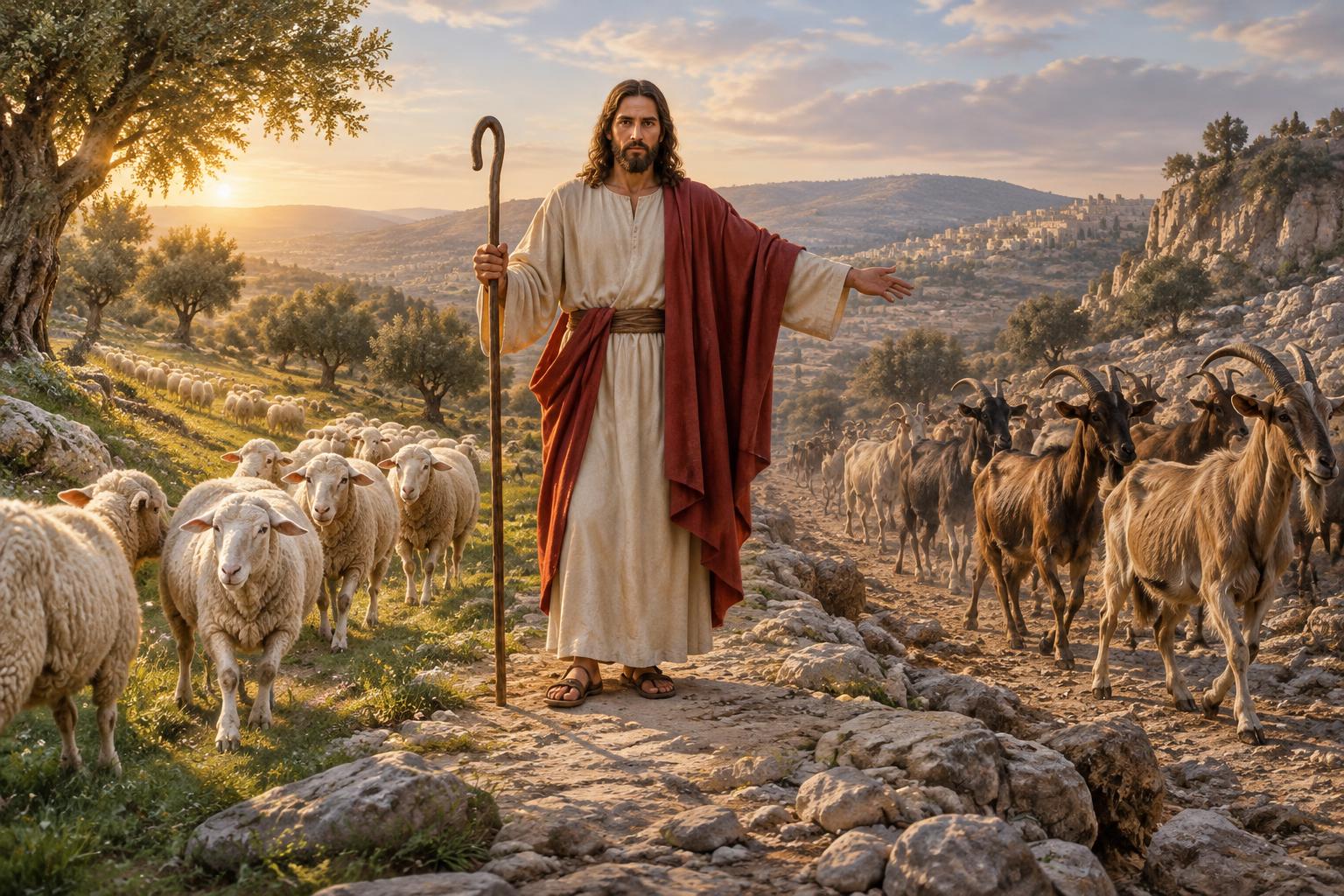
The series places the fish and sheep-and-goats judgment at the end of the thousand years and connects it with the great white throne (Revelation 20:7-15). Other Christians read Matthew 25 differently; Matthew does not explicitly name the millennium here. The shared certainty is accountability before Christ, not an agreed schedule or a date prediction.
The River That Brings Life to the Sea
Part Three adds a hopeful picture from Ezekiel 47. Water flows from the temple, becomes a river, and reaches the eastern sea. Trees flourish along its banks; where the water goes, life returns, and fishermen spread nets from En-gedi to En-eglaim (Ezekiel 47:1-10). The marshes remain salty (47:11), while the trees bear fruit and their leaves bring healing (47:12). Revelation 22:1-2 echoes the river, the tree and the healing of the nations.
The series reads the lifeless sea as humanity under death, the river as life through Christ, and the abundant fish as restored humanity. It connects the fishermen with Zechariah 8:23, where people of many languages take hold of a Jewish man's garment because God is with him. These are the teaching's typological connections, not an explicit identification made by Ezekiel or Matthew. In particular, Ezekiel does not call the salty marshes the second death, and his vision does not itself establish a timetable for every person's resurrection. John 5:28-29 and Acts 24:15 affirm resurrection and judgment; the river imagery holds out the wonderful promise that life comes from God.
The Lord of Every Harvest
Set side by side, the parables no longer compete. The soils describe reception of the word; the threshing floor and the tares reveal judgment; the fig baskets reveal both discipline and restoration. The supplied series arranges them into a timeline of ages, while the texts themselves keep the focus on repentance, patient growth, mercy and God's final authority. Mark 4:26-29 adds another essential note: the seed grows while the farmer sleeps and rises, and he does not know how. The Kingdom's growth is not entirely in human hands.
The harvest is not only a doctrine to be charted; it is a question to be answered. What kind of soil is your heart? Is the word taking root, or being snatched away, scorched or choked? Hear with an honest and good heart, keep the word and wait with patience. We cannot infer an end-date from these images; Jesus says the day and hour are not ours to know (Matthew 24:36). His present call remains clear: "Lift up your eyes and look at the fields, for they are already white for harvest" (John 4:35).
Sources and Further Study
Adapted in English from the supplied Harvest Parts 1-3 Tamil transcripts and accompanying Parts 19-21 slide decks. This is an edited synthesis, not a word-for-word translation; the contextual cautions above are editorial additions. Illustrations are imagined scenes, not historical evidence.
Read the principal passages in context: Matthew 13, Matthew 3, Jeremiah 24, Matthew 25, Ezekiel 47 and Revelation 20.