 Cedar Biblical
Decoding · 6 min read
The Mystery of Gethsemane: From the Olive Press to the Anointing Oil
Discover the deep prophetic typology of Christ's journey from the Golden Gate across the Kidron Valley into the crushing press of Gethsemane.
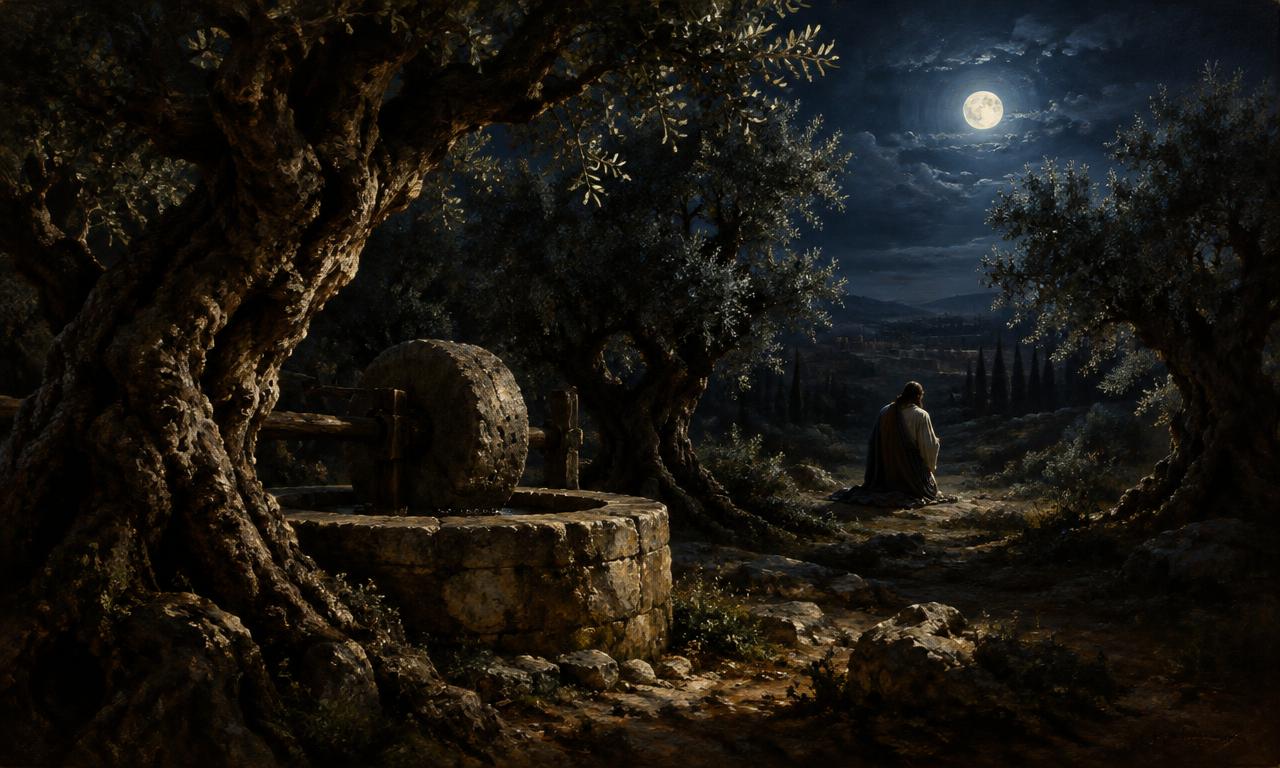
Before our Lord Jesus Christ gave His life upon the cross of Calvary, He entered a secluded grove nestled on the slopes of the Mount of Olives. The Gospel of John records that after speaking to His disciples, Jesus went forth with them over the brook Kidron, where there was a garden, into which He entered. To many readers, Gethsemane is merely a tragic backdrop where Jesus prayed in agony while His disciples slept. Yet when examined through the lens of Old Testament typology, geography, and Hebrew symbolism, this garden and the path leading to it reveal a meticulously orchestrated divine pattern.
Every step of the Lord’s movement on that fateful night was pregnant with prophetic meaning. Leaving the temple courts in Jerusalem, Jesus walked eastward through the Golden Gate, traversed the deep descent of the Kidron Valley, and climbed the Mount of Olives to reach Gethsemane. To understand the suffering of Christ, we must first trace the theological significance of the direction He took and the valley He crossed.
The Journey Eastward: Redeeming the Way of Exile
Throughout the Holy Scriptures, the east direction often signifies departure from the presence of God, the entrance of sin, and the sorrow of divine judgment. When Adam and Eve fell into transgression, the Lord God drove man out and placed cherubims at the east of the garden of Eden to guard the way of the tree of life. When Cain murdered his brother Abel, he went out from the presence of the Lord and dwelt in the land of Nod, east of Eden. Following the Great Flood, mankind journeyed eastward to the plain of Shinar to build the rebellious Tower of Babel. Likewise, when Lot separated from Abraham, he lifted his eyes, chose the fertile plains of the Jordan, and journeyed east toward Sodom. When the Southern Kingdom of Judah fell under judgment for their chronic idolatry, they were carried away captive eastward into Babylon.
Why then did Jesus set His face eastward toward Gethsemane? Because where sin entered and scattered humanity, the Redeemer went to meet judgment head-on. The gate through which He exited Jerusalem, known historically as the Golden Gate, was also referred to by the Jews as the Gate of Mercy. On the Day of Atonement (Yom Kippur), the scapegoat bearing the collective iniquities of Israel was led out through this very eastern gate, across the valley, into the desolate wilderness. As the true Scapegoat and the Lamb of God who taketh away the sin of the world, Jesus walked through the Gate of Mercy to secure universal mercy for mankind.
This path also fulfilled the remarkable vision granted to the prophet Ezekiel. In Ezekiel chapter 10, the glory of the Lord lifted from the threshold of the defiled temple, paused above the cherubim, moved through the east gate, and settled upon the mountain on the east side of the city—the Mount of Olives. Scripture reveals that Jesus Christ is "the brightness of his glory, and the express image of his person" (Hebrews 1:3). Just as the Shekinah glory had departed centuries earlier across the eastern threshold to the Mount of Olives, so Christ, the embodied glory of God, departed the earthly sanctuary, crossed the valley, ascended the mount, and ultimately ascended to the right hand of the Father from that very hill.
Descending into Kidron: The Valley of Death and Filth
To reach Gethsemane, one cannot remain on the heights; one must descend into the ravine known as the Kidron Valley before ascending the Mount of Olives. The root of the Hebrew name Kidron denotes darkness, mournfulness, and obscurity. It was widely known as a burial ground, a place lined with sepulchres along the slopes—a literal valley of the shadow of death.
Furthermore, Kidron was the historical dumping ground for Jerusalem's spiritual and physical filth. When godly kings such as Asa, Hezekiah, and Josiah purged the land of idolatry, they cast the carved groves, altars, and pollutions into the brook Kidron to be burned and pulverized into dust (2 Kings 23:6, 2 Chronicles 29:16). At Passover, when tens of thousands of lambs were slain in the temple, channels carried the sacrificial blood from the altar down into the waters of Kidron. Thus, when Jesus waded through this dark torrent, the waters ran dark with the blood of sacrifices and the symbolic filth of the nation's iniquity. He descended into the lowest place, fulfilling Isaiah 53:6: "All we like sheep have gone astray; we have turned every one to his own way; and the Lord hath laid on him the iniquity of us all."
Generations before, King David had walked this identical path in overwhelming grief. Betrayed by his own flesh and blood, his son Absalom, David crossed the brook Kidron weeping, with his head covered and his feet bare, accompanied by sorrowful followers (2 Samuel 15:30). Christ, the greater Son of David, walked that same dark descent, carrying the deep wound of betrayal by His familiar friend and disciple, Judas Iscariot. In descending into Kidron, Christ modeled the ultimate humiliation spoken of in Philippians 2:7-8, making Himself of no reputation and humbling Himself unto death, that He might subsequently be exalted.
The Crushing at the Olive Press
The destination of this sorrowful journey was Gethsemane, derived from the Aramaic words Gath (press) and Shemane (oil)—literally, "The Olive Press." This was the orchard where olives were gathered to be processed into rich, pure oil. The method used by ancient husbandmen to extract olive oil serves as an exact portrait of Christ's passion.
Olives are not immediately subjected to the heavy press beam. First, the fruit is placed into a stone basin where a rolling stone crushes the pulp until the olive completely loses its original beauty, form, and shape. Only after the olive is thoroughly bruised and shattered is it loaded into wicker baskets beneath immense wooden beams weighted with heavy stones. As stone upon stone is stacked onto the beam, the relentless downward pressure forces every drop of valuable oil out of the crushed mash until nothing remains but dry refuse.
When Jesus entered Gethsemane, He was entering the spiritual press. He took Peter, James, and John aside and began to be exceedingly sorrowful and very heavy, declaring, "My soul is exceeding sorrowful, even unto death" (Matthew 26:38). Under the initial crushing weight of spiritual agony, His sweat became as great drops of blood falling to the ground. He had begun to lose His form under the weight of human sin, fulfilling Isaiah 52:14: "His visage was so marred more than any man, and his form more than the sons of men."
From Gethsemane onward, weight after weight was relentlessly laid upon Him: the betrayal of Judas, the abandonment by His disciples, the illegal nocturnal trials before Annas and Caiaphas, the spitting, the pulling of His beard, the mocking by Herod, the scourging by a Roman cohort of soldiers, and the crowning with a brutal helmet of thorns. Finally, the cross itself was laid upon His lacerated back. Under this unfathomable load, Jesus cried out in the prophetic words of Psalm 22:14, "I am poured out like water, and all my bones are out of joint."
Yet inside every olive lies a rock-hard pit that resists crushing. While Christ was outwardly tender, meek, and lowly in heart (Matthew 11:29), inwardly His commitment to the Father's will was unyielding as granite. Long before the arrest, Isaiah prophesied of the Messiah's resolve: "For the Lord God will help me; therefore shall I not be confounded: therefore have I set my face like a flint, and I know that I shall not be ashamed" (Isaiah 50:7). No amount of external pressure could shatter His unwavering devotion to finish the work.
The Pure Oil Poured Out for the Church
When olives are pressed, they yield precious oil. When Jesus was pressed by wrath, mockery, and death, what came out of Him? Not vengeance, malice, or bitterness, but pure love, unmixed obedience, and total forgiveness. Through His being crushed, God extracted five biblical ministries of the oil for our eternal benefit:
First, olive oil was commanded to fuel the golden candlestick (Menorah) in the holy place, causing its seven lamps to burn continually. Christ was crushed so that the Holy Spirit might be poured out at Pentecost, providing continuous light and power to His church to shine as the light of the world.
Second, olive oil was used to consecrate kings. Samuel took the horn of oil and anointed David, and the Spirit of the Lord came upon him from that day forward (1 Samuel 16:13). Because Christ the King was bruised, we have been called into a royal lineage and seated with Him in heavenly places.
Third, olive oil consecrated the high priest. It was poured abundantly upon Aaron's head, running down his beard to the skirts of his garments, setting apart every faculty and limb for divine service. In the same manner, the believers' entire body is consecrated to yield its members as instruments of righteousness unto God.
Fourth, olive oil represents divine restoration and spiritual joy. In Joel 2:19-25, after the devastation wrought by the locusts, the Lord promised to restore grain, wine, and oil. In Eden, the locust of sin devoured human destiny; in Christ's sacrifice, the spiritual riches of grace and the sealing of the Holy Spirit are poured out upon us in full measure.
Fifth, olive oil served as ancient medicine to soothe, soften, and heal open wounds. When the Good Samaritan found the bruised traveler half-dead, he poured in oil and wine and bound up his wounds. Isaiah describes our natural condition apart from God as being covered with wounds, bruises, and putrefying sores from the sole of the foot to the crown of the head (Isaiah 1:6). But through the bruising of the Savior, the healing oil flowed: "He was wounded for our transgressions, he was bruised for our iniquities: the chastisement of our peace was upon him; and with his stripes we are healed" (Isaiah 53:5).
Sharing in the Fellowship of His Press
Believers must realize that Christ does not merely call us to admire His suffering; He calls us to follow in His footsteps. The Apostle Paul wrote boldly in Philippians 1:29 that it is given to us "not only to believe on him, but also to suffer for his sake." In Romans 8:17, we are designated as "heirs of God, and joint-heirs with Christ; if so be that we suffer with him, that we may be also glorified together."
In John 15:2, the Savior explains that every branch that beareth fruit, the Father purgeth it, that it may bring forth more fruit. The pruning shears of the divine Husbandman cut away what is carnal. When difficulties, sickness, betrayal, or misunderstandings press upon our lives, God is placing us in the press to purge out pride and self-reliance.
The critical question for every Christian is: when you are pressed by trials, what flows out of you? Does the pressure produce the poisonous juice of bitterness, gossip, resentment, and anger? Or does it yield the pure oil of patience, forgiveness, and Christlike mercy? Hebrews 12:15 warns against any "root of bitterness springing up" to defile many. Even when His trusted friends slept, Judas betrayed Him with a kiss, and an armed mob seized Him, Jesus prayed, "Not as I will, but as thou wilt."
When we yield ourselves to the Father's hand in our personal Gethsemane, our suffering ceases to be wasted pain. It becomes comforting oil. As the Apostle Paul declared, the God of all comfort "comforteth us in all our tribulation, that we may be able to comfort them which are in any trouble, by the comfort wherewith we ourselves are comforted of God" (2 Corinthians 1:4). Let us not despise the press of trials, but surrender fully, that out of our brokenness may flow the sweet, healing oil of the Spirit to a dark and hurting world.